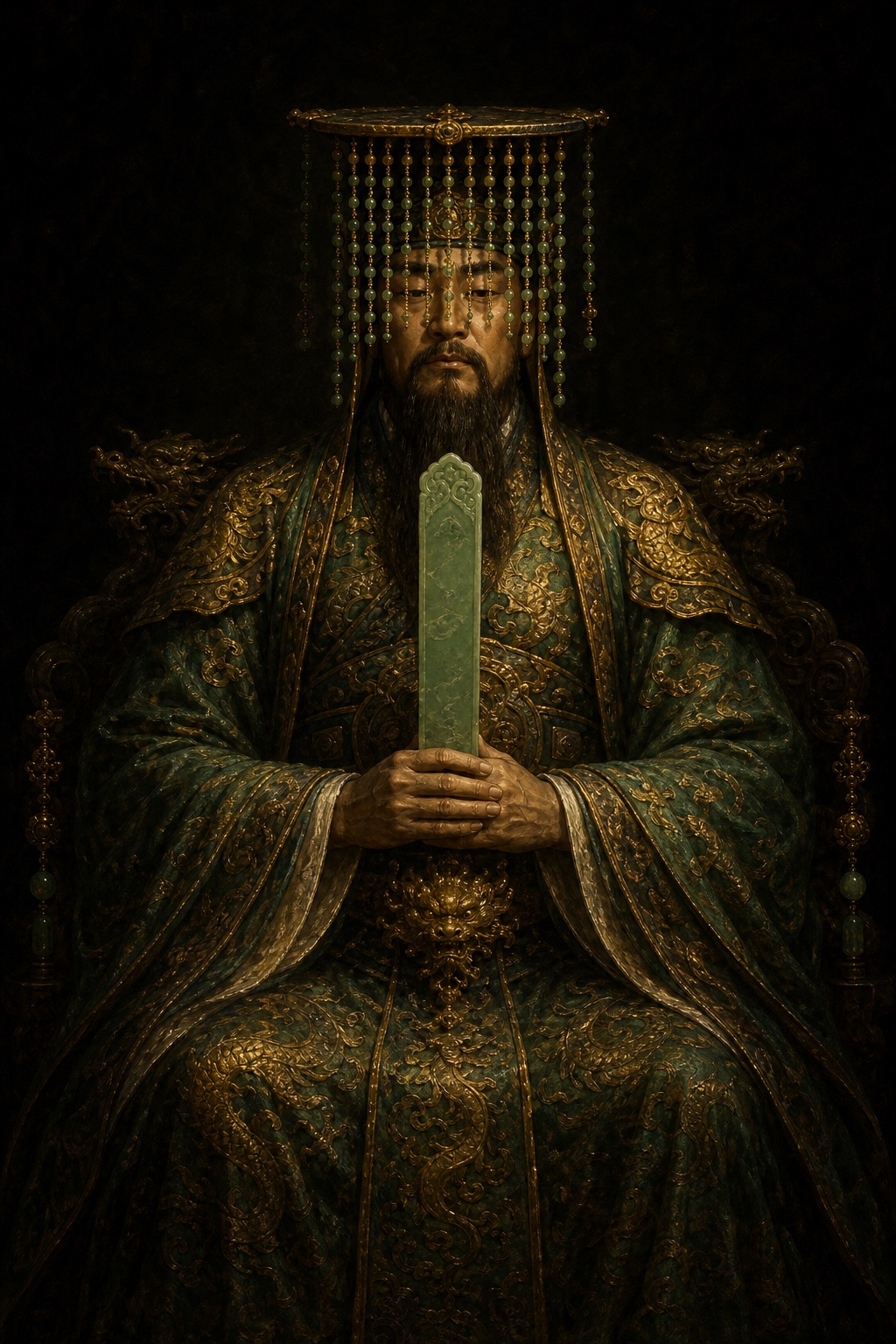
Yu Huang, the Jade Emperor — jade for purity — sits at the top of the Daoist and popular pantheon, and he rules it the way the Chinese state ruled China. Heaven under him is not a family of quarrelling relatives in the Greek manner but a functioning administration: ministries of thunder, of waters, of epidemics, of literature; gods holding office by appointment; promotions, demotions, memorials submitted upward, edicts handed down. Mortals petition him the way a subject petitions a magistrate, and the Kitchen God files an annual report on each household’s conduct.
Journey to the West opens by showing the machine at work, and the demonstration is unimprovable. A stone egg on a distant mountain cracks, a monkey climbs out, and light shoots from its eyes into the sky. Heaven notices — as a monitoring system notices:
驚動高天上聖大慈仁者玉皇大天尊玄穹高上帝,駕座金闕雲宮靈霄寶殿,聚集仙卿,見有金光燄燄,即命千里眼、順風耳開南天門觀看。
“This startled the Most Compassionate and Merciful Sage of High Heaven, the Jade Emperor, Great Heavenly Venerable, Most High Sovereign of the Dark Vault — enthroned in the Cloud Palace of the Golden Gates, in the Treasure Hall of Divine Mists, with his immortal ministers assembled. Seeing the blaze of golden light, he at once ordered Thousand-Mile Eye and Wind-Following Ear to open the Southern Gate of Heaven and look.” — Journey to the West, ch. 1; tr. Mythos Atlas
Everything about him is in that sentence. The title runs to seventeen characters and consists almost entirely of rank. He is seated, in a named hall, with his officials convened. He does not investigate the anomaly himself; he tasks two subordinates whose names are literally their functions — surveillance officers, an eye and an ear. And when they report back, his ruling is the purest expression of the bureaucratic mind in Chinese literature:
下方之物,乃天地精華所生,不足為異。
“A creature of the world below, born of the essence of heaven and earth. Nothing remarkable.” — Journey to the West, ch. 1; tr. Mythos Atlas
He files it and moves on. Five hundred years and one wrecked peach banquet later, this will look like the worst administrative decision ever taken, and the novel knows exactly what it is doing: the being who will bring heaven to a standstill enters the record as a routine case, correctly classified and closed.
His rise to the summit is unusually well documented, because part of it was an act of state. In 1012 the Song emperor Zhenzong, having bought a humiliating peace from the Khitan and needing to shore up his prestige, announced to his ministers that he had received a celestial letter and, in due course, a personal visit from Yu Huang’s envoy. Werner, writing in 1922 with an ex-consul’s dryness, concluded that the god “was born of a fraud, and came ready-made from the brain of an emperor.” That goes too far — a jade sovereign appears in Daoist scripture well before the Song. But the episode is real and revealing: an emperor in political trouble promoted a god, and the god stayed promoted for a thousand years. Divine authority and imperial authority propped each other up, which is precisely the arrangement his heaven exists to express.