The war for the throne, and the lots
Cronus did not let his children grow up. Apollodorus says that he used to swallow his offspring at birth: Hestia first, then Demeter and Hera, and after them Hades, whom Apollodorus calls Pluto, and Poseidon. When Zeus was born, Rhea wrapped a stone in swaddling clothes and gave it to Cronus to swallow, as if it were the newborn child. That stone is the first thing to come back. When Zeus was full-grown he took Metis, a daughter of Oceanus, as his helper, and she gave Cronus a drug that made him disgorge the stone and then the children he had swallowed. With them Zeus went to war against Cronus and the Titans.
ἐπειδὴ δὲ Ζεὺς ἐγενήθη τέλειος, λαμβάνει Μῆτιν τὴν Ὠκεανοῦ συνεργόν, ἣ δίδωσι Κρόνῳ καταπιεῖν φάρμακον, ὑφ᾽ οὗ ἐκεῖνος ἀναγκασθεὶς πρῶτον μὲν ἐξεμεῖ τὸν λίθον, ἔπειτα τοὺς παῖδας οὓς κατέπιε· μεθ᾽ ὧν Ζεὺς τὸν πρὸς Κρόνον καὶ Τιτᾶνας ἐξήνεγκε πόλεμον. μαχομένων δὲ αὐτῶν ἐνιαυτοὺς δέκα ἡ Γῆ τῷ Διὶ ἔχρησε τὴν νίκην, τοὺς καταταρταρωθέντας ἂν ἔχῃ συμμάχους· ὁ δὲ τὴν φρουροῦσαν αὐτῶν τὰ δεσμὰ Κάμπην ἀποκτείνας ἔλυσε. καὶ Κύκλωπες τότε Διὶ μὲν διδόασι βροντὴν καὶ ἀστραπὴν καὶ κεραυνόν, Πλούτωνι δὲ κυνέην, Ποσειδῶνι δὲ τρίαιναν· οἱ δὲ τούτοις ὁπλισθέντες κρατοῦσι Τιτάνων, καὶ καθείρξαντες αὐτοὺς ἐν τῷ Ταρτάρῳ τοὺς ἑκατόγχειρας κατέστησαν φύλακας. αὐτοὶ δὲ διακληροῦνται περὶ τῆς ἀρχῆς, καὶ λαγχάνει Ζεὺς μὲν τὴν ἐν οὐρανῷ δυναστείαν, Ποσειδῶν δὲ τὴν ἐν θαλάσσῃ, Πλούτων δὲ τὴν ἐν Ἅιδου
“But when Zeus was full-grown, he took Metis, daughter of Ocean, to help him, and she gave Cronus a drug to swallow, which forced him to disgorge first the stone and then the children whom he had swallowed, and with their aid Zeus waged the war against Cronus and the Titans. They fought for ten years, and Earth prophesied victory to Zeus if he should have as allies those who had been hurled down to Tartarus. So he slew their jailoress Campe, and loosed their bonds. And the Cyclopes then gave Zeus thunder and lightning and a thunderbolt, and on Pluto they bestowed a helmet and on Poseidon a trident. Armed with these weapons the gods overcame the Titans, shut them up in Tartarus, and appointed the Hundred-handers their guards; but they themselves cast lots for the sovereignty, and to Zeus was allotted the dominion of the sky, to Poseidon the dominion of the sea, and to Pluto the dominion in Hades.” — Apollodorus, The Library 1.2.1, tr. J. G. Frazer
The war lasted ten years, and it was won with help from below. Gaia, “Earth” in Frazer’s English, prophesied victory to Zeus if he had as allies those who had been hurled down to Tartarus, so he killed Campe, their jailoress, and loosed their bonds. Then the Cyclopes armed the three brothers: thunder, lightning and a thunderbolt for Zeus, a helmet for Hades, a trident for Poseidon. With these weapons the gods overcame the Titans, shut them up in Tartarus and set the Hundred-handers over them as guards.
The division of the world that follows is not a conquest. The brothers cast lots for the sovereignty, and the verb is διακληροῦνται, a drawing of lots. Zeus drew the dominion of the sky, Poseidon the sea, and Hades the realm below. In Apollodorus, Zeus leads the war, but his own share of the world comes to him by lot, on the same terms as his brothers’ shares.
Thunder, lightning and the bolt
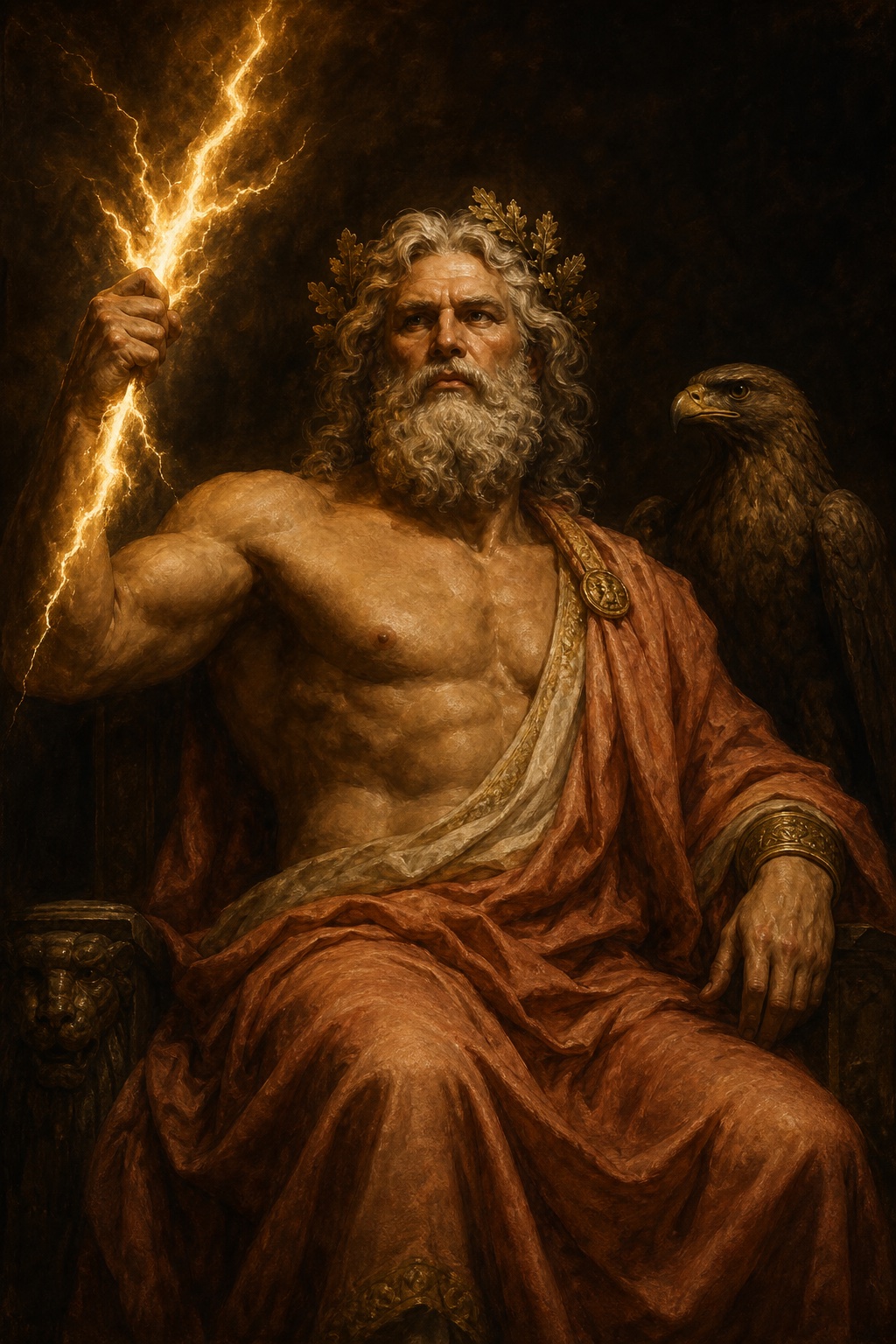
The weapon comes out of that war. In Apollodorus the Cyclopes give Zeus βροντὴν καὶ ἀστραπὴν καὶ κεραυνόν, thunder and lightning and a thunderbolt, and the bolt is a gift. Hesiod’s Theogony has a line in which the Cyclopes “gave Zeus the thunder and made the thunderbolt”, but the Greek text used for this entry prints that line in brackets as doubtful.
Hesiod shows the three weapons in use against Typhon, whom he calls Typhoeus. They appear in the same order as in Apollodorus: βροντήν τε στεροπήν τε καὶ αἰθαλόεντα κεραυνόν, thunder and lightning and lurid thunderbolt.
Ζεὺς δ᾽ ἐπεὶ οὖν κόρθυνεν ἑὸν μένος, εἵλετο δ᾽ ὅπλα, βροντήν τε στεροπήν τε καὶ αἰθαλόεντα κεραυνόν, πλῆξεν ἀπ᾽ Οὐλύμποιο ἐπάλμενος· ἀμφὶ δὲ πάσας ἔπρεσε θεσπεσίας κεφαλὰς δεινοῖο πελώρου. αὐτὰρ ἐπεὶ δή μιν δάμασεν πληγῇσιν ἱμάσσας, ἤριπε γυιωθείς, στενάχιζε δὲ γαῖα πελώρη
“So when Zeus had raised up his might and seized his arms, thunder and lightning and lurid thunderbolt, he leaped from Olympus and struck him, and burned all the marvellous heads of the monster about him. But when Zeus had conquered him and lashed him with strokes, Typhoeus was hurled down, a maimed wreck, so that the huge earth groaned.” — Hesiod, Theogony 853–858, tr. H. G. Evelyn-White
The six lines are all motion and fire. Zeus raises his might, takes up his arms, leaps from Olympus and strikes, and he burns every one of the monster’s heads. Then he lashes the beaten Typhoeus until he falls, maimed, and the huge earth groans under him. In these lines Zeus has no ally and says nothing; the bolt does the work.
Some twenty lines later, at 881–886, Hesiod turns from the fight to the throne. The gods press “far-seeing Olympian Zeus to reign and to rule over them, by Earth’s prompting”, and Zeus divides their dignities among them. In the same lines Hesiod calls him “Zeus, king of the gods”. Here Zeus hands out the shares himself, where in Apollodorus the brothers draw lots for theirs.
Justice, suppliants and strangers
In the opening lines of the Works and Days, Hesiod describes Zeus before he asks anything of him, and what he puts first is not justice but ease: a power that raises and lowers without effort. The demand for justice comes second, addressed to that same power:
ῥέα μὲν γὰρ βριάει, ῥέα δὲ βριάοντα χαλέπτει, ῥεῖα δ᾽ ἀρίζηλον μινύθει καὶ ἄδηλον ἀέξει, ῥεῖα δέ τ᾽ ἰθύνει σκολιὸν καὶ ἀγήνορα κάρφει Ζεὺς ὑψιβρεμέτης, ὃς ὑπέρτατα δώματα ναίει. κλῦθι ἰδὼν ἀίων τε, δίκῃ δ᾽ ἴθυνε θέμιστας
“For easily he makes strong, and easily he brings the strong man low; easily he humbles the proud and raises the obscure, and easily he straightens the crooked and blasts the proud, — Zeus who thunders aloft and has his dwelling most high. Attend thou with eye and ear, and make judgements straight with righteousness.” — Hesiod, Works and Days 5–10, tr. H. G. Evelyn-White
Each of the four clauses about his power opens on the same word, ῥέα or ῥεῖα, “easily”, and each one moves someone up or down: the strong brought low, the obscure raised, the crooked made straight. Only in the last line does Hesiod turn from what Zeus can do to what he should do. The verb of the prayer, ἴθυνε, which Evelyn-White renders “make judgements straight”, is the verb he has just used for straightening the crooked, ἰθύνει. Hesiod asks the god to do to judgements, with δίκῃ, righteousness, what he already does to the crooked.
Some of the people under that justice are named in the Odyssey. Speaking to Polyphemus, Odysseus calls himself and those with him suppliants, and he names the god who stands behind them:
ἀλλ’ αἰδεῖο, φέριστε, θεούς· ἱκέται δέ τοί εἰμεν. Ζεὺς δ’ ἐπιτιμήτωρ ἱκετάων τε ξείνων τε, ξείνιος, ὃς ξείνοισιν ἅμ’ αἰδοίοισιν ὀπηδεῖ
“Nay, mightiest one, reverence the gods; we are thy suppliants; and Zeus is the avenger of suppliants and strangers—Zeus, the strangers’ god—who ever attends upon reverend strangers.” — Homer, Odyssey 9.269–271, tr. A. T. Murray
The epithet in the middle of the line is ξείνιος, which Murray renders “the strangers’ god”. The lines give Zeus two duties toward strangers. He avenges the wrongs done to them, and he also goes with them: he “ever attends upon reverend strangers”.
The Iliad gives him oath-breakers as well, but as a speaker’s expectation, not as narration. When a truce is broken, Agamemnon says that “Zeus, son of Cronos, throned on high, that dwelleth in the heaven, shall himself shake over them all his dark aegis in wrath for this deceit”. What Agamemnon expects Zeus to shake over them is the aegis, not the thunderbolt.
His loves, and Hera
The Iliad’s own list of Zeus’s loves is spoken by Zeus, and he speaks it to Hera. On Ida he tells her that he has never desired any goddess or mortal woman as he desires her now, and to show how much that means, he names the others.
οὐ γάρ πώ ποτέ μ’ ὧδε θεᾶς ἔρος οὐδὲ γυναικὸς θυμὸν ἐνὶ στήθεσσι περιπροχυθεὶς ἐδάμασσεν, οὐδ’ ὁπότ’ ἠρασάμην Ἰξιονίης ἀλόχοιο, ἣ τέκε Πειρίθοον θεόφιν μήστωρ’ ἀτάλαντον· οὐδ’ ὅτε περ Δανάης καλλισφύρου Ἀκρισιώνης, ἣ τέκε Περσῆα πάντων ἀριδείκετον ἀνδρῶν· οὐδ’ ὅτε Φοίνικος κούρης τηλεκλειτοῖο, ἣ τέκε μοι Μίνων τε καὶ ἀντίθεον Ῥαδάμανθυν· οὐδ’ ὅτε περ Σεμέλης οὐδ’ Ἀλκμήνης ἐνὶ Θήβῃ, ἥ ῥ’ Ἡρακλῆα κρατερόφρονα γείνατο παῖδα· ἣ δὲ Διώνυσον Σεμέλη τέκε χάρμα βροτοῖσιν· οὐδ’ ὅτε Δήμητρος καλλιπλοκάμοιο ἀνάσσης, οὐδ’ ὁπότε Λητοῦς ἐρικυδέος, οὐδὲ σεῦ αὐτῆς, ὡς σέο νῦν ἔραμαι καί με γλυκὺς ἵμερος αἱρεῖ
“for never yet did desire for goddess or mortal woman so shed itself about me and overmaster the heart within my breast—nay, not when I was seized with love of the wife of Ixion, who bare Peirithous, the peer of the gods in counsel; nor of Danaë of the fair ankles, daughter of Acrisius, who bare Perseus, pre-eminent above all warriors; nor of the daughter of far-famed Phoenix, that bare me Minos and godlike Rhadamanthys; nor of Semele, nor of Alcmene in Thebes, and she brought forth Heracles, her son stout of heart, and Semele bare Dionysus, the joy of mortals; nor of Demeter, the fair-tressed queen; nor of glorious Leto; nay, nor yet of thine own self, as now I love thee, and sweet desire layeth hold of me.” — Homer, Iliad 14.315–328, tr. A. T. Murray
Seven women stand in the list before Hera: the wife of Ixion, Danaë, the daughter of far-famed Phoenix, Semele, Alcmene, Demeter and Leto. For five of them Zeus names the sons they bore: Peirithous, Perseus, Minos and Rhadamanthys, Heracles and Dionysus. The list is also a genealogy, and it puts heroes such as Perseus and Heracles beside a god, Dionysus.
It is a strange compliment. Zeus measures his desire for his wife against a catalogue of other women, and he puts her name last. The setting makes it stranger. Earlier in the same book, Hera has asked Hypnos to lull Zeus to slumber, and Hypnos, refusing her, remembers an earlier time she gave him such an order: while Zeus slept, she devised evil against his son Heracles as he sailed from Ilios, roused the blasts of cruel winds over the deep, and bore him away to Cos. Zeus, when he woke, was wroth.
Apollodorus tells a harsher story about Semele. Zeus loved her and bedded with her unknown to Hera, and he had agreed to do for her whatever she asked. Deceived by Hera, Semele asked him to come to her as he came when he was wooing Hera. Zeus could not refuse. He came to her bridal chamber in a chariot, with lightnings and thunderings, and launched a thunderbolt, and Semele expired of fright. Zeus snatched the six-month child from the fire and sewed it in his thigh; the Iliad’s list names Semele’s son as Dionysus. Hera does not enter the room in this story. Her part is one deception, and Zeus’s own promise and his own thunder do the rest.
Dodona and Olympia
At Dodona, Zeus is a god called on from far away. In the Iliad, Achilles prays to him by the name of the place:
Ζεῦ ἄνα, Δωδωναῖε, Πελασγικέ, τηλόθι ναίων Δωδώνης μεδέων δυσχειμέρου, ἀμφὶ δὲ Σελλοὶ σοὶ ναίουσ’ ὑποφῆται ἀνιπτόποδες χαμαιεῦναι
“Zeus, thou king, Dodonaean, Pelasgian, thou that dwellest afar, ruling over wintry Dodona,—and about thee dwell the Selli, thine interpreters, men with unwashen feet that couch on the ground.” — Homer, Iliad 16.233–235, tr. A. T. Murray
The only people the prayer places at Dodona are the Selli, the god’s ὑποφῆται, “thine interpreters”, men with unwashen feet who sleep on the ground. The Odyssey supplies the tree: in it, a journey to Dodona is made “to hear the will of Zeus from the high-crested oak of the god”. Between them, the two poems give Dodona its interpreters and its oak, and the oak is where the will of Zeus is heard.
Olympia’s claim goes back to the fight for the throne. Pausanias records two stories about the place. Some said that Zeus wrestled Cronus himself there for the throne, the version set beside Apollodorus’s war above. Others said that Zeus himself held the games there, “in honor of his victory over Cronus”, in Jones’s rendering. At Dodona he dwells afar, but at Olympia, in the stories Pausanias heard, he was once present in person, as the wrestler or as the one who held the games.