Noman is my name
The ninth book of the Odyssey is not told by the poet. It is told by Odysseus, at a Phaeacian dinner table, about himself — so the most famous thing he ever did survives in his own voice, with his own choices about what to put first. He puts the wine first. He and his comrades are shut inside a cave by a giant who has begun eating them, and the giant is not going to be fought. So the wine goes across three times, and three times it is drained down in folly, and once the drink has gone round the Cyclops’s wits the giant asks his prisoner for his name and promises a stranger’s gift in return.
Κύκλωψ, εἰρωτᾷς μ’ ὄνομα κλυτόν; αὐτὰρ ἐγώ τοι ἐξερέω· σὺ δέ μοι δὸς ξείνιον, ὥς περ ὑπέστης. Οὖτις ἐμοί γ’ ὄνομα· Οὖτιν δέ με κικλήσκουσι μήτηρ ἠδὲ πατὴρ ἠδ’ ἄλλοι πάντες ἑταῖροι
“Cyclops, thou askest me of my glorious name, and I will tell it thee; and do thou give me a stranger’s gift, even as thou didst promise. Noman is my name, Noman do they call me—my mother and my father, and all my comrades as well” — Homer, Odyssey 9.364–367, tr. Murray
The exchange is hospitality run backwards, and both parties know it. A ξείνιον is what a host owes a guest; this host has been eating his guests, and the prisoner asks for the gift anyway, politely, as though the rule still held. What comes back is a joke with teeth. The Cyclops promises to eat Noman last of the company and the rest before him, and calls that the gift.
The name is the trick, and it is not a disguise. Οὖτις is built out of the ordinary Greek for not anyone. It is not a foreign name or an invented lineage, the sort of thing that could be checked and found false; it is a hole in the sentence, and it is aimed at a question nobody has asked yet. Odysseus is not hiding from the Cyclops, who has him already, in the dark, behind a stone he cannot move. He is hiding from whoever the Cyclops will call.
Leaning on the stake
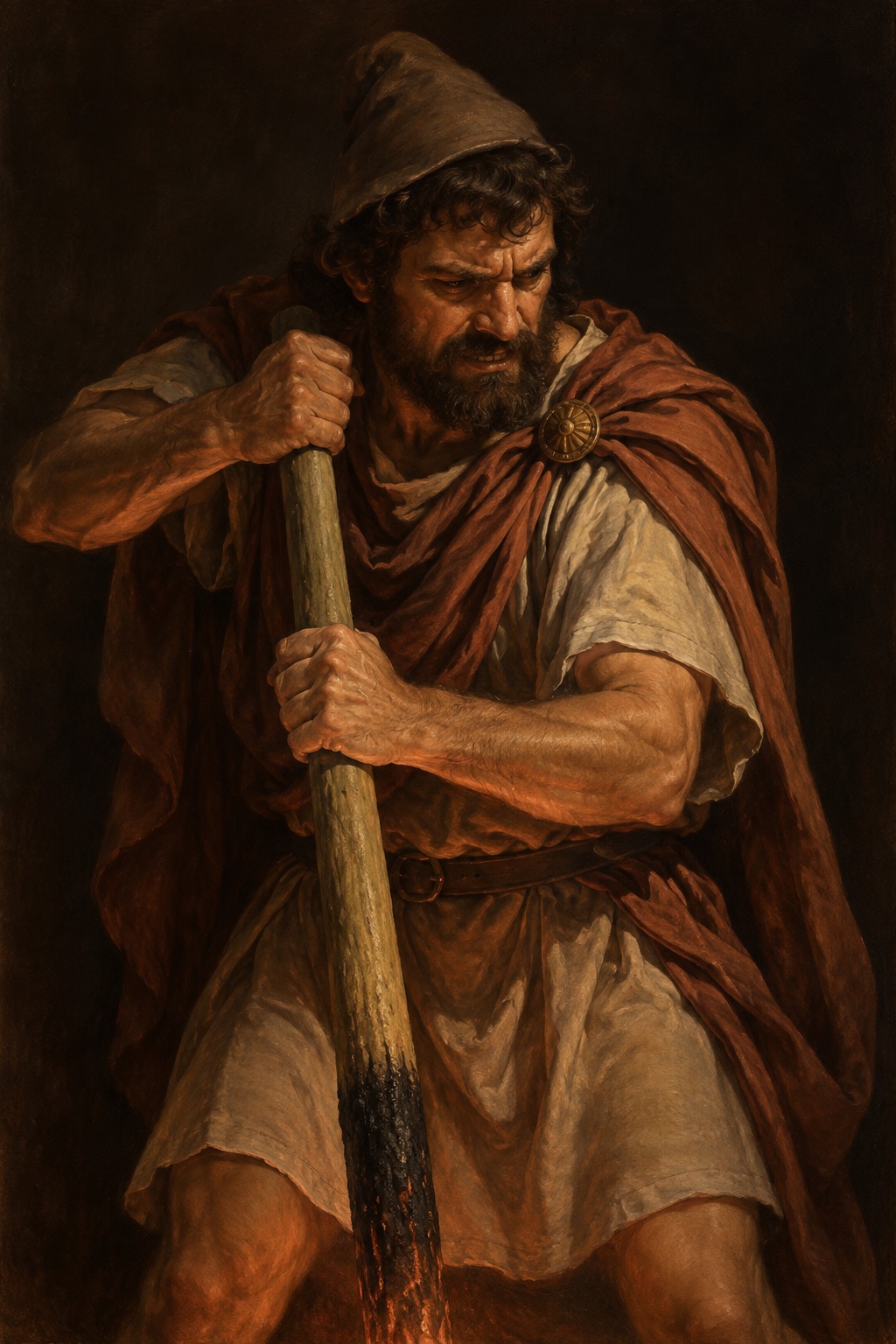
Green olive-wood, a length of it cut and sharpened at one end: that is the whole of the equipment. The giant goes over on his back with his neck bent aside, sleep takes him, and the wine comes back up out of him. Odysseus pushes the stake in under the deep ashes to heat it, and when it is glowing and about to catch, green as it is, he brings it up close out of the fire. His comrades stand round him. A god breathes great courage into them, and the poem gives Odysseus one line of his own.
οἱ μὲν μοχλὸν ἑλόντες ἐλάϊνον, ὀξὺν ἐπ’ ἄκρῳ, ὀφθαλμῷ ἐνέρεισαν· ἐγὼ δ’ ἐφύπερθεν ἐρεισθεὶς δίνεον
“They took the stake of olive-wood, sharp at the point, and thrust it into his eye, while I, throwing my weight upon it from above, whirled it round” — Homer, Odyssey 9.382–384, tr. Murray
Note how the work divides. The comrades set the point and drive it in; the verb that belongs to Odysseus alone is δίνεον, whirled it round, and he is above the shaft with his weight coming down through it. Homer’s comparison is not for a spear-thrust. It is for a shipwright boring a ship’s timber, one man on the drill from above while others below keep it turning with a thong wrapped round the shaft, so that the bit runs on and on and never stops. That is the picture: skilled, two-handed, repetitive labour, done fast, on a living body. It is also the only place in the episode where he is the subject of the verb instead of the mind behind it.
Then the false name earns what it cost. The screaming brings the other Cyclopes to the mouth of the cave and they shout in to ask who is hurting him. He answers that Noman is killing him by guile and not by force, and they leave, because a man whom nobody is hurting has nothing wrong with him — the cry for help defeats itself in his own mouth. Later the blinded giant stops the great ram at the door and talks to it before letting it go, telling it that a bad man and his wretched comrades put out his eye after mastering his wits with wine, a bad man named Noman. Then he sends the ram out through the doorway. A little way from the cave and the yard, Odysseus looses himself from under the ram first, and then looses his comrades.
The name he takes back
They get the flock down to the ship and pull away from the beach, and he cannot leave it there. He shouts back at the Cyclops. A rock comes out at the sound of his voice, and his crew stand round him and plead with him to stop provoking a man who throws things like that, and — as he tells the Phaeacians himself — they could not persuade his great-hearted spirit. He answers the Cyclops a second time, in anger.
Κύκλωψ, αἴ κέν τίς σε καταθνητῶν ἀνθρώπων ὀφθαλμοῦ εἴρηται ἀεικελίην ἀλαωτύν, φάσθαι Ὀδυσσῆα πτολιπόρθιον ἐξαλαῶσαι, υἱὸν Λαέρτεω, Ἰθάκῃ ἔνι οἰκί
“Cyclops, if any one of mortal men shall ask thee about the shameful blinding of thine eye, say that Odysseus, the sacker of cities, blinded it, even the son of Laertes, whose home is in Ithaca” — Homer, Odyssey 9.502–505, tr. Murray
Everything the false name was protecting is handed over in one sentence, and handed over in the fullest form available: the name, then the title the sacker of cities, then the father, then the island. It reads like a man dictating an inscription. He has just spent a night proving that anonymity is the most valuable thing he owns, and he trades it for the credit.
What he buys with it is an address. The Cyclops, who could not have named his attacker an hour before, lifts his hands to the starry sky and prays to Poseidon — if he is truly his son, and Poseidon truly claims to be his father — that Odysseus the sacker of cities may never come home; or, if it is fated that he see his own people and reach his well-built house and his native land, that he come late and in evil case, having lost every one of his comrades, in another man’s ship, and find troubles waiting in his house. Homer answers the prayer in half a line: so he spoke, and the dark-haired god heard him. Nothing that happens in the rest of the poem falls outside that list. The boast is not an ornament on the story of the Cyclops. It is the reason there is a story after it.
What he wanted instead
Book five finds him years further on, on Calypso’s island, with no ship and no way off it. Athena has been putting his case in the assembly of the gods, recounting his many woes one by one, and Zeus has ruled that he is to be let go — a will no other god can evade or make void, as the nymph herself concedes when she gives way. Calypso has her own account of the arrangement, and it is not a mean one: she took him in when every other man in his ship had perished, welcomed him kindly, fed him, and offered to make him immortal and ageless all his days. Then she puts the comparison to him directly. She is not, she says, the inferior of that woman in form or stature, and it is not seemly for mortal women to vie with immortals in comeliness at all. The poem introduces his answer with the epithet he carries everywhere, πολύμητις, of many wiles.
πότνα θεά, μή μοι τόδε χώεο· οἶδα καὶ αὐτὸς πάντα μάλ’, οὕνεκα σεῖο περίφρων Πηνελόπεια εἶδος ἀκιδνοτέρη μέγεθός τ’ εἰσάντα ἰδέσθαι· ἡ μὲν γὰρ βροτός ἐστι, σὺ δ’ ἀθάνατος καὶ ἀγήρως. ἀλλὰ καὶ ὧς ἐθέλω καὶ ἐέλδομαι ἤματα πάντα οἴκαδέ τ’ ἐλθέμεναι καὶ νόστιμον ἦμαρ ἰδέσθαι
“Mighty goddess, be not wroth with me for this. I know full well of myself that wise Penelope is meaner to look upon than thou in comeliness and in stature, for she is a mortal, while thou art immortal and ageless. But even so I wish and long day by day to reach my home, and to see the day of my return” — Homer, Odyssey 5.215–220, tr. Murray
He concedes the entire argument. Not you are wrong about Penelope, but I know it perfectly well myself — she is the plainer of the two, she is going to die, and the goddess offering the alternative is immortal and ageless and right on every point she has raised. And then ἀλλὰ καὶ ὧς, but even so. What he wants is not framed as a preference between two women, or two lives, or two kinds of body. It is a single object, νόστιμον ἦμαρ, the day of return, and he longs for it ἤματα πάντα, all his days — the same phrase Calypso had just used against him, when she said he pined after that woman every day of his life.
The epithet is the joke, and it is a good one. Πολύμητις is many-mētis: the practical, resourceful intelligence that finds the way through, which is what this wiki’s entry on Metis is about, and what produced both the empty name and the drill-work in the cave. Here it introduces a speech with no trick in it whatever. The man of many devices states plainly what he wants, and the wanting is the least ingenious thing about him. Latin later took him over as Ulysses, and every age since has argued about whether the cunning is admirable. The two scenes fit together without needing the argument settled. The cunning is a tool, and the thing it is for is a rocky island, a mortal wife, and one ordinary day with a date on it.