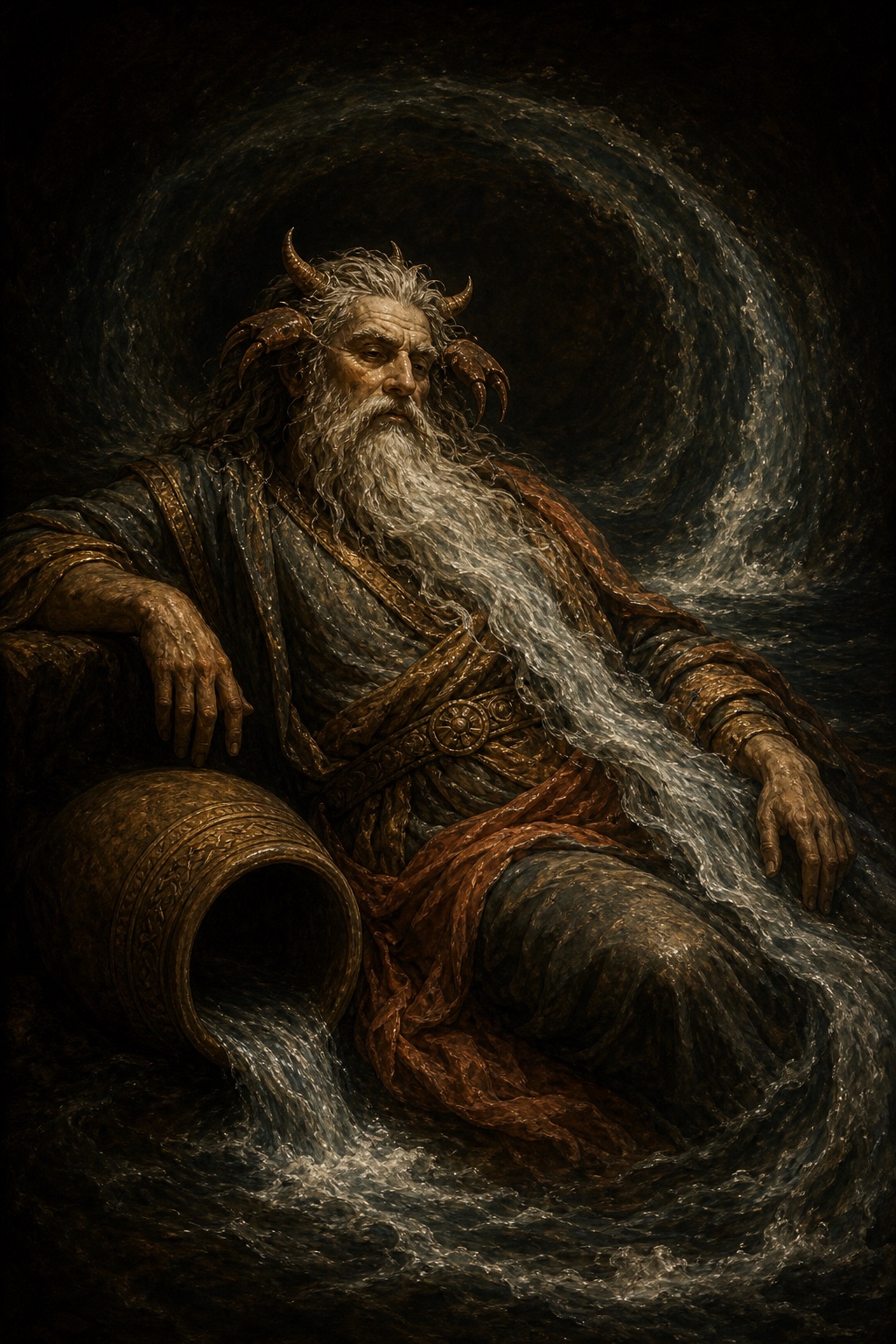
Oceanus is not the sea. Greek keeps other words for that — pontos for the open deep, thalassa for the water you sail on — and reserves this one for something stranger: a single fresh-water river running in a closed circle around the edge of the flat earth, with no bank on its far side. Every other body of water is drawn from it. The sun sets into it and comes back out of it in the morning. It is less a god of water than the plumbing diagram of the world.
Achilles says so while standing in a river that is trying to drown him, and the point he is making is about rank.
οὐδὲ βαθυρρείταο μέγα σθένος Ὠκεανοῖο, ἐξ οὗ περ πάντες ποταμοὶ καὶ πᾶσα θάλασσα καὶ πᾶσαι κρῆναι καὶ φρείατα μακρὰ νάουσιν
“Nor the great might of deep-flowing Ocean, from whom all rivers flow and every sea, and all the springs and deep wells.” — Homer, Iliad 21.195–197, tr. A. T. Murray
His household is enormous and almost entirely nameless. Hesiod gives him three thousand daughters and as many sons by his sister Tethys — the Oceanids and the rivers of the world — gets as far as forty-one of the daughters and twenty-five of the sons, and then gives up: the rest, he says, are hard for a mortal man to tell. This is not idle inflation. It means that any nymph, any spring, any river anywhere in the Greek world can be attached to the genealogy at will, and most were. Oceanus is the socket that the whole hydrological map plugs into.
What makes him unusual among the Titans is that he never fights. Hesiod’s Titans go into Tartarus as a class; Oceanus stays where he is, and keeps his function under the new management. Homer notices it and makes it structural: when Zeus summons every god on Olympus to the assembly, every river comes — save only Oceanus, who does not attend and is not compelled to. In Aeschylus he turns up to visit the chained Prometheus and advises him, kindly and uselessly, to stop antagonising the winner. He is the god of not being involved.
There is also a quieter suggestion that he was once first. Twice in the Iliad Hera speaks of “Oceanus, from whom the gods are sprung, and mother Tethys”, which is a cosmogony with no Chaos in it at all and no Gaia at the start — water before earth. Hesiod’s version won so completely that the alternative survives only as a formula in a speech about something else. The circling water at the world’s edge is a widely shared idea: Egypt fills it with Nun’s inert chaos, Norse cosmology puts a serpent in it big enough to bite its own tail. Greece put an old married couple there, with six thousand children and no ambition.