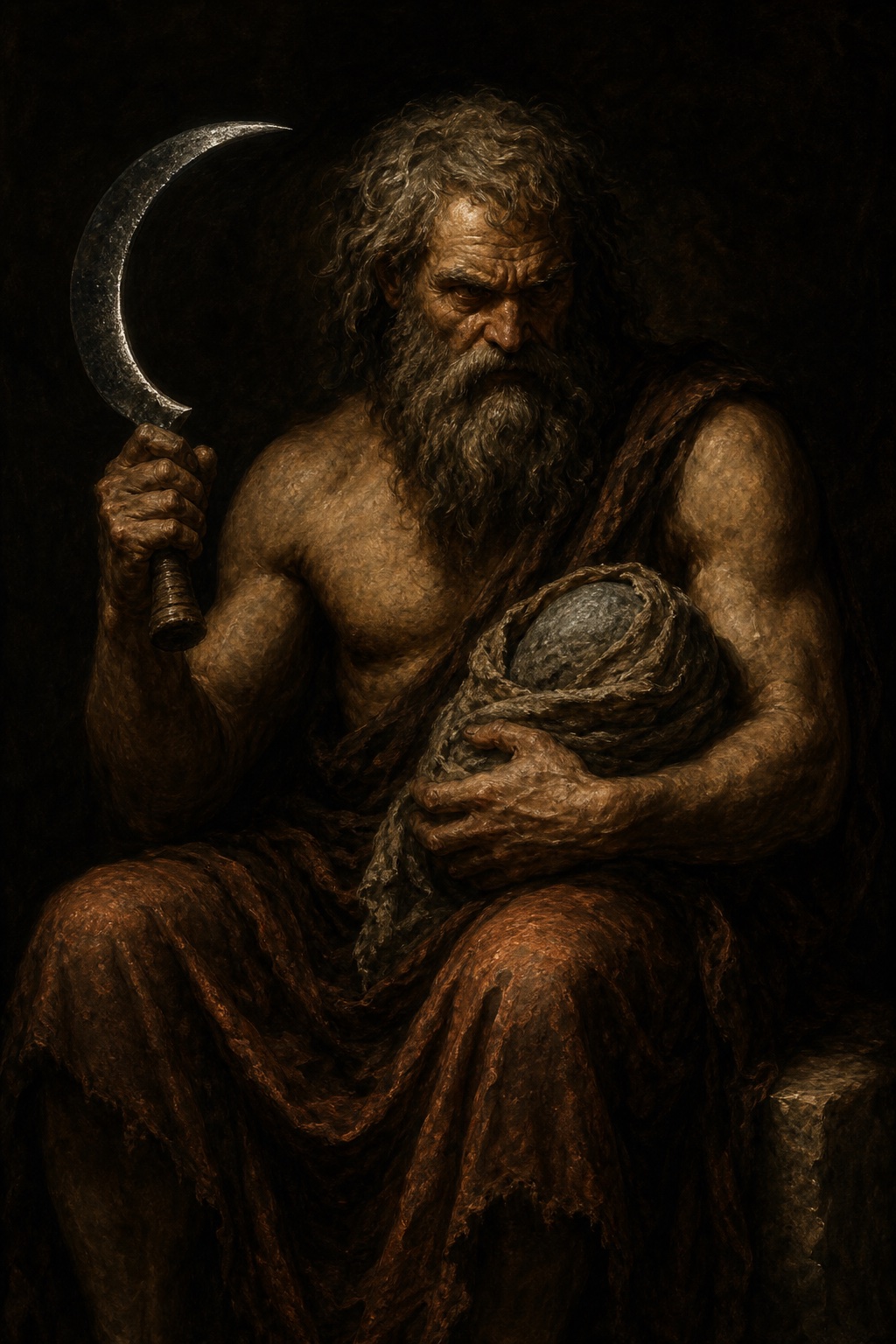
Cronus is the youngest of the Titans and the most consequential. Gaia, sick of Uranus stuffing her children back inside her, makes a sickle of grey adamant and asks which of her sons will use it; only Cronus takes it. He castrates his father from ambush, takes the sky’s throne, and inherits with it the curse Uranus speaks as he falls — that Cronus in turn will be put down by his own child.
He responds to that prophecy with the act everyone remembers him for. As each child is born to Rhea he swallows it whole, taking them from her knees, so that his rivals are inside him and there can be no succession at all.
καὶ τοὺς μὲν κατέπινε μέγας Κρόνος, ὥς τις ἕκαστος νηδύος ἐξ ἱερῆς μητρὸς πρὸς γούναθ᾽ ἵκοιτο, τὰ φρονέων, ἵνα μή τις ἀγαυῶν Οὐρανιώνων ἄλλος ἐν ἀθανάτοισιν ἔχοι βασιληίδα τιμήν
“These great Cronos swallowed as each came forth from the womb to his mother’s knees with this intent, that no other of the proud sons of Heaven should hold the kingly office amongst the deathless gods.” — Hesiod, Theogony 459–462, tr. Evelyn-White
It fails in the ordinary way of such precautions: Rhea hides the sixth child and hands him a wrapped stone instead, and the grown Zeus forces him to bring the others back up — the stone first, the siblings after, alive and undigested. The war that follows runs ten years and ends with the Titans shut in Tartarus. Hesiod’s epithet for him throughout is ankulomētēs, “crooked-schemer”, and the scheming is always this same defensive kind: hoarding, holding down, refusing to let the next thing happen.
A gentler Cronus survives alongside the ogre. The Athenians kept a midsummer festival, the Kronia, at which masters ate with their slaves, and Greek writers looking backward placed a golden age under his rule when men lived without toil. Later Latin authors merged him with Saturn and the harvest, so that the god who devoured his children also carries a reaping-hook and presides over the year’s cut grain.