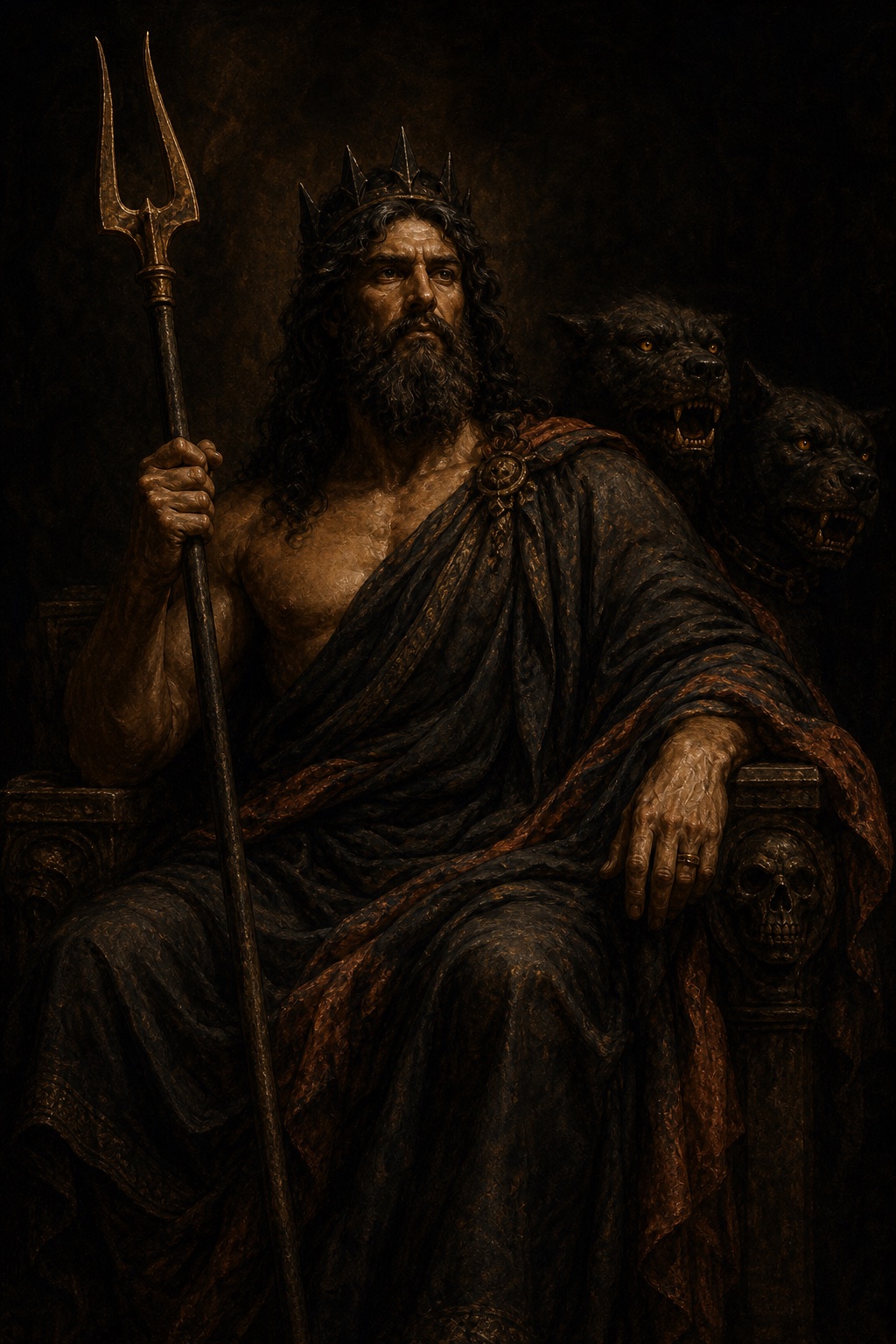
Hades rules the underworld, having drawn it as his portion when he and his brothers Zeus and Poseidon divided the world by lot after defeating the Titans. He rarely leaves his shadowed kingdom, governing the dead with a sternness the Greeks find more fearsome than cruel — he is rarely called wicked, only inexorable, the one god who never bends once judgment is passed. His other name, Plouton, “the wealthy one,” ties him to the buried riches of the earth, grain and ore alike, sprung from the same soil that holds the dead.
His marriage begins in abduction: he seizes Persephone, daughter of Demeter, from a meadow with Zeus’s tacit consent, and her mother’s grief over the loss withholds the harvest until a bargain is struck — Persephone spends part of each year below with Hades and part above with Demeter, and the seasons turn on the arrangement. His realm is guarded by Cerberus, watered by the Styx and Lethe, and closed against escape; only a handful of visitors, Orpheus and Heracles among them, are ever permitted to leave it.
ἐχθρὸς γάρ μοι κεῖνος ὁμῶς Ἀΐδαο πύλῃσιν ὅς χ’ ἕτερον μὲν κεύθῃ ἐνὶ φρεσίν, ἄλλο δὲ εἴπῃ
“For hateful in my eyes, even as the gates of Hades, is that man that hideth one thing in his mind and sayeth another.” — Homer, Iliad 9.312–313, tr. A. T. Murray