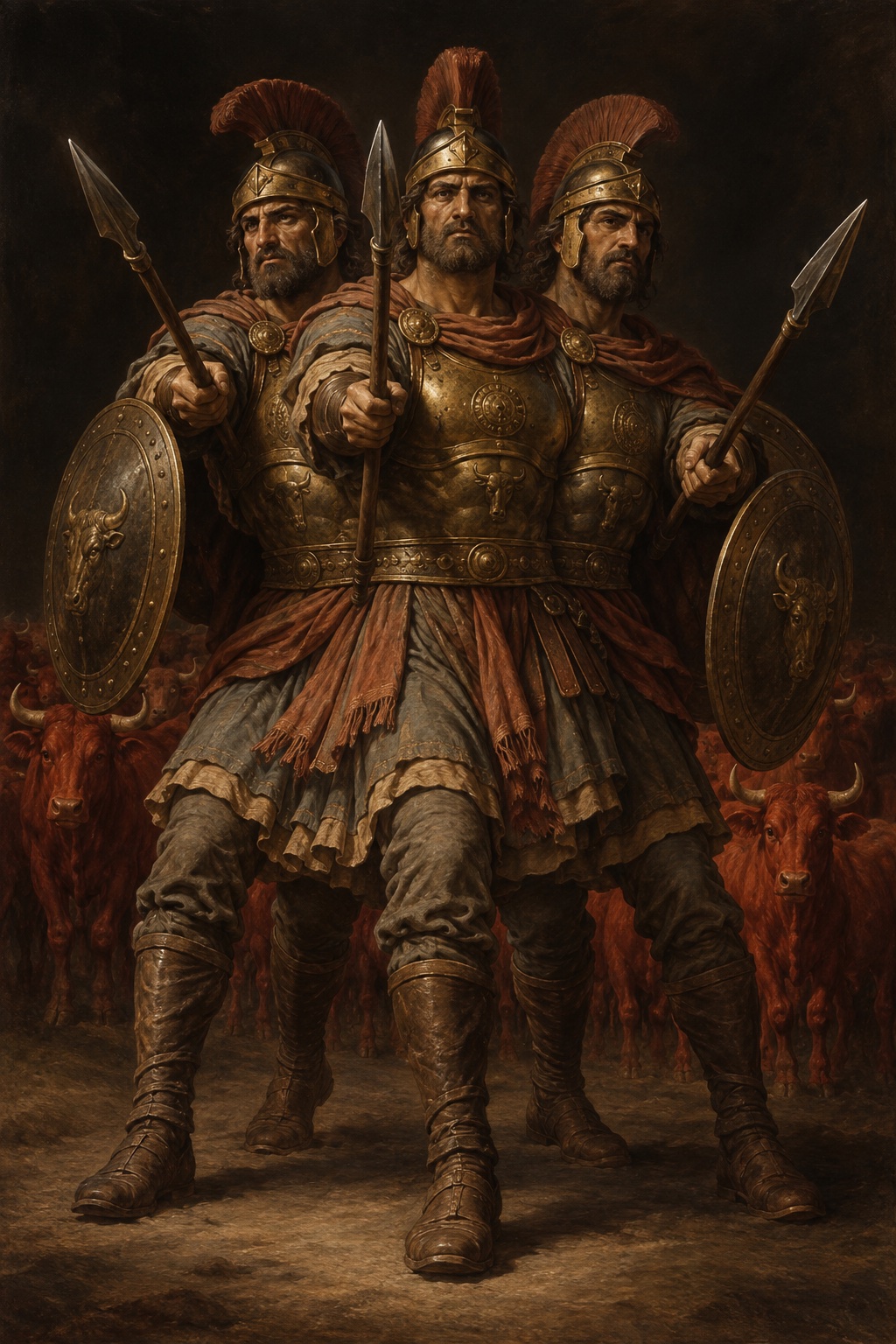
Son of Chrysaor
Geryon’s father came into the world at a killing. In the story of Perseus, Apollodorus tells how the hero found the three Gorgons asleep and cut off the head of Medusa, the only one of them who was mortal. As soon as the head was off, ἐκ τῆς Γοργόνος ἐξέθορε Πήγασος πτηνὸς ἵππος, καὶ Χρυσάωρ ὁ Γηρυόνου πατήρ: out of the Gorgon sprang the winged horse Pegasus, and Chrysaor, the father of Geryon. At that point Apollodorus says nothing else about Chrysaor. He names him by his son. Hesiod gives the same family in eight lines of the Theogony, and the lines go straight from Geryon’s birth to his death.
Χρυσάωρ δ᾽ ἔτεκεν τρικέφαλον Γηρυονῆα μιχθεὶς Καλλιρόῃ κούρῃ κλυτοῦ Ὠκεανοῖο. τὸν μὲν ἄρ᾽ ἐξενάριξε βίη Ἡρακληείη βουσὶ παρ᾽ εἰλιπόδεσσι περιῤῥύτῳ εἰν Ἐρυθείῃ ἤματι τῷ ὅτε περ βοῦς ἤλασεν εὐρυμετώπους Τίρυνθ᾽ εἰς ἱερὴν διαβὰς πόρον Ὠκεανοῖο Ὄρθον τε κτείνας καὶ βουκόλον Εὐρυτίωνα σταθμῷ ἐν ἠερόεντι πέρην κλυτοῦ Ὠκεανοῖο
“But Chrysaor was joined in love to Callirrhoe, the daughter of glorious Ocean, and begot three-headed Geryones. Him mighty Heracles slew in sea-girt Erythea by his shambling oxen on that day when he drove the wide-browed oxen to holy Tiryns, and had crossed the ford of Ocean and killed Orthus and Eurytion the herdsman in the dim stead out beyond glorious Ocean” — Hesiod, Theogony 287–294, tr. Evelyn-White
The two authors agree on the parents. In Hesiod the mother is Callirrhoe, κούρῃ κλυτοῦ Ὠκεανοῖο, a daughter of glorious Oceanus, and Apollodorus names the same pair, Χρυσάορος καὶ Καλλιρρόης τῆς Ὠκεανοῦ, Chrysaor and Callirrhoe the daughter of Oceanus. Through his father Geryon is a grandson of Medusa, and through his mother a grandson of Oceanus.
Hesiod gives Geryon himself a single word, τρικέφαλον, three-headed. The next sentence kills him: τὸν μὲν ἄρ᾽ ἐξενάριξε βίη Ἡρακληείη, where βίη Ἡρακληείη, the might of Heracles, is the epic way of naming the hero himself. Everything else in the passage belongs to the scene around the death. Hesiod places it in sea-girt Erytheia, περιῤῥύτῳ εἰν Ἐρυθείῃ, beside Geryon’s cattle, and dates it to the day when Heracles drove the oxen to holy Tiryns, after he had crossed the ford of Ocean and killed Orthus and the herdsman Eurytion, σταθμῷ ἐν ἠερόεντι, in the dim stead, out beyond the Ocean. In eight lines Geryon is born and dies. Apart from the three heads, the poem tells only who his parents were, what he owned, and who was killed on the day he died.
Three men in one body
Hesiod counts Geryon’s heads. Apollodorus describes his body. He tells the whole raid, as the tenth of the labours of Heracles, and his is the fullest account of Geryon in these sources.
δέκατον ἐπετάγη ἆθλον τὰς Γηρυόνου βόας ἐξ Ἐρυθείας κομίζειν. Ἐρύθεια δὲ ἦν Ὠκεανοῦ πλησίον κειμένη νῆσος, ἣ νῦν Γάδειρα καλεῖται. ταύτην κατῴκει Γηρυόνης Χρυσάορος καὶ Καλλιρρόης τῆς Ὠκεανοῦ, τριῶν ἔχων ἀνδρῶν συμφυὲς σῶμα, συνηγμένον εἰς ἓν κατὰ τὴν γαστέρα, ἐσχισμένον δὲ εἰς τρεῖς ἀπὸ λαγόνων τε καὶ μηρῶν. εἶχε δὲ φοινικᾶς βόας, ὧν ἦν βουκόλος Εὐρυτίων, φύλαξ δὲ Ὄρθος ὁ κύων δικέφαλος ἐξ Ἐχίδνης καὶ Τυφῶνος γεγεννημένος. πορευόμενος οὖν ἐπὶ τὰς Γηρυόνου βόας διὰ τῆς Εὐρώπης, ἄγρια πολλὰ <ζῷα> ἀνελὼν Λιβύης ἐπέβαινε, καὶ παρελθὼν Ταρτησσὸν ἔστησε σημεῖα τῆς πορείας ἐπὶ τῶν ὅρων Εὐρώπης καὶ Λιβύης ἀντιστοίχους δύο στήλας. θερόμενος δὲ ὑπὸ Ἡλίου κατὰ τὴν πορείαν, τὸ τόξον ἐπὶ τὸν θεὸν ἐνέτεινεν· ὁ δὲ τὴν ἀνδρείαν αὐτοῦ θαυμάσας χρύσεον ἔδωκε δέπας, ἐν ᾧ τὸν Ὠκεανὸν διεπέρασε. καὶ παραγενόμενος εἰς Ἐρύθειαν ἐν ὄρει Ἄβαντι αὐλίζεται. αἰσθόμενος δὲ ὁ κύων ἐπ᾽ αὐτὸν ὥρμα· ὁ δὲ καὶ τοῦτον τῷ ῥοπάλῳ παίει, καὶ τὸν βουκόλον Εὐρυτίωνα τῷ κυνὶ βοηθοῦντα ἀπέκτεινε. Μενοίτης δὲ ἐκεῖ τὰς Ἅιδου βόας βόσκων Γηρυόνῃ τὸ γεγονὸς ἀπήγγειλεν. ὁ δὲ καταλαβὼν Ἡρακλέα παρὰ ποταμὸν Ἀνθεμοῦντα τὰς βόας ἀπάγοντα, συστησάμενος μάχην τοξευθεὶς ἀπέθανεν. Ἡρακλῆς δὲ ἐνθέμενος τὰς βόας εἰς τὸ δέπας καὶ διαπλεύσας εἰς Ταρτησσὸν Ἡλίῳ πάλιν ἀπέδωκε τὸ δέπας
“As a tenth labour he was ordered to fetch the kine of Geryon from Erythia. Now Erythia was an island near the ocean; it is now called Gadira. This island was inhabited by Geryon, son of Chrysaor by Callirrhoe, daughter of Ocean. He had the body of three men grown together and joined in one at the waist, but parted in three from the flanks and thighs. He owned red kine, of which Eurytion was the herdsman and Orthus, the two-headed hound, begotten by Typhon on Echidna, was the watchdog. So journeying through Europe to fetch the kine of Geryon he destroyed many wild beasts and set foot in Libya, and proceeding to Tartessus he erected as tokens of his journey two pillars over against each other at the boundaries of Europe and Libya. But being heated by the Sun on his journey, he bent his bow at the god, who in admiration of his hardihood, gave him a golden goblet in which he crossed the ocean. And having reached Erythia he lodged on Mount Abas. However the dog, perceiving him, rushed at him; but he smote it with his club, and when the herdsman Eurytion came to the help of the dog, Hercules killed him also. But Menoetes, who was there pasturing the kine of Hades, reported to Geryon what had occurred, and he, coming up with Hercules beside the river Anthemus, as he was driving away the kine, joined battle with him and was shot dead. And Hercules, embarking the kine in the goblet and sailing across to Tartessus, gave back the goblet to the Sun” — Apollodorus, Bibliotheke 2.5.10, tr. J. G. Frazer
Apollodorus begins with the place. Erytheia is Ὠκεανοῦ πλησίον κειμένη νῆσος, an island lying near the Ocean, and he adds that it is now called Gadira, ἣ νῦν Γάδειρα καλεῖται. Then he comes to its owner. Geryon has τριῶν ἔχων ἀνδρῶν συμφυὲς σῶμα, the body of three men grown together. The body is συνηγμένον εἰς ἓν κατὰ τὴν γαστέρα, joined into one at the belly, which Frazer renders the waist, and ἐσχισμένον δὲ εἰς τρεῖς ἀπὸ λαγόνων τε καὶ μηρῶν, split into three from the flanks and thighs. The sentence says where the three men are joined and where they part, and it stops there. Apollodorus does not count heads. Hesiod counts only heads, with the one word τρικέφαλον. Neither author describes the whole figure.
After the body Apollodorus lists the household. εἶχε δὲ φοινικᾶς βόας: Geryon owned red cattle, and two others looked after them. Eurytion was the herdsman, βουκόλος Εὐρυτίων, and the guard, φύλαξ, was Orthus, ὁ κύων δικέφαλος, the two-headed dog, ἐξ Ἐχίδνης καὶ Τυφῶνος γεγεννημένος, born of Echidna and Typhon. Hesiod gives Orthus the same parents. A few lines after the Geryon passage he lists the children that Echidna bore to Typhon, and Orthus comes first, named by his master: Ὄρθον μὲν πρῶτον κύνα γείνατο Γηρυονῆι. Cerberus, the hound of Hades, comes second in that list, and the Hydra third. By the time Hesiod tells of the dog’s birth, the poem has already told of his death. In Hesiod the master has three heads. In Apollodorus his dog has two.
The tenth labour
Apollodorus gives more of the passage to the road than to Geryon. Heracles crosses Europe, killing many wild beasts on the way, and enters Libya. Past Tartessus he sets up two pillars facing each other at the boundaries of Europe and Libya, ἀντιστοίχους δύο στήλας, as σημεῖα τῆς πορείας, tokens of his journey. Then the heat of the march turns him against the Sun: θερόμενος δὲ ὑπὸ Ἡλίου κατὰ τὴν πορείαν, τὸ τόξον ἐπὶ τὸν θεὸν ἐνέτεινεν, heated by Helios on the march, he bends his bow at the god. Helios does not punish him. He admires his daring and gives him a golden cup, χρύσεον ἔδωκε δέπας, and in the cup Heracles crosses the Ocean. The cup is the god’s and not Geryon’s, and Heracles has it only for the journey.
On Erytheia Heracles camps on Mount Abas, ἐν ὄρει Ἄβαντι αὐλίζεται. The dog notices him and rushes at him, and he strikes it with his club, τῷ ῥοπάλῳ παίει. When the herdsman Eurytion comes to help the dog, Heracles kills him.
Geryon is not there. The news reaches him from a herdsman of another master: Μενοίτης δὲ ἐκεῖ τὰς Ἅιδου βόας βόσκων, Menoetes, who was grazing the cattle of Hades there, tells Geryon what has happened. Geryon overtakes Heracles beside the river Anthemus, παρὰ ποταμὸν Ἀνθεμοῦντα, when Heracles is already driving the cattle away, τὰς βόας ἀπάγοντα. The fight takes four words: συστησάμενος μάχην τοξευθεὶς ἀπέθανεν, he joined battle, was shot, and died. Apollodorus gives Geryon no weapon and no deed in the fight. In the whole passage he does only two things: he comes after his cattle, and he joins battle for them.
Heracles’s bow comes into the passage twice, first against the Sun and then in τοξευθεὶς, and the cup of Helios carries him both ways. Heracles loads the cattle into the cup, sails across to Tartessus, and gives the cup back to Helios, Ἡλίῳ πάλιν ἀπέδωκε τὸ δέπας. The passage ends on the word δέπας, with the cup back in the hands of its owner.
Where the accounts differ
Hesiod and Apollodorus agree on the parents, the island, the herdsman, the hound and the killer. In both, Orthus and Eurytion die in the same raid as their master. Hesiod says outright that the hound was killed, Ὄρθον τε κτείνας, but does not tell how. Apollodorus tells how, with a stroke of the club, and his verb for the stroke is παίει, he strikes. He keeps ἀπέκτεινε, he killed, for Eurytion. It is Frazer’s killed him also that takes the dog’s death as given.
The accounts part on where and how Geryon dies. Hesiod puts the killing in sea-girt Erytheia, beside the cattle. Apollodorus puts it beside the river Anthemus, with the cattle already on the move, and he does not say whether the river is on the island. Hesiod names no weapon. Apollodorus’s τοξευθεὶς makes the death a bowshot. Hesiod’s Heracles crosses the ford of Ocean, διαβὰς πόρον Ὠκεανοῖο, and the poem does not say how. Apollodorus’s Heracles crosses in the cup of Helios. Menoetes and the cattle of Hades are in Apollodorus alone. Hesiod names the end of the drive, holy Tiryns, and the passage from Apollodorus stops at Tartessus, where the cup goes back to the Sun.