Echidna’s third child
Hesiod gives the Hydra her birth, her upbringing and her death inside six lines. She comes in the Theogony’s catalogue of monsters, among the children Echidna bore after Typhon lay with her: first Orthus, the hound of Geryon, then Cerberus, the hound of Hades, and then, with the words τὸ τρίτον, a third.
τὸ τρίτον Ὕδρην αὖτις ἐγείνατο λυγρὰ ἰδυῖαν Λερναίην, ἣν θρέψε θεὰ λευκώλενος Ἥρη ἄπλητον κοτέουσα βίῃ Ἡρακληείῃ. καὶ τὴν μὲν Διὸς υἱὸς ἐνήρατο νηλέι χαλκῷ Ἀμφιτρυωνιάδης σὺν ἀρηιφίλῳ Ἰολάῳ Ἡρακλέης βουλῇσιν Ἀθηναίης ἀγελείης
“And again she bore a third, the evil-minded Hydra of Lerna, whom the goddess, white-armed Hera nourished, being angry beyond measure with the mighty Heracles. And her Heracles, the son of Zeus, of the house of Amphitryon, together with warlike Iolaus, destroyed with the unpitying sword through the plans of Athene the spoil-driver.” — Hesiod, Theogony 313–318, tr. Evelyn-White
After her name and her place, Λερναίην, of Lerna, Hesiod says one thing about her own nature: λυγρὰ ἰδυῖαν, which Evelyn-White renders evil-minded. The rest of the passage is about other people. The next thing he says is who raised her. ἣν θρέψε θεὰ λευκώλενος Ἥρη: the white-armed goddess Hera reared her, and the reason is in the following line, ἄπλητον κοτέουσα βίῃ Ἡρακληείῃ, being angry beyond measure with the mighty Heracles. The Hydra is brought up for a quarrel that is not hers. Hesiod gives no cause for her rearing except Hera’s anger at a hero.
The next sentence ends her. καὶ τὴν μὲν Διὸς υἱὸς ἐνήρατο νηλέι χαλκῷ: the son of Zeus killed her with the pitiless bronze, which Evelyn-White makes the unpitying sword. Hesiod gives Heracles two lineages in two lines, first Διὸς υἱὸς, the son of Zeus, then Ἀμφιτρυωνιάδης, of the house of Amphitryon, and he gives him a companion, σὺν ἀρηιφίλῳ Ἰολάῳ, together with warlike Iolaus. The plan comes from Athena, βουλῇσιν Ἀθηναίης. One goddess rears the Hydra and another plans her death, and in these six lines the monster herself does nothing at all.
The line after the passage is harder to read. Hesiod goes on, Ἥ δὲ Χίμαιραν ἔτικτε, She was the mother of Chimaera, and the pronoun does not say who she is. It may go back to Echidna, whose children the passage has been listing, or it may point to the Hydra, the last of those children to be named. This wiki’s Echidna entry counts the Chimera among Echidna’s children. This entry names the Chimera neither as the Hydra’s sister nor as her daughter, because the line does not decide between them.
The second labour
Hesiod names the killing and moves on. Apollodorus tells it at length, as the second of the labours that Eurystheus set Heracles, and his is the one account in these sources in which the Hydra acts.
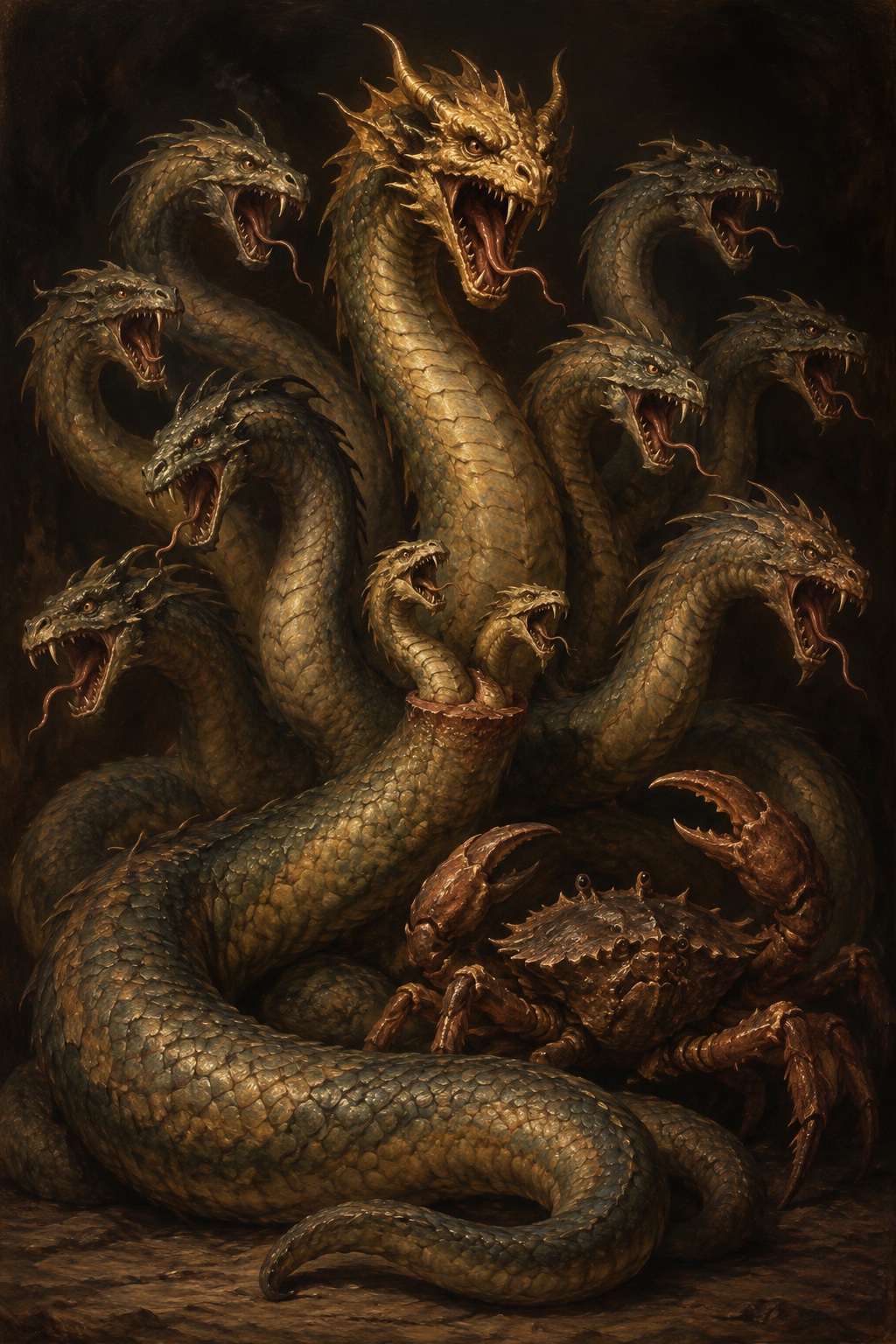
δεύτερον δὲ ἆθλον ἐπέταξεν αὐτῷ τὴν Λερναίαν ὕδραν κτεῖναι· αὕτη δὲ ἐν τῷ τῆς Λέρνης ἕλει ἐκτραφεῖσα ἐξέβαινεν εἰς τὸ πεδίον καὶ τά τε βοσκήματα καὶ τὴν χώραν διέφθειρεν. εἶχε δὲ ἡ ὕδρα ὑπερμέγεθες σῶμα, κεφαλὰς ἔχον ἐννέα, τὰς μὲν ὀκτὼ θνητάς, τὴν δὲ μέσην ἀθάνατον. ἐπιβὰς οὖν ἅρματος, ἡνιοχοῦντος Ἰολάου, παρεγένετο εἰς τὴν Λέρνην, καὶ τοὺς μὲν ἵππους ἔστησε, τὴν δὲ ὕδραν εὑρὼν ἔν τινι λόφῳ παρὰ τὰς πηγὰς τῆς Ἀμυμώνης, ὅπου ὁ φωλεὸς αὐτῆς ὑπῆρχε, βάλλων βέλεσι πεπυρωμένοις ἠνάγκασεν ἐξελθεῖν, ἐκβαίνουσαν δὲ αὐτὴν κρατήσας κατεῖχεν. ἡ δὲ θατέρῳ τῶν ποδῶν ἐνείχετο περιπλακεῖσα. τῷ ῥοπάλῳ δὲ τὰς κεφαλὰς κόπτων οὐδὲν ἀνύειν ἠδύνατο· μιᾶς γὰρ κοπτομένης κεφαλῆς δύο ἀνεφύοντο. ἐπεβοήθει δὲ καρκίνος τῇ ὕδρᾳ ὑπερμεγέθης, δάκνων τὸν πόδα. διὸ τοῦτον ἀποκτείνας ἐπεκαλέσατο καὶ αὐτὸς βοηθὸν τὸν Ἰόλαον, ὃς μέρος τι καταπρήσας τῆς ἐγγὺς ὕλης τοῖς δαλοῖς ἐπικαίων τὰς ἀνατολὰς τῶν κεφαλῶν ἐκώλυεν ἀνιέναι. καὶ τοῦτον τὸν τρόπον τῶν ἀναφυομένων κεφαλῶν περιγενόμενος, τὴν ἀθάνατον ἀποκόψας κατώρυξε καὶ βαρεῖαν ἐπέθηκε πέτραν, παρὰ τὴν ὁδὸν τὴν φέρουσαν διὰ Λέρνης εἰς Ἐλαιοῦντα τὸ δὲ σῶμα τῆς ὕδρας ἀνασχίσας τῇ χολῇ τοὺς ὀιστοὺς ἔβαψεν
“As a second labour he ordered him to kill the Lernaean hydra. That creature, bred in the swamp of Lerna, used to go forth into the plain and ravage both the cattle and the country. Now the hydra had a huge body, with nine heads, eight mortal, but the middle one immortal. So mounting a chariot driven by Iolaus, he came to Lerna, and having halted his horses, he discovered the hydra on a hill beside the springs of the Amymone, where was its den. By pelting it with fiery shafts he forced it to come out, and in the act of doing so he seized and held it fast. But the hydra wound itself about one of his feet and clung to him. Nor could he effect anything by smashing its heads with his club, for as fast as one head was smashed there grew up two. A huge crab also came to the help of the hydra by biting his foot. So he killed it, and in his turn called for help on Iolaus who, by setting fire to a piece of the neighboring wood and burning the roots of the heads with the brands, prevented them from sprouting. Having thus got the better of the sprouting heads, he chopped off the immortal head, and buried it, and put a heavy rock on it, beside the road that leads through Lerna to Elaeus. But the body of the hydra he slit up and dipped his arrows in the gall.” — Apollodorus, Bibliotheke 2.5.2, tr. J. G. Frazer
Frazer calls the Hydra “it” throughout. The Greek does not: ὕδρα is a feminine noun, Apollodorus refers to her as αὕτη and αὐτῆς, and this entry follows the Greek. What he says of her body is short. εἶχε δὲ ἡ ὕδρα ὑπερμέγεθες σῶμα: she had a huge body, with nine heads, τὰς μὲν ὀκτὼ θνητάς, τὴν δὲ μέσην ἀθάνατον, eight mortal, but the middle one immortal. He gives her no scales, no breath and no color. He does give her a place. She was bred ἐν τῷ τῆς Λέρνης ἕλει, in the swamp of Lerna, she went out onto the plain and ravaged the cattle and the country, and her den was on a hill beside the springs of Amymone.
Heracles comes by chariot, with Iolaus driving, halts the horses, and forces her out of the den with βέλεσι πεπυρωμένοις, fiery shafts. As she comes out he seizes her and holds her fast, and she answers with the one thing Apollodorus gives her own body to do: ἡ δὲ θατέρῳ τῶν ποδῶν ἐνείχετο περιπλακεῖσα, she wound herself about one of his feet and clung to him. Then comes the club, τῷ ῥοπάλῳ, and the thing that makes her so hard to kill: μιᾶς γὰρ κοπτομένης κεφαλῆς δύο ἀνεφύοντο, for as fast as one head was smashed there grew up two. Every blow that should bring the fight nearer its end doubles the head it strikes. Hesiod’s Heracles kills her with bronze. Apollodorus’s Heracles cannot kill her with the club at all, and has to find another way.
The crab and the firebrands
Neither side fights alone. ἐπεβοήθει δὲ καρκίνος τῇ ὕδρᾳ ὑπερμεγέθης: a crab came to the Hydra’s help, and Apollodorus calls it ὑπερμεγέθης, huge, the same word he used for her body. It bites his foot. Heracles kills the crab, and then, καὶ αὐτὸς, he too calls for a helper, βοηθὸν τὸν Ἰόλαον. The word for help runs through both sides of the fight: the crab ἐπεβοήθει, came to her aid, and Iolaus is called in as βοηθὸν, a helper.
Iolaus does the work that stops the heads. ὃς μέρος τι καταπρήσας τῆς ἐγγὺς ὕλης τοῖς δαλοῖς ἐπικαίων τὰς ἀνατολὰς τῶν κεφαλῶν ἐκώλυεν ἀνιέναι: he sets fire to part of the nearby wood, and with the brands he burns τὰς ἀνατολὰς τῶν κεφαλῶν, the places where the heads rise, Frazer’s the roots of the heads, so that no new heads can come up. In Apollodorus the searing is Iolaus’s work, not Heracles’s. Heracles’s part is to finish what the fire makes possible. τὴν ἀθάνατον ἀποκόψας κατώρυξε καὶ βαρεῖαν ἐπέθηκε πέτραν: he chops off the immortal head, buries it, and puts a heavy rock on it, beside the road that runs through Lerna to Elaeus. Apollodorus never says that the immortal head dies. It is cut off, put in the ground and weighted down, and the text leaves it there under the rock by the road. Last of all Heracles slits up her body and dips his arrows in her gall, τῇ χολῇ.
The labour ends with a ruling against him. Εὐρυσθεὺς δὲ ἔφη μὴ δεῖν καταριθμῆσαι τοῦτον ἐν τοῖς δέκα τὸν ἆθλον: Eurystheus said that this labour should not be reckoned among the ten, οὐ γὰρ μόνος ἀλλὰ καὶ μετὰ Ἰολάου τῆς ὕδρας περιεγένετο, because he had not got the better of the hydra by himself, but with the help of Iolaus. Later, when the labours have taken eight years and a month, Eurystheus still refuses to accept the Hydra, or the cattle of Augeas, and for that reason sets an eleventh, the golden apples of the Hesperides. Hesiod names Iolaus beside Heracles with a warrior’s epithet, ἀρηιφίλῳ, and finds nothing wrong in it. Apollodorus’s Eurystheus takes the same partnership as his reason to strike the deed from the count.
The gall on the arrows
The arrows outlast the labour. Later in the same book, an arrow that Heracles shoots at the centaurs sticks in the knee of Chiron and makes a wound that proves incurable, and another, which Pholus draws from a corpse, slips from his hand onto his foot and kills him on the spot. Apollodorus names no poison in either place.
He names it at the end of Heracles’s life. At the river Evenus the centaur Nessus, who ferries travelers across for a fare, tries to violate Deianeira while he carries her over, and Heracles shoots him to the heart. Dying, Nessus tells her that if she wants a love charm to use on Heracles she should mix the seed he has let fall on the ground with the blood that flowed from the wound inflicted by the barb. At the river Apollodorus says nothing about what was on the barb. Deianeira does as Nessus told her and keeps the mixture.
When Heracles has taken Iole captive and sends the herald Lichas to Trachis for fine clothing, Deianeira learns about Iole from him. Afraid that Heracles will love Iole more than herself, she smears the tunic with the blood of Nessus, believing it a love charm, and Heracles puts it on to offer sacrifice. ὡς δὲ θερμανθέντος τοῦ χιτῶνος ὁ τῆς ὕδρας ἰὸς τὸν χρῶτα ἔσηπε: as soon as the tunic was warmed, the poison of the hydra began to corrode his skin. It is the only place in the book after the labours where Apollodorus names her, and he names her as a poison. Heracles tears off the tunic, which clings to his body so that his flesh comes away with it, and he is carried to Trachis. From there he goes on to Mount Oeta and builds his pyre.
In Hesiod, Hera reared the Hydra because she was angry with Heracles. Apollodorus does not join the two accounts, but in his the Hydra outlasts her own death twice. Her immortal head lies under the rock beside the road to Elaeus, and her gall, carried on Heracles’s arrows, is what reaches his skin at the end.