The minister who fed off nine mountains
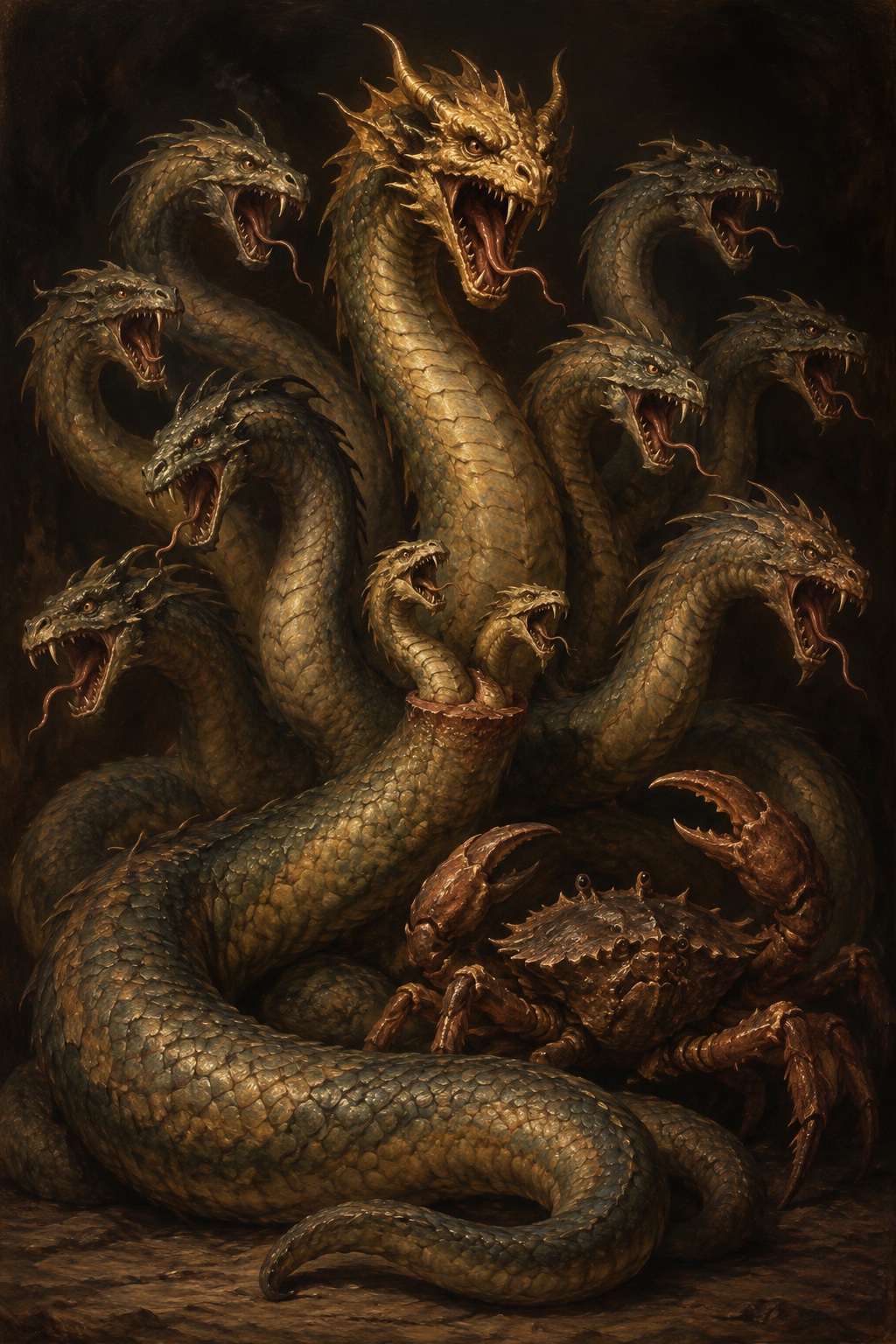
The Shanhaijing’s book of the regions beyond the northern sea does not introduce him as a god or as a man. Its neighbours on that page get formulas — there is a god, there is a country, there is a people — and he gets a job title. 共工之臣, a subject of Gong Gong; 曰相柳氏, called Xiangliushi, with the clan suffix 氏 the Liezi puts on Gong Gong’s own name. Everything the notice says about him afterwards is either an appetite or an injury.
共工之臣曰相柳氏,九首,以食于九山。相柳之所抵,厥為澤谿。禹殺相柳,其血腥,不可以樹五穀種。禹厥之,三仞三沮,乃以為眾帝之臺
“Gong Gong had a minister called Xiangliushi. He had nine heads, and with them he fed off nine mountains. Wherever Xiangliu butted the ground, the place became marsh and gully. Yu killed Xiangliu; his blood stank, and the five grains could not be sown in it. Yu dug the place out, and three times he filled it in and three times it sank, and so he made of it the terrace of the assembled emperors.” — Shanhaijing, “Classic of Regions Beyond the Seas: North”; tr. Mythos Atlas
Nine heads, nine mountains. The notice sets the two numbers side by side and never says how they divide, and 以食于九山 is the only thing in it he does for his own sake: he eats. The other verb is 抵, to butt or drive against. 相柳之所抵,厥為澤谿 — the place he butts becomes marsh and gully. That is not a flood in the ordinary sense and it is not a weapon either. It is a body heavy enough that the ground gives under it, recorded as a habit rather than as an event.
Then Yu, and four clauses that are all aftermath. The blood stinks and the five grains will not take in it. Yu digs the place out. 三仞三沮 — three times he fills it in, three times it sinks. What finally stands there is not a field but a terrace, 眾帝之臺, raised by the assembled emperors on ground that would not be farmed. He is killed halfway through his own notice, and the rest of it is about the land.
Nine heads with human faces
A dozen characters further on, after the usual note about which country lies east of which, the chapter turns back and describes him, in the flat inventory voice it uses for everything else in the north.
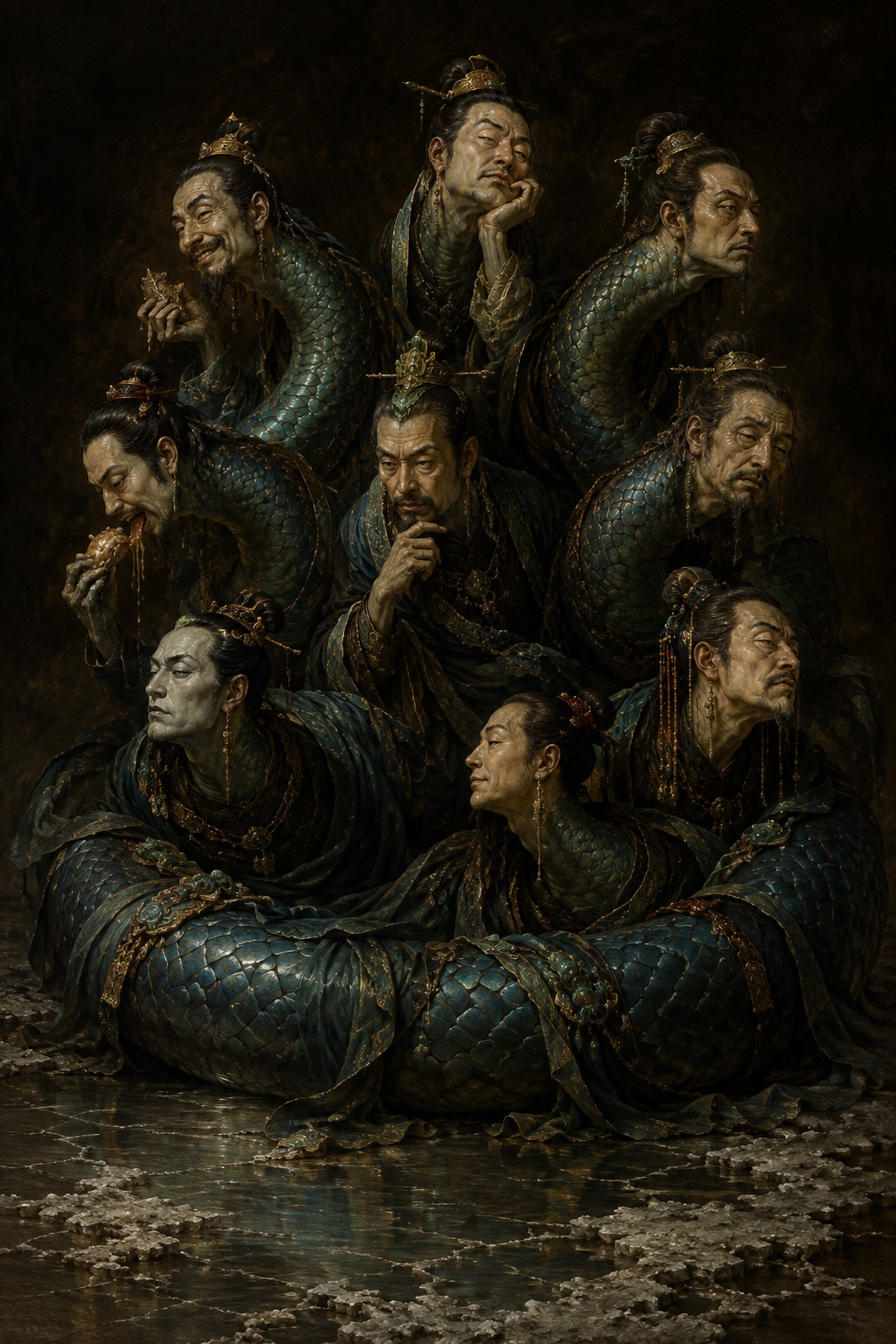
相柳者,九首人面,蛇身而青。不敢北射,畏共工之臺
“As for Xiangliu: nine heads with human faces, and a snake’s body, and blue-green. None dare shoot to the north, for fear of Gong Gong’s terrace.” — Shanhaijing, “Classic of Regions Beyond the Seas: North”; tr. Mythos Atlas
九首人面 gives him faces and stops. There is no torso in the sentence and no arms, and this atlas adds none: what is attested is a snake’s body with human faces above it and nothing in between. 蛇身而青 then puts a single colour word on the whole animal, and 青 is the classical term that covers blue and green together without choosing between them. The same chapter uses it a little further east for the snake Kuafu’s country holds in its right hand. Nothing here narrows it, so this entry leaves it as wide as the text does.
The last clause is the odd one, because it is not about him at all. 不敢北射,畏共工之臺 — none dare shoot to the north, in fear of Gong Gong’s terrace. The description of the dead minister ends by naming a monument to his master, and the dread on the page belongs to the terrace rather than to the nine heads. Even his own notice keeps him a subordinate.
The same episode, under another name
In the book of the great wilderness of the north the whole thing happens again, in the same order, with the same ending — and the name is different.
共工臣名曰相繇,九首蛇身,自環,食于九土。其所歍所尼,即為源澤,不辛乃苦,百獸莫能處。禹湮洪水,殺相繇,其血腥臭,不可生榖;其地多水,不可居也。禹湮之,三仞三沮,乃以為池,羣帝因是以為臺
“Gong Gong had a minister named Xiangyao. He had nine heads on a snake’s body, coiled back upon himself, and he fed off nine lands. Wherever he spat and wherever he settled became spring and marsh; the water was not acrid but bitter, and no beast could live there. Yu dammed the flood and killed Xiangyao; his blood stank and no grain would grow, and the ground held so much water that it could not be lived on. Yu filled it in, and three times he filled it and three times it sank, and so he made of it a pool, and on account of this the assembled emperors made a terrace.” — Shanhaijing, “Great Wilderness: North”; tr. Mythos Atlas
Neither chapter mentions the other. They simply run in step: a minister of Gong Gong, nine heads on a snake, a feeding counted in nines, ruined water where he has been, Yu killing him, blood that will not grow grain, ground that sinks three times, and a terrace at the end. The differences are small and real. 九土, nine lands, for 九山, nine mountains. 自環, coiled back on himself, which the seaward chapter never says and which is the single most drawable thing anyone records about him. 其所歍所尼, where he spits and where he settles, for the blunt 所抵. And here the water gets described rather than merely made: 不辛乃苦,百獸莫能處, not acrid but bitter, and no beast can live in it.
The killing is put differently too. 海外北經 has four characters, 禹殺相柳, Yu killed Xiangliu. 大荒北經 folds the damming and the killing into one breath, 禹湮洪水,殺相繇. Neither names a weapon, and neither gives Yu an opponent who fights back.
What the ground remembers
Both chapters end on the same four characters and then part by one word. 三仞三沮: three times the ground is filled and three times it collapses. 海外北經 makes the finished thing 眾帝之臺, the terrace of the assembled emperors; 大荒北經 makes a pool of it first, 乃以為池, and only then the terrace, 羣帝因是以為臺 — on account of this the emperors made a terrace. Either way the closing sentence of the episode is about building, and neither chapter calls the building a memorial to him. It is what goes up when the ground will not hold anything else.
What the two notices refuse to give him is nearly everything a figure here usually has. No parents and no children: the genealogy the Shanhaijing gives Gong Gong elsewhere names Shuqi and Houtu and does not name him. No country, no mountain, no rite. Not even a fight, since 禹殺相柳 has no duel in it. What he has instead is a consequence — nine mountains eaten, marsh where he lay, water turned bitter, blood the fields could not take back — and two chapters that could not agree what to call him while they wrote it down.