The race with the sun
The Classic of Mountains and Seas spends one sentence on him in 海外北經, the book of the regions beyond the northern sea. There is no build-up, no adversary, and no reason given for why he starts running.
夸父與日逐走,入日。渴,欲得飲,飲於河、渭,河、渭不足,北飲大澤。未至,道渴而死。棄其杖,化為鄧林
“Kuafu raced with the sun, and entered the sun. He was thirsty and wanted a drink, and drank at the He and the Wei; the He and the Wei were not enough, and he went north to drink the Great Marsh. Before he arrived he died of thirst on the road. He cast away his staff, and it became the Deng forest.” — Shanhaijing, “Classic of Regions Beyond the Seas: North”; tr. Mythos Atlas
入日 is two characters and the hardest thing in the passage: he does not merely chase the sun, he goes into it. Whatever that is meant to describe, it happens before the thirst does — the running is finished, and by any ordinary reading the race has been won, at the exact point where the story turns against him. The rivers are the two largest in the north. 河, which classical Chinese calls simply the He, is the Yellow River; 渭 is the Wei, its great western tributary. He empties both and is still thirsty.
Then the sentence kills him with an errand. He is not struck down, tricked, hunted or punished. He turns north for a lake, and 道渴而死 — he dies of thirst on the road, which is how an ordinary traveller dies, a long way from anything worth calling a battlefield. The final clause is not about him at all: it is about what he dropped.
A man, not a god
大荒北經, the book of the great wilderness, tells the same pursuit again, and this time it gives him a body, two generations of ancestry, and a killer.
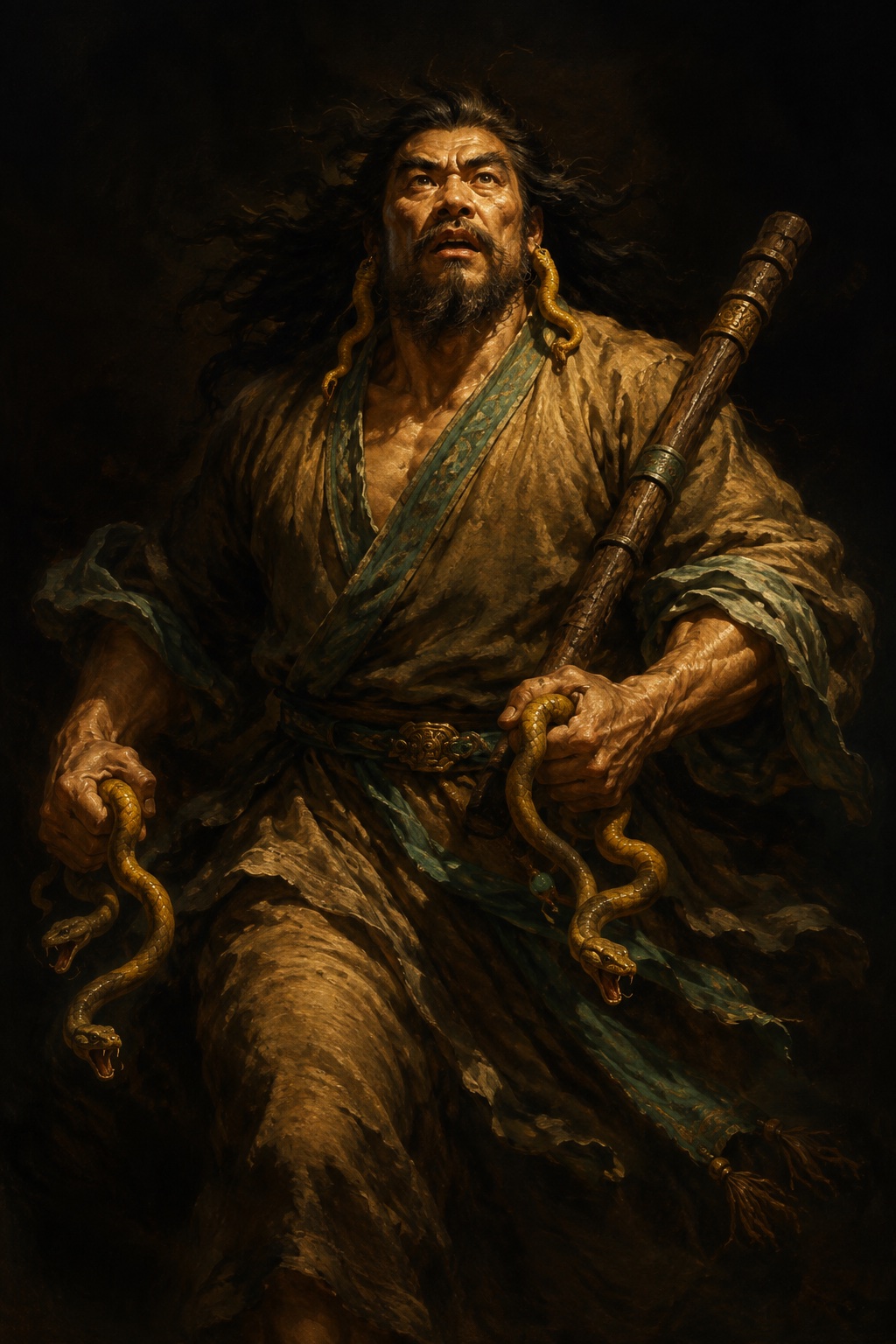
有人珥兩黄蛇,把兩黄蛇,名曰夸父。后土生信,信生夸父。夸父不量力,欲追日景,逮之于禺谷。將飲河而不足也,將走大澤,未至,死于此。應龍已殺蚩尤,又殺夸父
“There is a man who wears two yellow snakes at his ears and grips two yellow snakes in his hands; his name is Kuafu. Houtu begat Xin, and Xin begat Kuafu. Kuafu did not measure his strength: he wished to pursue the light of the sun, and overtook it at Yugu. He was about to drink the He, and it was not enough; he was about to make for the Great Marsh, but before he arrived he died there. The Responding Dragon had already killed Chiyou, and killed Kuafu too.” — Shanhaijing, “Great Wilderness: North”; tr. Mythos Atlas
有人 — there is a man. The distinction is deliberate and the page keeps it: the same chapter hands out 有神, there is a god, to the bird-bodied Yuqiang, to the nine-headed Jiufeng and to the tiger-headed Qiangliang, and files Kuafu with the men instead. The northern book’s notice on his country adds only that its people are large. That single word is the whole warrant for the giant of every later picture, and it is also why this atlas files him as a hero rather than a monster: four snakes are an ornament, not a monstrous body, and nothing here or in the northern book has him commit a single act of disorder.
The genealogy is two links and no story: Houtu begat Xin, Xin begat Kuafu. Then comes the judgement, 夸父不量力 — he did not measure his strength — which is the compiler stepping in to say what the northern book left the reader to decide. And where the northern book has him run into the sun without saying where, this one names the place: he overtakes it at Yugu 禺谷, the valley the sun goes down into. He catches it at the end of the day, at the western edge of the world, which is the one place a runner going west could ever expect to.
Two deaths, one sentence apart
Twenty characters after he dies of thirst, something kills him.
未至,死于此 — he did not arrive, he died there. That is the same death the northern book gives him, with the same cause and the same failure to reach the same lake. The next clause, without a pause or a transition, has the Responding Dragon killing Chiyou and then killing Kuafu as well. Two accounts of one death sit side by side in a single paragraph, and nothing in the chapter tries to reconcile them.
That second clause is not new to this wiki. It is the sentence Chiyou’s entry already quotes from this chapter, where it runs on to explain the rainfall of the south: the dragon, too exhausted to climb back to heaven, settles there. Read from the dragon’s end, Kuafu is the second name on a war dragon’s list, standing beside the figure the Book of Documents calls the first maker of disorder. Read from three clauses earlier, he is a man who ran out of water.
The entry keeps both, because the corpus holds both and choosing between them would be an editorial decision dressed up as a fact. The likeliest explanation is that the Shanhaijing is a compilation and not an author: two independent notices about the same name were copied into the same paragraph, one of them belonging to the war at Zhuolu and one to a pursuit that has nothing to do with any war. What is worth noticing is which one the tradition kept. The dragon is remembered for Chiyou; Kuafu is remembered for the thirst.
The staff, and what grew from it
棄其杖,化為鄧林. He throws away the staff, and the staff becomes a forest — one clause of transformation for a death that was given none. It is the only thing he leaves behind, and it is not a monument, a cult, or a lesson. It is timber.
The northern book returns to it a few lines later, placing the Deng forest east of Kuafu’s country, and then glosses it, flatly, as two trees. Later commentary makes them peaches, and the peach grove has been repeated ever since; that identification belongs to a fourth-century commentator and appears on neither of the pages quoted here, so the atlas leaves it where it was found.
The three accounts cannot agree on how he died or where his trees came from, and they agree completely on everything else: a man goes after the sun, catches or nearly catches it, and cannot drink enough to survive the attempt. This atlas’s other Chinese sun story is Hou Yi’s, and it runs in the opposite direction — an archer stands still and shoots nine suns out of the sky, and the world is saved. Kuafu moves, and saves nothing, and the wilderness book had already delivered its verdict in the three characters 不量力 — which the Liezi, telling the story all over again, repeats word for word.