Chiyou is older than the emperor who kills him, and he is introduced not as a villain in a story but as a cause in an argument. The Shangshu, the Book of Documents, is the oldest of the Chinese classics; its chapter on criminal punishment opens by explaining where wrongdoing came from:
蚩尤惟始作亂,延及于平民,罔不寇賊,鴟義,奸宄,奪攘,矯虔。
“According to the teachings of ancient times, Chi You was the first to produce disorder, which spread among the quiet, orderly people, till all became robbers and murderers, owl-like and yet self-complacent in their conduct, traitors and villains, snatching and filching, dissemblers and oppressors.” — Shangshu, “Marquis of Lu on Punishments”, tr. James Legge
Follow the logic of the chapter it opens and you get the reason he matters. Because Chiyou made disorder, punishment had to be invented; the five mutilating punishments are described a few lines later. The law is downstream of him. He is not merely an enemy of the register — he is the reason there is a register.
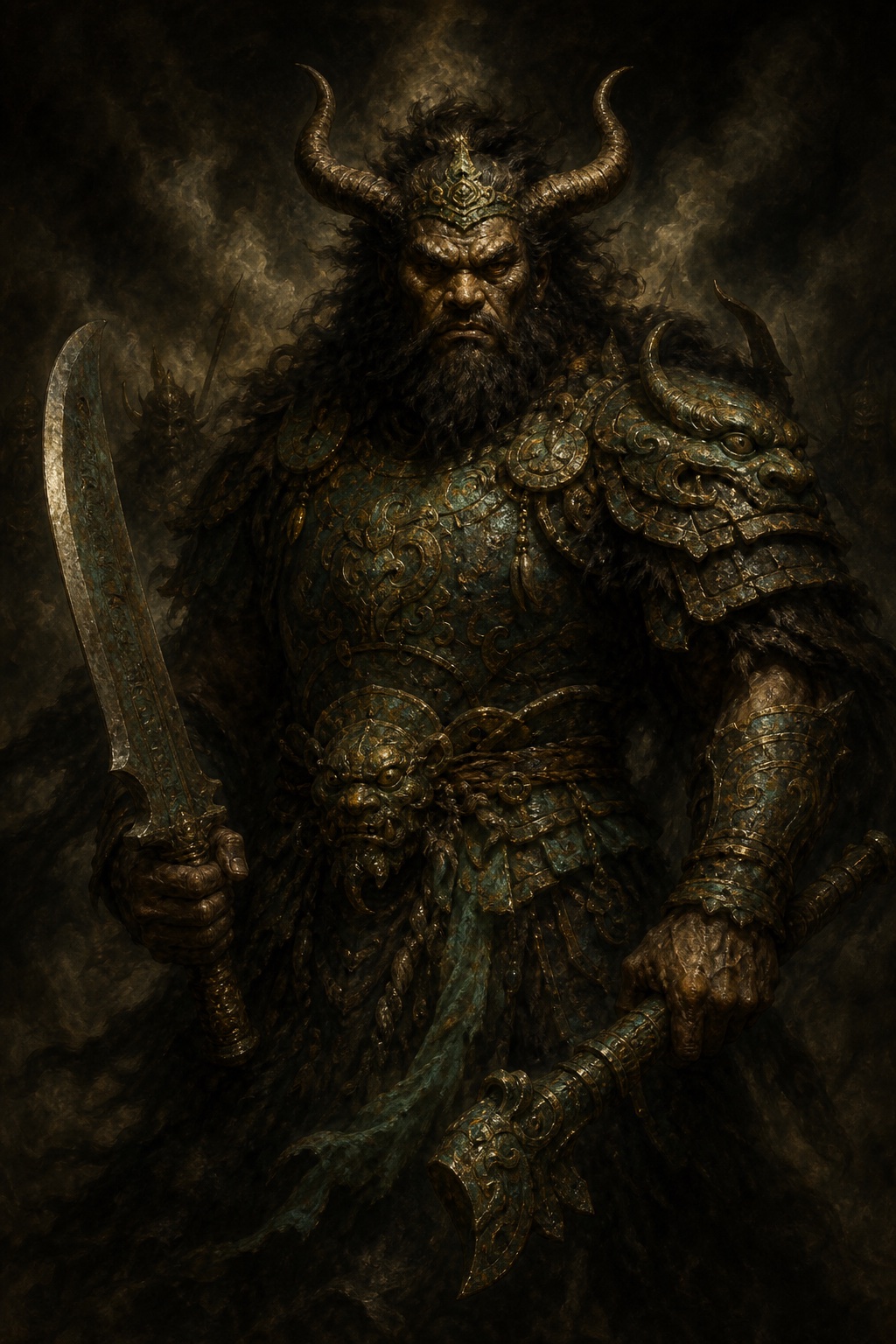
The Shiji gives the battle, drained of the marvellous: 蚩尤作亂,不用帝命 — “Chiyou made disorder and would not obey the sovereign’s command” — followed by a levy of troops and a field at Zhuolu. Sima Qian reports it the way he would report a Han punitive expedition, and that flatness is the point. The material he left out is loud everywhere else: eighty-one brothers with beasts’ bodies, bronze heads and iron brows, eating sand and stones; the invention of metal weapons; a fog so thick that armies lose each other inside it, dispelled only by the south-pointing chariot that holds its bearing through the murk.
The Shanhaijing keeps a much stranger record of the same war, in which the Yellow Emperor does not do his own killing:
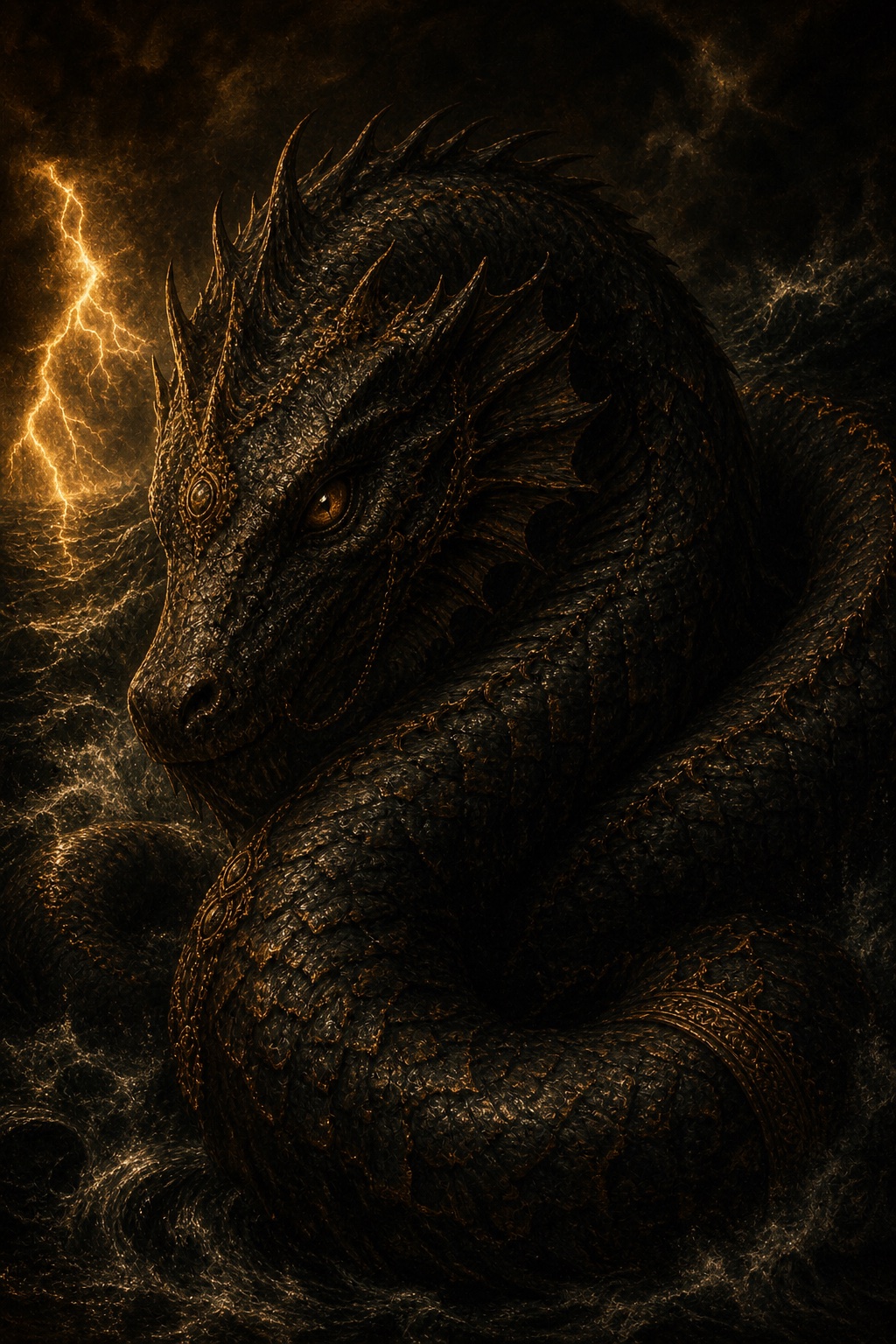
應龍已殺蚩尤,又殺夸父,乃去南方處之,故南方多雨。
“The Responding Dragon, having killed Chiyou, killed Kuafu too, and then went away to dwell in the south. That is why the south has so much rain.” — Shanhaijing, “Great Wilderness: North”; tr. Mythos Atlas
An aetiology of regional rainfall, hung on the exhaustion of a war dragon who could no longer get back up to heaven. The same campaign that the Shiji files as a transfer of the mandate is here a weather report.
His afterlife is stranger still. A figure introduced to justify the Yellow Emperor’s mandate was later worshipped as a god of war by the emperors themselves — the founder of the Han sacrificed to him before campaigning, which is to say the state made offerings to the personification of rebellion for help in putting rebellion down. And in the present day he is claimed as an ancestor by the Hmong and by the Miao of southern China: the descendants, in that telling, of the losing side at Zhuolu. The same story does duty as a charter for order and as a memory of the people it was imposed on.