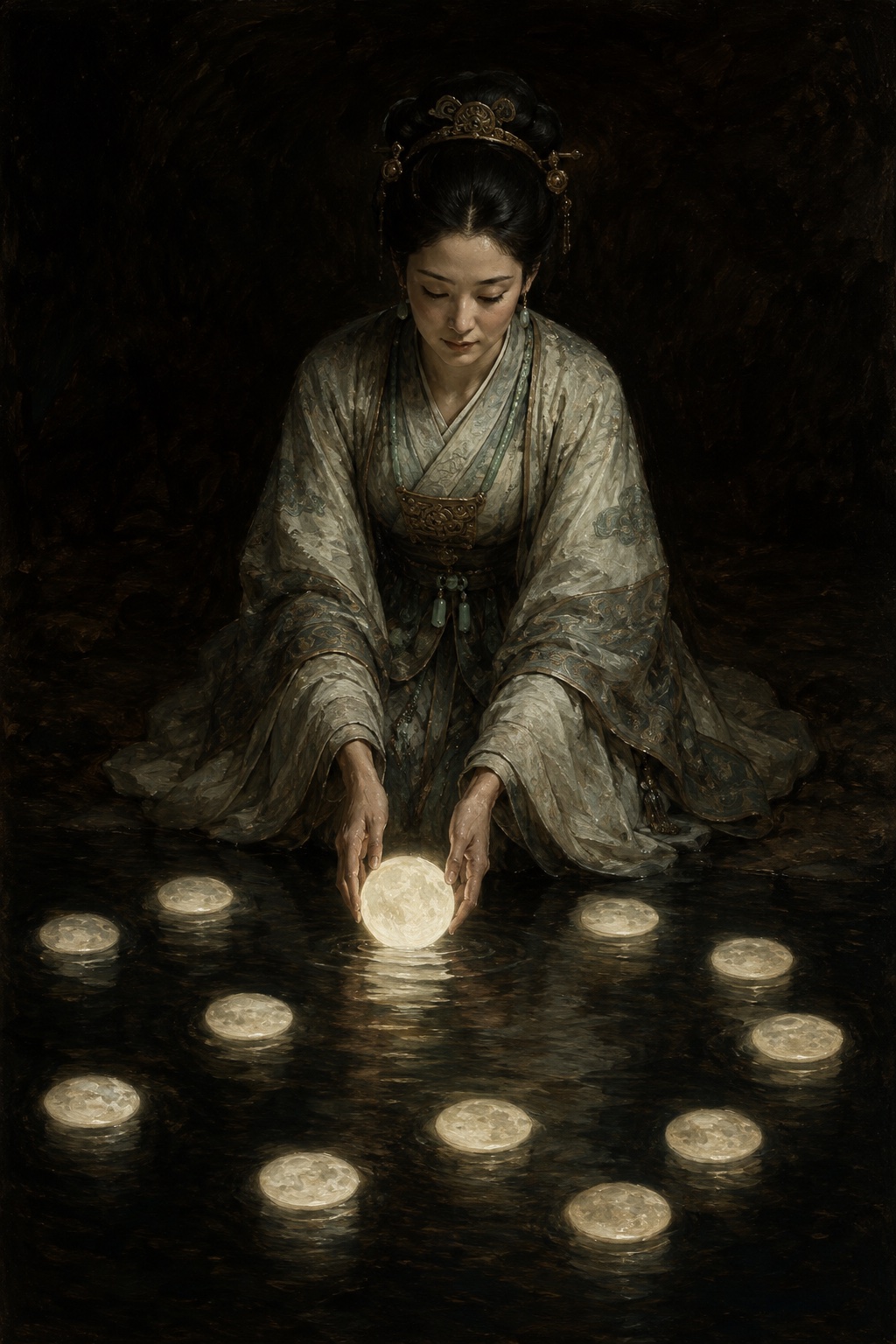
有女子方浴月 — a woman bathing the moon
The Shanhaijing gives her one sentence. It sits in the middle of the “Classic of the Great Wilderness: West”, between a man with reversed arms and a mountain of five-coloured birds, in the stretch of the book that catalogues the places where the sun and moon go down.
有女子方浴月。帝俊妻常羲,生月十有二,此始浴之
“There is a woman bathing the moon. Changxi, the wife of Dijun, bore twelve moons, and this is their first washing.” — Shanhaijing, “Classic of the Great Wilderness: West”; tr. Mythos Atlas
Twenty characters, and three of the four things this entry can say are in them. She is 帝俊妻, Dijun’s wife. She bore the moons, and there are twelve of them, one for each month of the year. And the moment the text chooses to record is not the bearing but the washing — 此始浴之, this is the first time they are washed, which makes what she is doing an act of care rather than of creation. The moons already exist. She is cleaning them.
The grammar puts the picture before the name, too. 有女子方浴月 — there is a woman, presently bathing the moon — is what the traveller sees; 帝俊妻常羲 is the gloss that follows, explaining who the woman turned out to be. The Shanhaijing is a gazetteer before it is a mythology, and this is how it reports a goddess: as a thing you would come across.
The matched pair
Her entry cannot be written without Xihe’s, because the book wrote them as a pair and put them at opposite ends of the world.
東南海之外,甘水之間,有羲和之國。有女子名曰羲和,方浴日於甘淵。羲和者,帝俊之妻,生十日
“Beyond the south-east sea, between the waters of Gan, there is the country of Xihe. There is a woman there named Xihe, and she is bathing the suns in the Gan Abyss. Xihe is the wife of Dijun, and she bore the ten suns.” — Shanhaijing, “Classic of the Great Wilderness: South”; tr. Mythos Atlas
Put the two beside each other and the correspondence is exact down to the clause order: a woman at water, the act in progress, then 帝俊之妻 and the number she bore. Ten suns in the south-east for the ten days of the old week; twelve moons in the west for the twelve months. Between them the two sentences account for the entire visible sky and the entire calendar, and they do it by describing two women doing laundry.
What neither sentence contains is Dijun himself. He is named twice and does nothing in either — his own entry notes that he fathers none of that light in any line the book gives him, and that he is the fixed point his wives are defined against. The suns and moons are theirs. Hou Yi’s entry tells what happens when the ten suns come out at once and someone has to shoot nine of them down; the twelve moons have no such story, and the Shanhaijing leaves Changxi’s children exactly where it found them, in the water, being washed.
尚儀作占月 — the same pairing, four centuries later
The pairing survives outside the Shanhaijing, in a text with no interest in either goddess. The Lüshi Chunqiu, compiled in the third century BC, has a chapter arguing that a ruler should not do his officials’ jobs, and it opens with a roll of the twenty inventors who between them made civilisation.
大橈作甲子,黔如作虜首,容成作厤,羲和作占日,尚儀作占月
“Danao made the sexagenary cycle, Qianru made the captives’ tally, Rongcheng made the calendar, Xihe made the divination of the sun, Shangyi made the divination of the moon.” — Lüshi Chunqiu, “Wu gong”; tr. Mythos Atlas
Three names in a row do the calendar: Rongcheng the reckoning itself, then 羲和 for the sun and 尚儀 for the moon, in adjacent clauses of four characters each. The parallelism is the same one the Shanhaijing draws, transposed from washing to divining and from a wilderness gazetteer into a list of ministers.
The name, however, is 尚儀 and not 常羲. Later commentators treat the two as the same figure under a variant writing, and the argument is not a weak one — the pairing with 羲和 is exact, the domain is the moon in both, and Chinese texts of this period are notoriously loose with homophonous graphs. But neither of these two passages says so, and this atlas does not assert what its sources do not. What can be said is what is on the page: two independent traditions, several centuries apart, both put a woman of the moon immediately beside 羲和 of the sun, and neither has a use for her apart from that symmetry.
Not the moon goddess you were expecting
Chang’e is the goddess Chinese tradition means when it says the moon — the woman who swallowed the elixir, rose, and stayed. She and Changxi are not the same figure, they are not written the same way, and this corpus has never equated them; nothing in Chang’e’s story involves Dijun, twelve moons, or a pool, and nothing in Changxi’s involves an elixir, a flight, or a hare.
They divide the moon between them along a line worth naming. Chang’e’s moon is a place — somewhere to go, somewhere to be stranded, and every telling of her story is about the distance between there and here. Changxi’s moons are objects: twelve of them, hers, produced and then maintained, and the only thing anyone ever sees her do is take care of them. One goddess lives on the moon. The other made the months, and washes them.