The oldest surviving version of Chang’e’s story is fifteen characters long, and it is not even about her. The Huainanzi is making a philosophical point about borrowed things running out, and reaches for her as an illustration:
譬若羿請不死之藥於西王母,姮娥竊以奔月,悵然有喪,無以續之。
“It is like this: Yi begged the drug of no-dying from the Queen Mother of the West, and Heng E stole it and fled with it to the moon. Disconsolate, he was bereft, with no way to get more.” — Huainanzi, “Lanming”; tr. Mythos Atlas
Two things in that sentence are easy to miss. The first is her name: 姮娥, Heng E. She becomes Chang’e later, when the character 姮 collides with the personal name of the Han emperor Wen and has to be avoided. The second is whose story it is. The grief in the line belongs to Yi — 悵然有喪, bereft and with no way to get more — and Chang’e appears only as the thing that happened to his elixir. The Han’s most famous escape is first recorded as somebody else’s loss.
Three centuries later the astronomer Zhang Heng tells it again, and adds two details that change its temperature completely:
羿請無死之藥於西王母,姮娥竊之以奔月。將往,枚筮之於有黃,有黃占之曰:「吉。翩翩歸妹,獨將西行,逢天晦芒,毋驚毋恐,後其大昌。」姮娥遂託身于月,是爲蟾蠩。
“Yi begged the drug of no-dying from the Queen Mother of the West, and Heng E stole it and fled with it to the moon. Before setting out she had it divined by Youhuang, who cast the stalks and pronounced: ‘Auspicious. The fluttering Marrying Maiden, going west alone; she will meet the darkening of heaven — do not be startled, do not be afraid; afterwards she will greatly flourish.’ So Heng E entrusted her body to the moon, and became the toad.” — Zhang Heng, Lingxian; tr. Mythos Atlas
She consults an oracle first. This is not an impulse and not quite a theft of opportunity — she asks whether to go, is told the omen is good, and goes anyway into the darkening of heaven having been warned there would be one. The oracle even names a hexagram, 歸妹, the Marrying Maiden, which in the Book of Changes is the sign of a woman leaving her house for another.
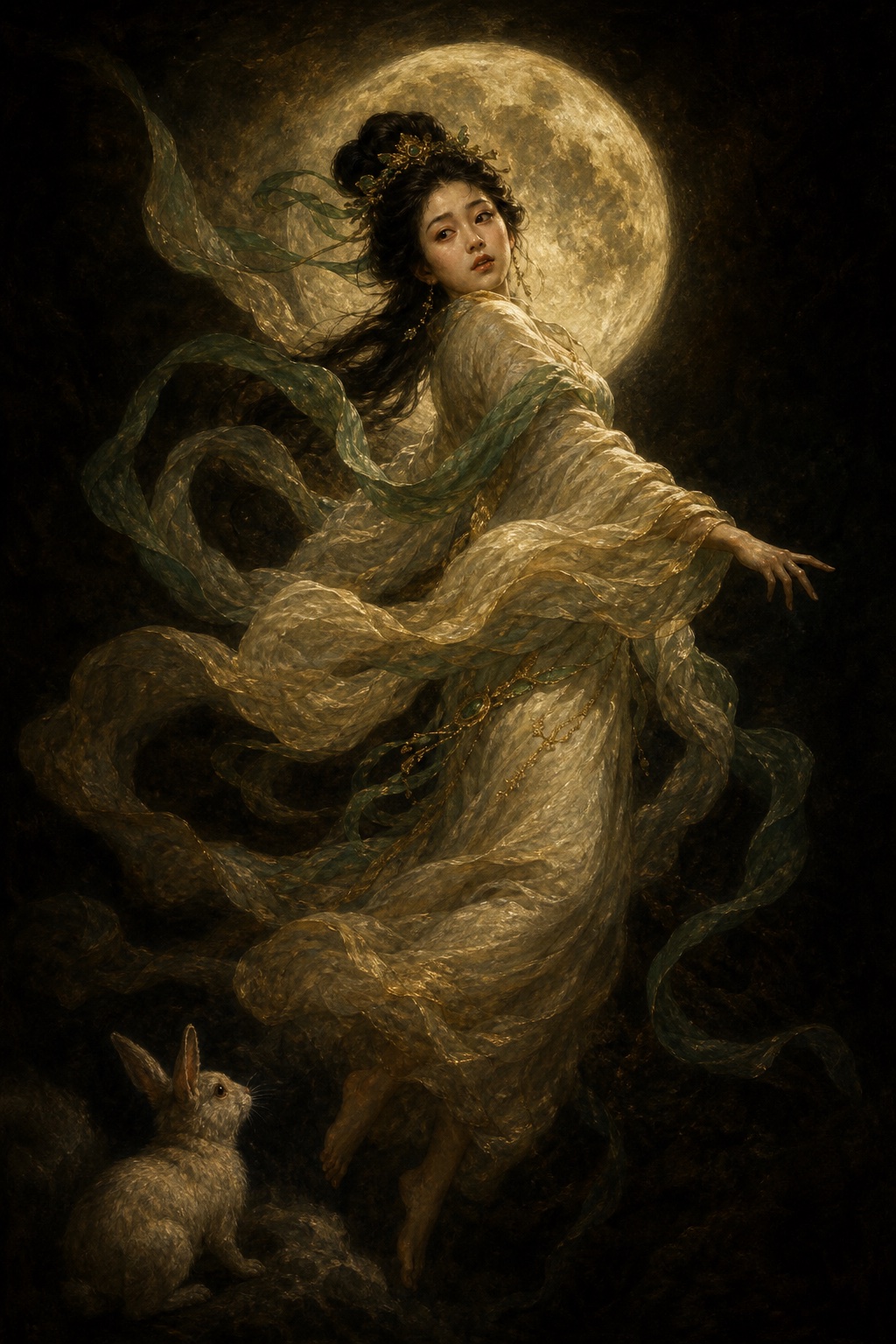
And then the landing: 是爲蟾蠩 — she became the toad. Not a goddess in a lunar palace but the squat shape the Han saw in the moon’s markings, which appears on Han funerary banners and bronze mirrors long before anyone drew a beautiful woman up there. The jade rabbit pounding the elixir, the cassia tree, the cold palace of Guanghan, the pity — all of that accretes afterwards, softening a punishment into an exile and an exile into a romance.
Why she did it is left open, and the tradition has never closed it: thief in some versions, in others a wife keeping the drug from a student who came to steal it, in others simply curious. It does not need settling. What the Mid-Autumn Festival remembers, when families eat mooncakes and look up, is not the verdict but the distance. She got the one thing this entire pantheon is chasing, and it cost her everyone she knew — and in the oldest telling of all, it cost her her shape.