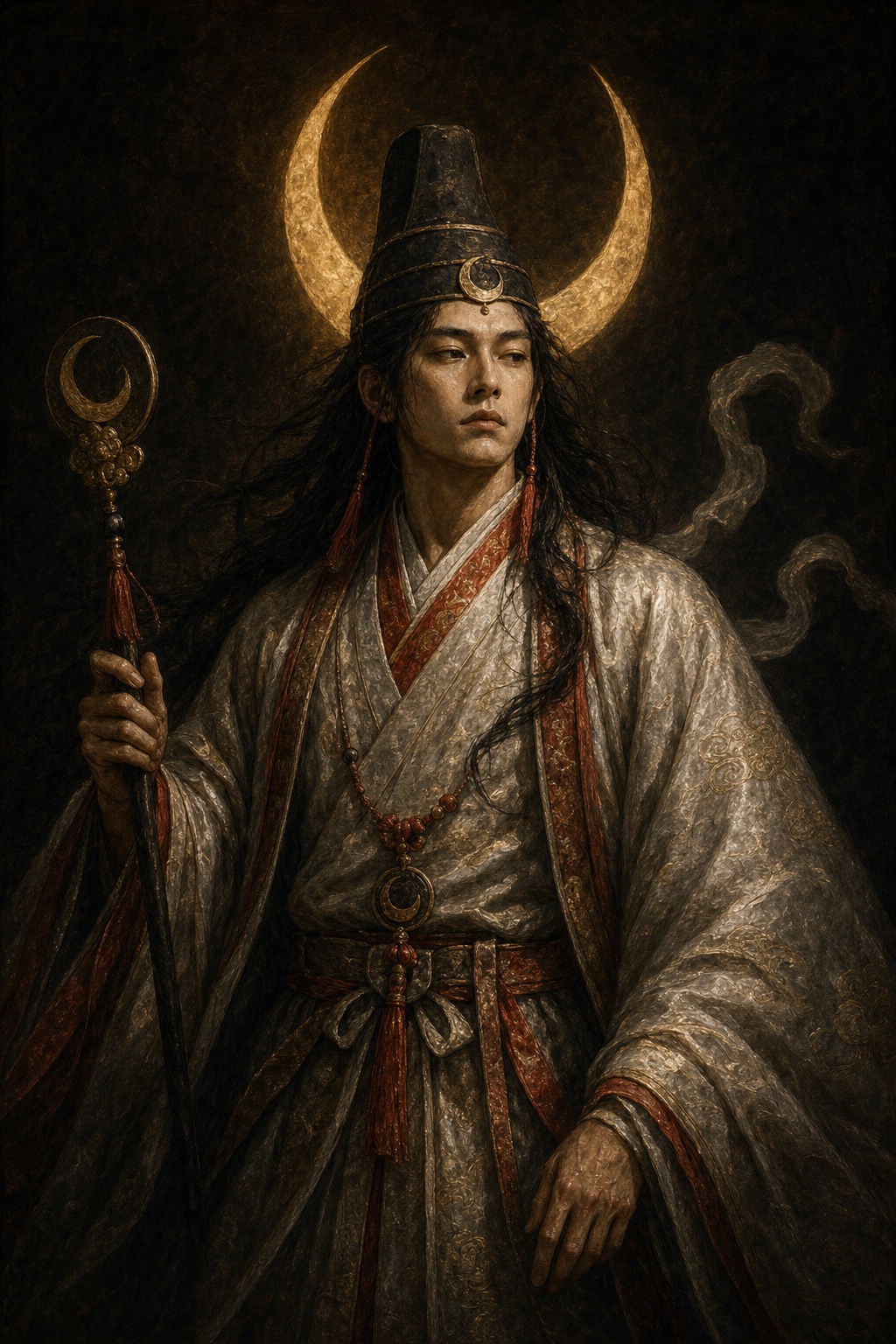
Tsukuyomi-no-Mikoto, the Moon-Night-Possessor, is born when Izanagi washes his right eye during the purification after fleeing Yomi, the land of the dead. Alongside his sister Amaterasu and brother Susanoo, he is counted among the three most precious children born of that rite, and Izanagi sets him to rule the night as Amaterasu rules the day. Despite this cosmic rank, strikingly little myth survives about him; he is the quietest of the three noble children, with almost no independent story in the Kojiki.
The one substantial episode attached to him, told in the Nihon Shoki, explains why sun and moon never share the sky. Sent by Amaterasu to attend the food goddess Uke Mochi, Tsukuyomi watches her produce a banquet by disgorging rice, fish, and game from her mouth. Disgusted at being served food he considers polluted, he draws his sword and kills her:
是時月夜見尊忿然作色曰:「穢哉,鄙矣!寧可以口吐之物敢養我乎?!」廼拔劒撃殺。然後復命,具言其事
“Tsuki-yomi no Mikoto became flushed with anger, and said:—‘Filthy! Nasty! That thou shouldst dare to feed me with things disgorged from thy mouth.’ So he drew his sword and slew her, and then returned and made his report, relating all the circumstances.” — Nihon Shoki, Book I; English tr. W. G. Aston, Nihongi (1896)
Amaterasu, horrified, refuses ever to look on him again, and the two separate — the mythic origin of day and night existing apart. The Kojiki tells a similar tale of a slain food deity, Ogetsu-hime, but assigns that killing to Susanoo instead. Tsukuyomi is venerated at a small number of shrines today, including Tsukiyomi-no-miya, a subsidiary shrine of Ise.