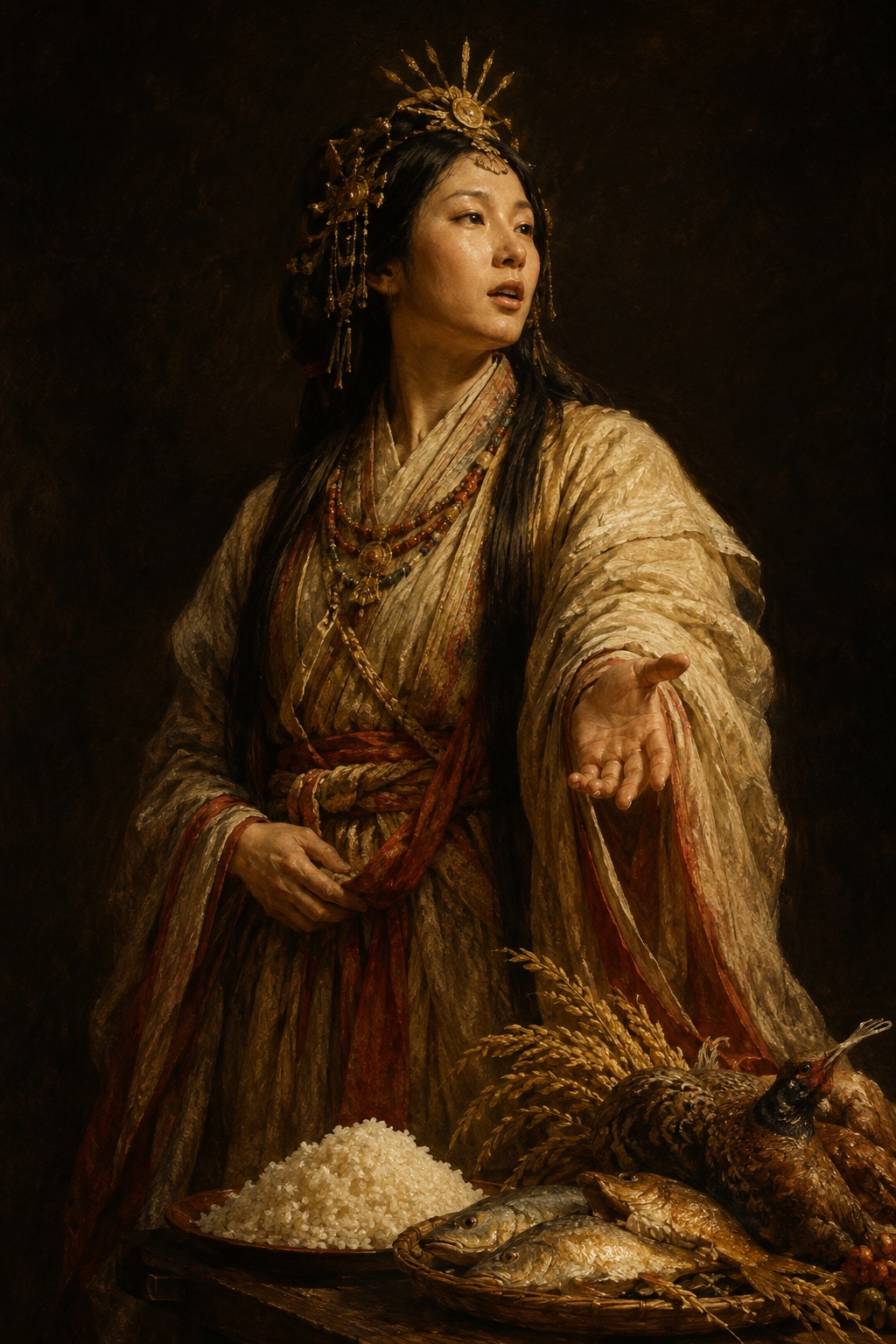
The feast from her mouth
Uke Mochi 保食神 is the food deity of 葦原中國, the central land of reed-plains, and the Nihon Shoki brings her on stage only to be visited. Izanagi has just charged his three noble children with their realms; Amaterasu, hearing from Heaven that there is a food deity in the land below, sends her brother Tsukuyomi down to wait upon her. Uke Mochi receives him by turning her head.
保食神乃廻首嚮國,則自口出飯。又嚮海則鰭廣鰭狹亦自口出
“Thereupon Uke-mochi no Kami turned her head towards the land, and forthwith from her mouth there came boiled rice: she faced the sea, and again there came from her mouth things broad of fin and things narrow of fin…” — Nihon Shoki, Book I; English tr. W. G. Aston, Nihongi (1896)
The sentence runs on past the quotation. She faces the mountains as well, and game rough of hair and soft of hair comes out of her the same way, until every kind of thing is ready and set out on 百机, a hundred tables, for her guest. That is the whole of what the chronicle shows her doing alive: no weapon, no trick, no demand, only the food and the tables.
Tsukuyomi sees a meal that has come out of a mouth and takes it for filth. He draws his sword, kills her where she stands, and returns to Heaven to report what he has done — his words and the blow are quoted on his own page. Amaterasu’s fury at him is what drives the sun and the moon apart for good. From Uke Mochi’s side there is nothing to record except that she gave a guest everything she had and was killed for the way she produced it.
The crops born from her body
Amaterasu refuses ever to look at her brother again and sends a second messenger, Ame-kuma-bito, to see what has become of the goddess. What he finds is the passage the entry turns on.
是時,保食神實已死矣,唯有其神之頂,化爲牛馬,顱上生粟,眉上生繭一作「蚕」 ,眼中生稗,腹中生稻,陰生麥及大豆小豆
“At this time Uke-mochi no Kami was truly dead already. But on the crown of her head there had been produced the ox and the horse; on the top of her forehead there had been produced millet; over her eyebrows there had been produced the silkworm; within her eyes there had been produced panic; in her belly there had been produced rice; in her genitals there had been produced wheat, large beans and small beans.” — Nihon Shoki, Book I; English tr. W. G. Aston, Nihongi (1896)
The chronicle fixes each thing to a part of her and names every crop separately rather than summing them up: the ox and horse at the crown of the head, millet at the forehead, the silkworm over the eyebrows, panic in the eyes, rice in the belly, wheat and the large and small beans in the genitals. The small aside 一作「蚕」 sitting inside the line is the compiler’s own note that another text writes the silkworm with a different character.
Ame-kuma-bito carries all of it up to Amaterasu, who rejoices and says that these are the things by which the race of visible men will eat and live. She makes the millet, the panic, the wheat and the beans the seed of the dry fields and the rice the seed of the water-fields, appoints an overseer of Heaven, and sows the first rice in the narrow and the long fields of Heaven; that autumn the ears hang down eight span long. Then she takes the silkworms into her own mouth and succeeds in reeling thread from them, and the art of rearing silkworms begins there. Every one of those gifts is Amaterasu’s to hand out because Uke Mochi’s body made it first — in this telling, farming and silk both start inside a dead goddess.
One writing among several
The episode is not the chronicle’s main narrative. It sits inside a block introduced by the formula 一書曰, which Aston renders “In one writing it is said” — Book I collects alternative accounts of the age of the gods and prints them beside one another, and Uke Mochi belongs entirely to one of them. Every occurrence of her name in the book falls inside that single block. Outside it she has no story, and inside it she has no genealogy: no father, no mother, no consort, no child. She is simply the deity who is there when the messenger arrives.
The same book also names 倉稻魂命, the granary-spirit deity, as a separate being, born when Izanagi was hungry. The chronicle that tells Uke Mochi’s story therefore keeps the two apart, whatever later tradition made of the food deities. Aston does record one thing about her cult, in a note to this passage: he counts her and Amaterasu as the two principal deities worshipped at Ise.
The Kojiki tells it of another goddess
The Kojiki carries a killing that looks like hers and is not. There the slain food deity is Ogetsu-hime — whom that text spells 大氣津比賣, 大氣都比賣 and 大宜津比賣 within sixty characters — the killer is Susanoo rather than Tsukuyomi, and the deity who takes up what her body makes is Kamimusubi rather than Amaterasu. The manner differs too: the Nihon Shoki has the food come from Uke Mochi’s mouth alone as she turns her head to land, sea and mountain, while the Kojiki has it come 自鼻、口及尻, from the nose and the mouth and the backside.
The harvest differs most of all, and that is the proof that these are two tellings of a shared motif rather than one story recorded twice. In the Kojiki the silkworm comes from the head, the rice-seed from the two eyes, millet from the ears, small beans from the nose, wheat from the genitals and large beans from the backside. There is no ox, no horse and no panic anywhere in it, and of the seven things Uke Mochi’s body produces only the wheat is born from the same place in both books.
The merger is easy to make, and Aston himself makes it: a note to this very passage says that the Kojiki has Susanoo slay Uke Mochi under a variant of her name. The Kojiki text does not support that. It writes 大氣都比賣 there, and it never once writes 保食神.