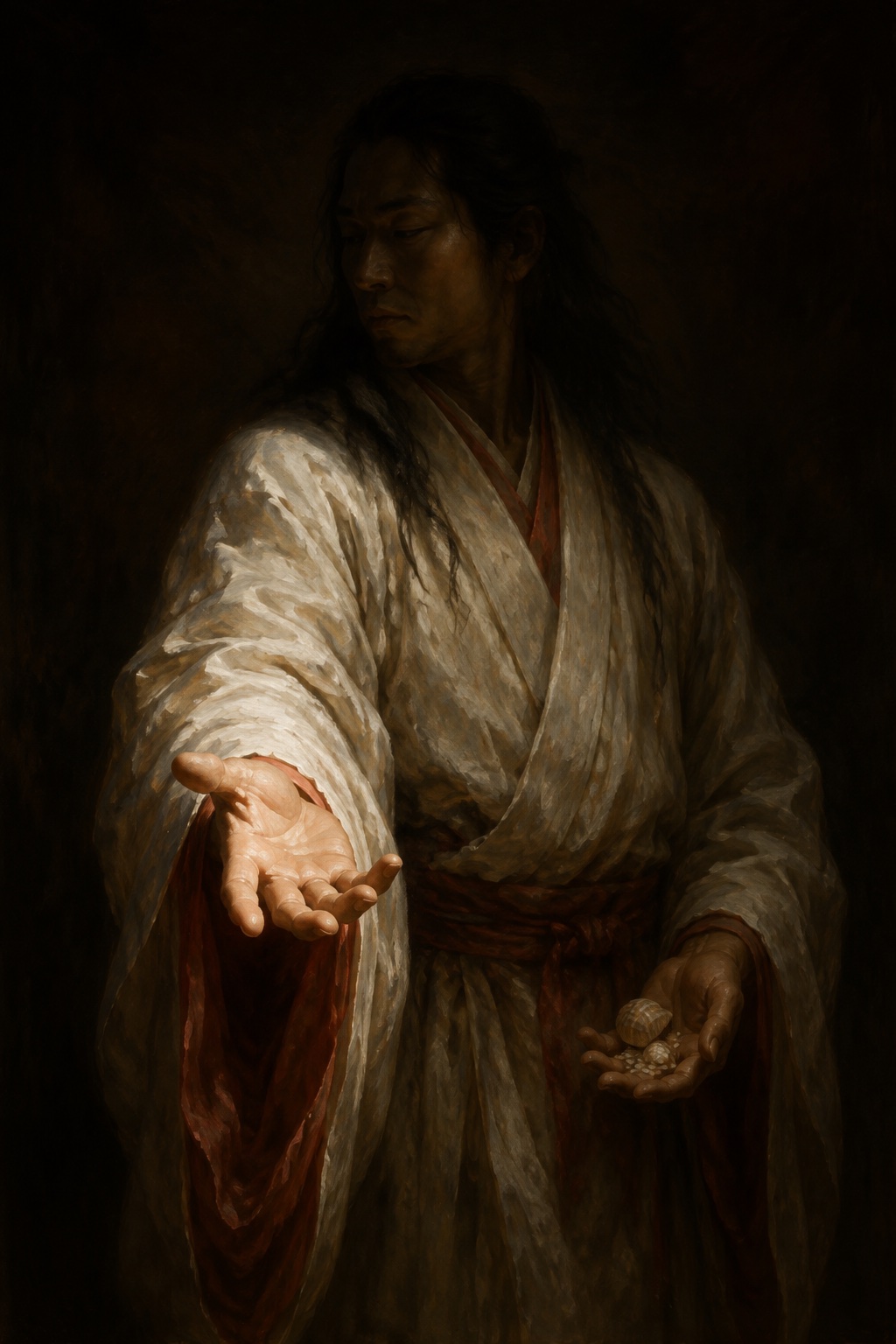
The third name in the book
The Kojiki opens with a list, and Kamimusubi is the third item on it. Nothing has happened yet — no land, no sea, no pair of deities to make either — and the chronicle spends its first sentence naming three deities who come into being in the Plain of High Heaven, then reports in the same breath that they are gone.
天地初發之時,於高天原成神名,天之御中主神。〈訓高下天云阿麻。下效此〉次高御産一作「座」巢日神,次神産巢日神。此三柱神者,並獨神成坐而隱身也
“…when the Heaven and Earth began were the Deity Master-of-the-August-Centre-of-Heaven, next the High-August-Producing-Wondrous Deity, next the Divine-Producing-Wondrous-Deity. These three Deities were all Deities born alone, and hid their persons.” — Kojiki, Sect. I, tr. Basil Hall Chamberlain (1882)
Two phrases in that line decide most of what this entry is allowed to say. 獨神成坐 — they came into being alone, single deities, without the male-and-female pairing the Kojiki gives to nearly everything after them; the generations that follow arrive two by two, brother and sister, down to Izanagi and Izanami. And 隱身, they hid their persons. The chronicle does not kill them, exile them or seat them anywhere. It records that they withdrew from sight and then carries on without them, and the two deities named immediately afterwards get the same clause again, almost word for word.
That is why this page has no siblings, no consort and no birth. Ame-no-minakanushi and Takamimusubi stand in the same sentence, but the sentence’s own word for the three of them is 獨神, and making them brothers would contradict the line quoted above. The two annotations inside the passage belong to the source page rather than to the myth: 〈訓高下天云阿麻。下效此〉 instructs that the 天 after 高 be read ama and that the same hold below, and 一作「座」 records that another witness writes 座 for the 産 in Takamimusubi’s name.
The deity you appeal to when a god is dead
Okuninushi’s page gives the next episode half a clause. The Kojiki gives it one sentence, and that sentence is the only place in the book where Kamimusubi is asked for something and answers with an act.
Onamuji — Okuninushi before he has the greater name — has eighty brothers, and the brothers decide to kill him. They heat a boulder the size of a boar until it glows, roll it down Mount Tema, and tell him to catch it. He catches it, sticks to it, burns and dies.
尒其御祖命哭患而參上于天,請神産巢日之命時,乃遣 𧏛 一作「⿱刮虫」貝比賣与蛤貝比賣,令作活
“Thereupon Her Augustness his august parent cried and lamented, and went up to Heaven, and entreated His Divine-Producing-Wondrous-Augustness, who at once sent Princess Cockle-Shell and Princess Clam to bring him to life.” — Kojiki, Sect. XXII, tr. Basil Hall Chamberlain (1882)
Every stage of it is one clause long and none of it is elaborated. 哭患而參上于天 — the dead god’s own parent weeps, grieves and goes up to Heaven. 請神産巢日之命 — and asks. 乃遣…令作活 — thereupon the deity sends, and orders them to make him live. There is no bargaining, no condition, no delay and no reported speech: the chronicle gives Kamimusubi not one word here, only a verb. The two who are sent are 𧏛貝比賣 and 蛤貝比賣 — Kisagai-hime and Umugi-hime, the cockle-shell maiden and the clam-shell maiden, and what they then do is domestic rather than divine — one grinds and scorches her shell to powder, the other carries water, and the mixture is smeared on the burnt god like mother’s milk. He gets up a beautiful young man and walks away.
The annotation standing inside the quoted line, 一作「⿱刮虫」, is the source page’s own note that another witness writes the cockle’s name with a different graph — and the graph it offers is not a character at all. ⿱刮虫 is a recipe for one: 刮 set above 虫, a shape Unicode has no codepoint for. It is kept here for the reason Uke Mochi’s page keeps its 一作「蚕」: dropping it would cost the two goddesses their names, and their names are the act.
A note on where the quotation stops. The sentence runs on past 令作活, but the zh.wikisource text of Book I then reads 蛤貝比賣持人 — Princess Clam carried a person — where the sense and Chamberlain both require 持水, carried water. The fault is in the page’s raw wikitext rather than in this atlas’s handling of it, so the quotation is cut short of it instead of repaired.
令取茲成種 — the grain is taken, not made
Susanoo, thrown out of Heaven, asks the food deity Ogetsu-hime for something to eat. She produces it from her nose, her mouth and her backside; he takes that for filth and kills her. The Kojiki then spends one sentence on her body and one clause on Kamimusubi, and Japanese agriculture begins in the second of them.
故所殺神於身生物者:於頭生蠶,於二目生稻種,於二耳生粟,於鼻生小豆,於陰生麥,於尻生大豆。故是,神産巢日御祖命令取茲成種
“So the things that were born in the body of the Deity who had been killed were [as follows]: in her head were born silkworms, in her two eyes were born rice-seeds, in her two ears was born millet, in her nose were born small beans, in her private parts was born barley, in her fundament were born large beans. So His Augustness the Deity-Producing-Wondrous-Ancestor caused them to be taken and used as seeds.” — Kojiki, Sect. XVII, tr. Basil Hall Chamberlain (1882)
令取茲成種 is a causative: caused these to be taken, and made into seed. Kamimusubi does not create the grain, does not grow it and is not present at the killing. Six things are already lying in a corpse; the deity gives one order about what is to be done with them. That is the same shape as the revival — a situation, a dispatch, then nothing further — and it is this entry’s whole claim to agriculture.
The title used here is 神産巢日御祖命, the Ancestor form, against the plain 神産巢日神 of the opening. Chamberlain’s footnote to this section states that the longer and the shorter title name one deity, and this atlas follows him; the Kojiki’s own body text never says so. The Nihon Shoki tells a killing that looks like this one and is not — there the slain food deity is Uke Mochi, the killer is Tsukuyomi, and the one who takes up what the body has made is Amaterasu. The two harvests overlap only in part, which is why this wiki keeps them as two tellings of a shared motif rather than one story recorded twice.
此者實我子也 — the child who dipped between the fork of my hand
The one passage in which Kamimusubi speaks is not, at first, about Kamimusubi. Okuninushi is standing at the cape of Miho in Izumo when a very small deity comes in on the crest of the wave in a boat made from a seed-pod, dressed in goose skins flayed whole, and will not give a name. A toad speaks, and defers. The one it defers to is Kuebiko the scarecrow, who cannot walk and knows everything under Heaven, and it is the scarecrow who supplies the parentage.
故大國主神坐出雲之御大之御前時,自波穗乘天之羅摩船而内剥鵝皮剥為衣服,有歸來神。尒雖問其名,不答。且雖問所從之諸神,皆白不知。尒多迩具久白言〈自多下四字以音〉 :「此者久延毗古必知之。」即召久延毗古問時,答白:「此者神産巢日神之御子,少名毗古那神。〈自毗下三字以音〉」故尒白上於神産巢日御祖命者,答告:「此者實我子也。於子之中,自我手俣久岐斯子也〈自久下三字以音〉。故与汝葦原色許男命,為兄弟而作堅其國
“So when the Deity Master-of-the-Great-Land dwelt at the august cape of Miho in Idzumo, there came riding on the crest of the waves in a boat of heavenly Kagami a Deity dressed in skins of geese flayed with a complete flaying, who, when asked his name, replied not; moreover the Deities who accompanied him, though asked, all said that they knew not. Then the toad spoke, saying: ‘As for this, the Crumbling Prince will surely know it.’ Thereupon the Deity Master-of-the-Great-Land summoned and asked the Crumbling-Prince, who replied, saying: ‘This is the Little-Prince-the-Renowned-Deity, the august child of the Deity-Producing-Wondrous-Deity.’ So on their then respectfully informing His Augustness the Deity-Producing-Wondrous-August-Ancestor, he replied, saying: ‘This is truly my child. He among my children is the child who dipped between the fork of my hand. So do he and thou become brethren, and make and consolidate this land.’” — Kojiki, Sect. XXVII, tr. Basil Hall Chamberlain (1882)
The identification is only a claim until the parent confirms it, and the confirmation runs to two sentences: 此者實我子也, this is truly my child, and then 自我手俣久岐斯子也, the child who dipped between the fork of my hand. A parent who mislaid a child through the gap between the fingers, did not miss him, and learns where he went from a scarecrow.
Then the order, and it is the one command Kamimusubi speaks aloud in the Kojiki: 故与汝葦原色許男命,為兄弟而作堅其國 — with 葦原色許男命, which is Okuninushi under another of his names, become brothers and make and consolidate this land. 為兄弟, become brothers. Not serve, not obey, not follow. The land-making that Okuninushi’s page carries is chartered here as a partnership between equals, by a deity who then takes no part in it. This is also the only harvested passage in the atlas that names Kamimusubi twice and under two titles — 神産巢日神 in the scarecrow’s answer, 神産巢日御祖命 when the news is carried up.
獨神 and 御祖 — a parent the sources never sex
The English on this page calls Kamimusubi “His” three times and “he” once. The Japanese printed above each of those lines does neither, and the gap between the two is the most interesting thing about the deity.
The kanbun gives three titles and not one of them carries a sex: 神産巢日神 in the opening and in the scarecrow’s answer, 神産巢日之命 in the appeal from Mount Tema, 神産巢日御祖命 for the seed-taking and for the claiming of the child. 御祖 is a forebear or a parent, and 祖 by itself is an ancestor. 獨神 says only that the deity came into being without a partner, in a book that pairs its other deities male and female and says which is which. 此者實我子也 says “my child” and stops there.
Chamberlain, translating in 1882, made the deity male throughout, because English left him no third option once he had committed to a pronoun. What makes the choice visible is that inside the single sentence of Sect. XXII he reads the identical morpheme both ways: Onamuji’s own 其御祖命 becomes “Her Augustness his august parent”, feminine, and his note on the word says that 祖 properly means a grandparent but is often used in archaic Japanese writing for a mother. One 祖 male and one 祖 female, two words apart, decided on context alone.
The Nihon Shoki does not settle it either. Kamimusubi occurs there once, as 神皇產靈尊 in a variant list of the deities of the Plain of High Heaven, with a pronunciation gloss attached and no verb anywhere near it. Nothing in the first two books shows the deity do anything at all.
So this entry gives Kamimusubi no sex in any of its six languages, and writes “the deity” where English wants a pronoun. The wiki is not wholly consistent about that, and the inconsistency is worth stating rather than smoothing away: Sukunabikona’s page carries a father field pointing here, and the children field on this page is that field’s reciprocal. Both follow the translator. The chronicle they translate says only that the deity had children, and that one of them slipped through the fork of a hand.