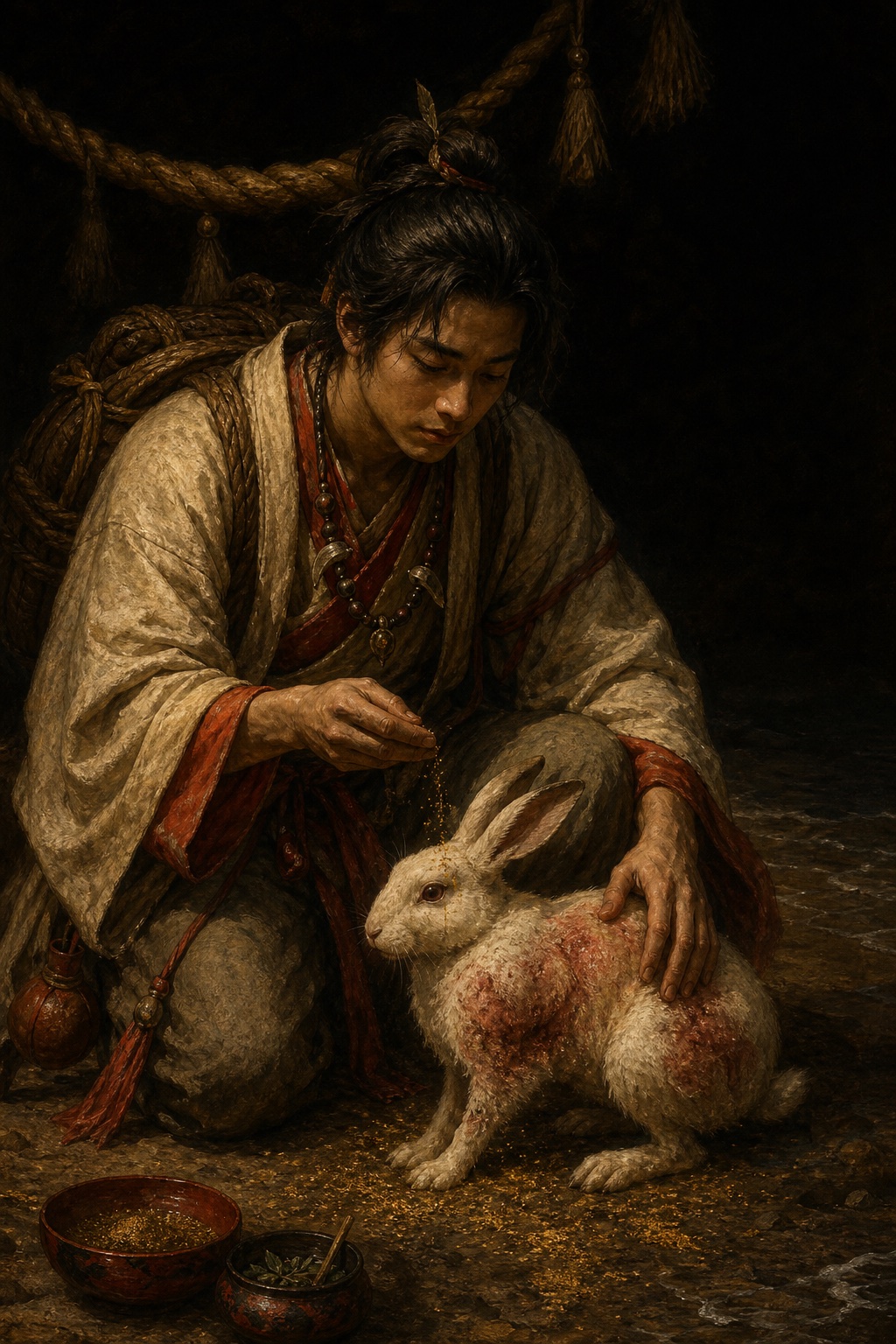
Okuninushi — the Deity Master-of-the-Great-Land — is Susanoo’s descendant and the god who makes the country habitable. He is introduced not as a warrior but as a servant, trailing behind his eighty brothers with their luggage on his back as they travel to Inaba to compete for the hand of Princess Yakami.
On the way they find a hare that has been flayed. It had tricked the sea-crocodiles into forming a bridge, boasted about it one step too early, and been stripped of its skin. The brothers, for amusement, tell it to bathe in salt water and lie in the wind, which makes it far worse. Okuninushi, arriving last, gives it the correct treatment.
今急往此水門,以水洗汝身,即取其水門之蒲黃,敷散而輾轉其上者,汝身如本膚必差。」故為如教,其身如本也。此稻羽之素菟者也,於今者謂菟神也。故其菟白大穴牟遲神:「此八十神者,必不得八上比賣。雖負帒,汝命獲之
““Go quickly now to the river-mouth, wash thy body with the fresh water, then take the pollen of the sedges [growing] at the river-mouth, spread it about, and roll about upon it, whereupon thy body will certainly be restored to its original state.” So [the hare] did as it was instructed, and its body became as it had been originally. This was the White Hare of Inaba. It is now called the Hare Deity. So the hare said to the Deity Great-Name-Possesser: “These eighty Deities shall certainly not get the Princess of Yakami. Though thou bearest the bag, Thine Augustness shall obtain her.”” — Kojiki, Sect. XXI, tr. Basil Hall Chamberlain (1882)
The remedy is more specific in the kanbun than in Chamberlain’s English: 蒲黃 is cattail pollen, a standard drug in the Sinitic pharmacopoeia, not the “pollen of the sedges” his translation gives. The hare is right, and the brothers respond by killing him — twice. They roll a red-hot boulder down a mountain for him to catch, and he burns to death; his mother goes up to heaven and pleads with Kamimusubi, and he is restored. They then crush him in a split tree; he is revived again. Advised to flee, he goes down to Susanoo in the Nether-Distant-Land, where he meets Suseri-bime, marries her on sight, and is set a series of lethal tests by his new father-in-law — a room of snakes, a room of centipedes and wasps, a burning moor — surviving each through his wife’s scarves and, at the last, a mouse. He escapes with Susanoo’s sword, bow and koto, and his father-in-law, thoroughly beaten, shouts after him to go and rule.
He then builds the country: with the dwarf deity Sukunabikona he lays out the land, establishes agriculture and medicine, and teaches remedies against disease and against harm from beasts and insects. Which makes what happens next the strangest passage in the Kojiki. Amaterasu, in heaven, decides that the land belongs to her descendants, and sends envoys to demand it. Okuninushi consults his sons, and — after one of them resists and is defeated — agrees to withdraw, on the single condition that a palace be built for him with pillars sunk deep into the bedrock and a roof reaching to the sky. That is the shrine at Izumo, the oldest and among the largest in Japan.
The kuniyuzuri, the “ceding of the land”, is the mythological charter of the imperial line, and it is transparently a settlement with the older gods of Izumo rather than a conquest of them. Okuninushi keeps the unseen world — the realm of the dead, of spirits, and of the invisible bonds between people — while the visible world passes to the sun goddess’s line. He remains the deity of Izumo, where the gods of Japan are said to gather each year in the tenth month, and where he is petitioned above all as a maker of marriages.