Fear in Konoe’s palace
The Nue has a chapter of its own in the Heike Monogatari. In A. L. Sadler’s English translation of 1918 it is the fifteenth chapter of the fourth book, and its title is the one word Nue. It is a chapter about a man as much as about a monster. It comes just after the Heike has told how Yorimasa, of the Minamoto, rose in revolt with Prince Takakura and died with him, and it looks back over his life: his descent, the verses that raised him in rank, and his deeds with the bow. One of those deeds, the chapter says, stood above the rest.
“Among the many deeds of renown that Yorimasa performed in the course of his life the most remarkable was in the Ninpei period when the Emperor Konoe-in was on the Throne. Every night the Emperor was frightened by something, and though he summoned the most celebrated of the priests and had them chant those Sutras most potent for exorcism it was all of no effect.” — The Heike Monogatari, Book IV ch. XV, tr. A. L. Sadler (1918)
At first the text has no name for what frightens the emperor. It is only something. It has a time, though, and a direction. The fear came at about the hour of the Ox, which Sadler glosses as 2 a.m., when a black cloudy mass came up from the wood of Higashi Sanjō and hung over the palace. The priests’ sutras did nothing to it, so the courtiers held a council.
The council found a precedent. In an earlier reign, that of Horikawa, the emperor had been frightened in the same way. Minamoto no Yoshiie, then commander of the guards, took his place on the verandah of the Shishinden at the hour of the apparition. He twanged his bowstring three times and called out his own name in a loud voice, and the emperor’s distress ended. On the strength of that precedent the council chose Yorimasa from among the warriors of the Taira and the Minamoto. He went because it was an imperial order, but not without a protest. Samurai, he said, were posted at the palace to drive away rebels and to punish those who disobeyed the imperial commands. This was the first time he had heard of them being set against apparitions.
The shape in the black cloud
Yorimasa took one retainer with him, his most trusted, I-no-Hayata of Totomi, who carried an arrow feathered with the underfeathers of an eagle’s wing. Yorimasa himself wore a double kariginu and carried his lacquered bow and two barbed arrows, and he took up his post on the verandah of the Shishinden, where Yoshiie had stood before him. The second arrow was not meant for the monster. A courtier, Masayori, had put Yorimasa’s name forward for the task, and Yorimasa had resolved that if his first arrow failed, he would shoot the second straight at Masayori’s neck.
“After awhile, as has been described, at the time when the Emperor was always wont to be alarmed, a mass of black cloud came from the direction of the wood by Higashi Sanjo and floated over the top of the Palace. Yorimasa, looking up, saw a strange shape in the midst of the cloud and determining not to live if he missed, took an arrow” — The Heike Monogatari, Book IV ch. XV, tr. A. L. Sadler (1918)
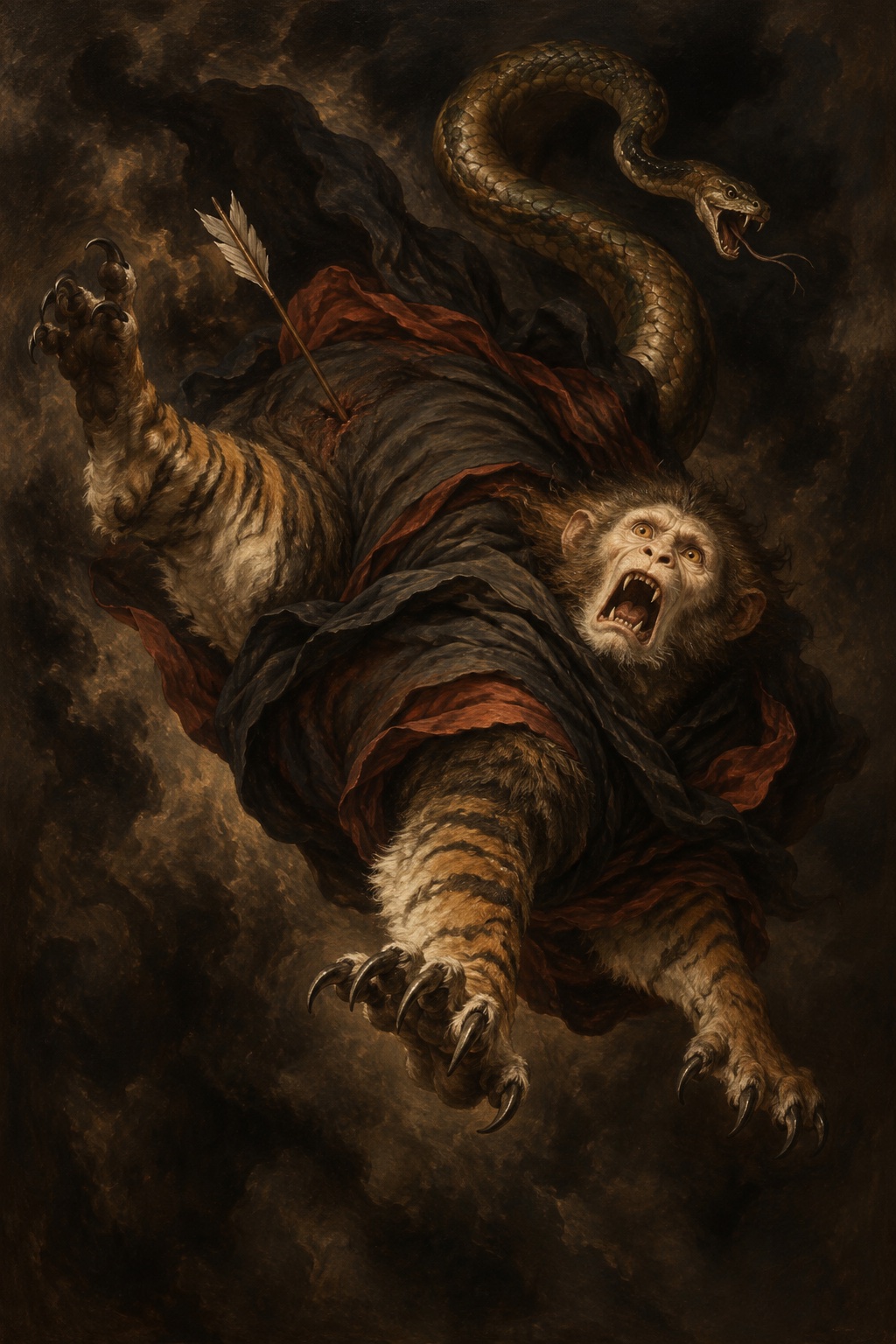
The text does not describe the shape. It says that the shape was strange and that it was in the middle of the cloud, and nothing more. It is Yorimasa who sees it, when he looks up. He called on Hachiman, the god of war, drew the bow with all his strength and let the arrow go.
“The arrow flew straight to the mark and Yorimasa gave a loud shout of triumph as I-no-Hayata came running up, seized the thing as it fell” — The Heike Monogatari, Book IV ch. XV, tr. A. L. Sadler (1918)
Hayata held it down with all his strength and ran it through nine times with his sword. The chapter divides the killing between the two men. Yorimasa’s arrow brought the creature down out of the cloud, and his retainer finished it on the ground.
Monkey, badger, snake and tiger
Only when the torches come does anyone see what has been killed.
“Then many others ran up with torches, and when they came to inspect it they found it was a most horrible monster with a monkey’s head, the body of a badger, the tail of a snake and feet like a tiger, its voice being like a Nue bird.” — The Heike Monogatari, Book IV ch. XV, tr. A. L. Sadler (1918)
The description takes one sentence, and it names four animals, one for each part of the body: the head of a monkey, the body of a badger, the tail of a snake and feet like a tiger’s. The badger is Sadler’s word. The sentence gives no size and no colour, and it gives the creature no wings.
The last clause is about the voice, and it is the only place in this first episode where Sadler’s text uses the word Nue. The chapter is called Nue, but the creature that Yorimasa shoots for Konoe is never itself called a Nue. Before the torches it is something, the monster, the creature and the thing; under the torches it is a most horrible monster. Its voice is like that of a nue bird, and the text does not say what a nue bird is. It uses the name only to describe a sound.
The emperor, in his gratitude, gave Yorimasa a famous sword called Shishiō, which Sadler renders as Lion King. The Sadaijin Yorinaga carried it out to him. As Yorinaga came halfway down the palace steps on the tenth day of the fourth month, a cuckoo cried overhead, and the minister and the archer exchanged lines of verse about the cuckoo and the crescent moon before Yorimasa took the sword. The chapter adds that Yorimasa was a distinguished poet as well as a peerless warrior. Of the body it says one thing more. Sadler now calls it the bird: the bird was put into a boat and set adrift.
The second Nue, under Nijō
The chapter tells of a second shooting, and this time the text gives the name to the creature itself. In the Ōhō period, in the reign of Nijō, a monstrous bird called Nue was heard crying in the palace. The emperor’s heart was troubled, and he sent for Yorimasa, as had been done before. It was the evening of the twentieth day of the fifth month.
“The Nue only flew once over the Palace and its voice was not heard a second time. It was so dark that nothing could be seen and therefore there was nowhere to aim, so Yorimasa took a great whirring arrow and shot it over the roof of the Palace at the place where the cry had been heard.” — The Heike Monogatari, Book IV ch. XV, tr. A. L. Sadler (1918)
This Nue was heard and not seen, so Yorimasa had to aim at a sound. His first arrow went over the palace roof toward the place of the cry. The noise of that arrow frightened the Nue, and it sprang up into the sky. At once Yorimasa loosed a smaller whirring arrow, which struck the creature and brought it down, and everyone in the palace came running out, shouting. The text gives this second Nue no body. It does not describe it after the fall, and it does not say what was done with it.
The reward this time was a robe of honour. The Udaijin Kinyoshi presented it. He praised Yorimasa with a comparison from ancient China, where a wild goose had been shot beyond the clouds, and said that Yorimasa had now shot a Nue in the rain. The two men exchanged verses, and Yorimasa took the robe. Then the chapter returns to his life. He received the fief of Izu and made his eldest son, Nakatsuna, its governor. He reached the Third Rank and lived at ease on his estates in Tamba and Wakasa, until he began the revolt in which he died with the Prince, his sons and his grandsons. The chapter ends at the point from which it began to look back.
A bird called nue
The Heike is not the only text that remembers the shooting. The Taiheiki recalls it in its twelfth book, in the section on how Hiroari shot a strange bird. In the year when the era name was changed to Kenmu, the chronicle says, there was an epidemic, and from the autumn a strange bird came and cried above the palace. The nobles met to find an archer, and they recalled three precedents. In China, in the age of Yao, nine suns came out, and an archer shot down eight of them. In Japan, in Horikawa’s reign, a monster troubled the emperor, and Yoshiie quieted it by sounding his bowstring three times. That is the same precedent that the council recalls in the Heike. The third precedent is the Nue.
又近衛院の御在位の時、鵺と云鳥の雲中に翔て鳴しをば、源三位頼政卿蒙勅、射落したりし例あれば、源氏の中に誰か可射候者有
“And in the reign of Konoe-in, a bird called the nue flew crying among the clouds, and Lord Yorimasa, Minamoto of the Third Rank, received the imperial command and shot it down. Since there is that precedent, is there anyone among the Genji who can shoot it?” — Taiheiki, Book XII; tr. Mythos Atlas
In this sentence the Nue is 鵺と云鳥, a bird called nue. It flies and cries among the clouds, 雲中に翔て鳴し, and Yorimasa shoots it down at the emperor’s command, 蒙勅. The sentence gives it no body at all. It has no monkey’s head and no tiger’s feet, no black cloud from Higashi Sanjō and no Hayata. What remains is a cry in the clouds, an emperor’s command and an archer who brought the bird down. That is all the nobles need from the story, because what they are looking for is an archer. No one came forward. Perhaps, the chronicle says, they thought that a miss would be a disgrace for life. In the end the court sent for a man named Hiroari, 隠岐次郎左衛門広有. The rest of the chapter is about Hiroari and his own bird, and nothing in it describes the Nue.
The two texts therefore use the name in different ways. The Taiheiki calls the creature of Konoe’s reign a bird called nue, and it gives it nothing but a cry in the clouds. Sadler’s Heike gives the same creature a body made of four animals, compares its voice to a nue bird, and calls it a bird only when it is set adrift. The creature that the Heike calls the Nue outright is the second one, under Nijō, which is heard and never described. Neither text says what a nue bird looks like. This atlas uses Nue as the name of the creature, as the Heike does in its chapter title and the Taiheiki does in its one sentence.