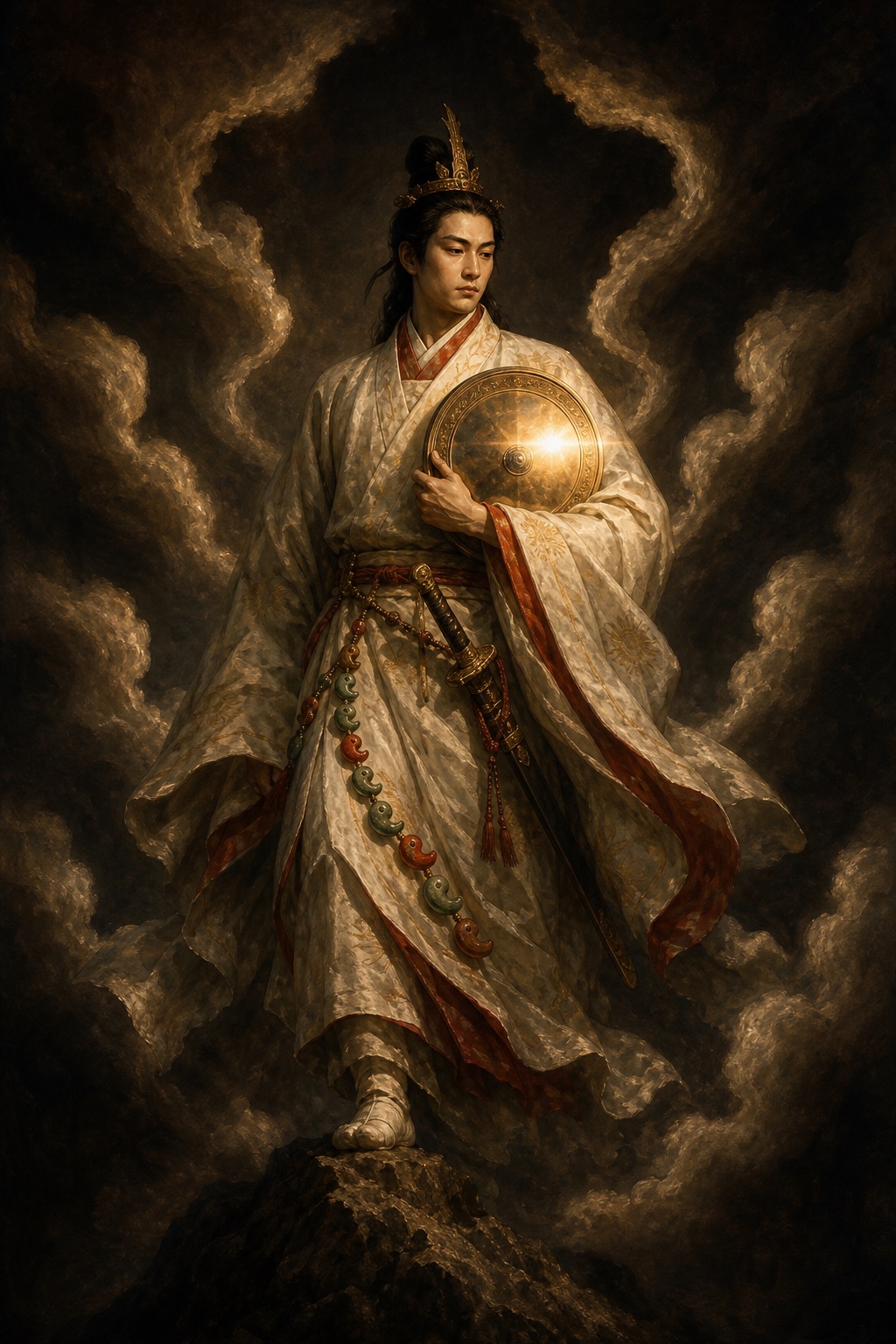
Sent in his father’s place
The mythological charter of Japan’s imperial line opens with heaven choosing who will rule the earth below. Amaterasu and Takagi-no-kami — the High-Integrating-Deity — do not send their son. They send their grandson.
Before he leaves, the gods equip him for the job — and hand him, in the same breath, the objects that will define the throne he is founding.
於是副賜其遠岐斯〈此三字以音〉八尺勾𤥼鏡及草那藝釼,亦常世思金神、手力男神、天石門別神而詔者:「此之鏡者,專為我御魂而如拜吾前,伊都岐奉
“Thereupon they joined to him the eight-feet [long] curved jewels and mirror that had allured [the Heaven-Shining-Great-August-Deity from the Rock-Dwelling, ] and also the Herb-Quelling-Great-Sword, and likewise the Deity Thought-Includer, the Hand-Strength-Male-Deity, and the Deity Heavenly-Rock-Door-Opener of Eternal Night, and charged him thus: “Regard this mirror exactly as if it were our august spirit, and reverence it as if reverencing us”” — Kojiki, Sect. XXXIII, tr. Basil Hall Chamberlain (1882)
The mirror is the one Amaterasu’s own myth already made famous — it is what lured her out of the Heavenly Rock-Cave, and the charge over it here, to “regard this mirror exactly as if it were our august spirit,” is why it is still enshrined at Ise as her surrogate. The sword is the Herb-Quelling-Great-Sword, also called Kusanagi — the one Susanoo drew from the tail of the serpent that had threatened Kushinada-hime, and sent up to Amaterasu; this passage sends it down again, one generation further, to her grandson. Mirror, sword and curved jewels together are the Three Sacred Treasures — the regalia every reigning emperor still inherits.
Descent to Takachiho
With the treasures in hand, Ninigi makes the crossing himself — the tenson kōrin, the “descent of the heavenly grandchild.”
故尒,詔天津日子番能迩迩藝命而離天之石位,押分天之八重多那〈此二字以音〉雲而伊都能知和岐知和岐弖〈自伊以下十字以音〉 ,於天浮橋,宇岐士摩理,蘇理蘇理多多斯弖〈自宇以下十一字亦以音〉 ,天降坐于竺紫日向之高千穗之久士布流多氣
“[the Heaven-Shining-Great-August-Deity and the High-Integrating-Deity] commanded His Augustness Heaven’s-Prince-Rice-ear-Ruddy-Plenty; and he, leaving the Heavenly Rock-Seat, pushing asunder the eight-fold heavenly spreading clouds, and dividing a road with a mighty road-dividing, set off floating shut up in the Floating Bridge of Heaven, and descended from Heaven onto the peak of Kuzhifuru which is Takachiho in Tsukushi” — Kojiki, Sect. XXXIV, tr. Basil Hall Chamberlain (1882)
The kanbun calls him by name — 天津日子番能迩迩藝命 — where Chamberlain gives a calque. “His Augustness Heaven’s-Prince-Rice-ear-Ruddy-Plenty” is that calque, and it is not decoration — rice-ear sits inside it, the same crop the land below is named for. Chamberlain’s own footnote hedges on the geography: it is uncertain whether Kuzhifuru is the modern Takachiho-yama or the nearby Kirishima-yama, though the latter is generally preferred. Either way, the passage goes on to have Ninigi find the spot facing the land of Kara, catching the light of both the morning and the evening sun, and call it good — and there he sinks his palace pillars to bedrock and raises its beams to the Plain of High Heaven.
Ancestor of the throne
Ninigi’s own reign is barely narrated; what matters is who comes after him. He marries Ko-no-hana-no-Sakuya-hime, and among their sons is Fire-Subside — also called Hikohohodemi — whose own descendants, a few generations on, include Jimmu, first Emperor of Japan.
That line is the point of the whole episode. Amaterasu never comes down to rule the earth herself; she sends her mirror, and her grandson carries it. Everything the imperial house still claims — the regalia at Ise, the descent to Takachiho, the throne at Himuka in Tsukushi — runs back through Ninigi to her.