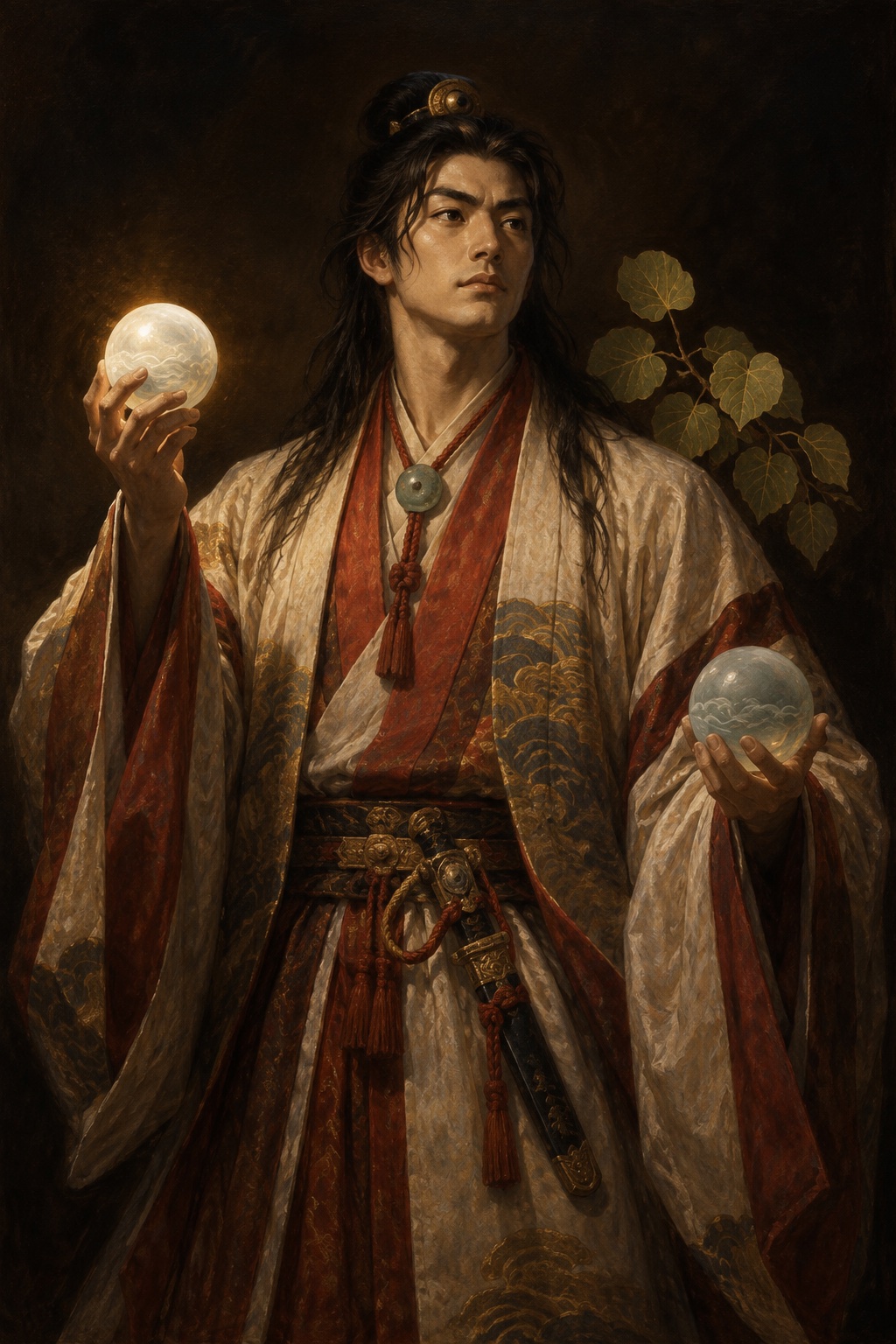
The exchange of luck
The youngest of the three sons born in the burning hall is a hunter. His elder brother Hoderi takes the sea and its fish; Hoori takes the mountains and their game. The word the Kojiki uses for what each of them holds is 佐知, sachi, which Chamberlain renders “luck” while warning in his own note that no English word carries the whole of it: it is at once the good fortune, the skill the fortune comes from, and the implement the skill is practised with. To trade luck is therefore to trade a livelihood. Hoori asks three times, his brother refuses three times, and the exchange happens only 纔, barely, at last.
故,火照命者,為海佐知毗古〈此四字以音。下效此也〉而取鰭廣物、鰭狹物;火遠理命者,為山佐知毗古而取毛麁物、毛柔物。尒火遠理命謂其兄火照命:「各相易佐知欲用。」三度雖乞,不許,然遂纔得相易。尒火遠理命以海佐知釣魚,都不得一魚,亦其鉤失海。於是,其兄火照命乞其釣曰:「山佐知母,己之佐知佐知;海佐知母,已之佐知佐知。今各謂返佐知之時。〈佐知二字以音〉」其弟火遠理命答曰:「汝鉤者,釣魚不得一魚,遂失海。」
“So His Augustness Fire-Shine was a prince who got his luck on the sea, and caught things broad of fin and things narrow of fin. His Augustness Fire-Subside was a prince who got his luck on the mountains, and caught things rough of hair and things soft of hair. Then His Augustness Fire-Subside said to his elder brother His Augustness Fire-Shine: “Let us mutually exchange, and use each other’s luck.” [Nevertheless,] though he thrice made the request, [his elder brother] would not accede [to it]; but at last with difficulty the mutual exchange was obtained. Then His Augustness Fire-Subside, undertaking the sea-luck, angled for fish, but never got a single fish; and moreover he lost the fish-hook in the sea. Thereupon his elder brother His Augustness Fire-Shine asked him for the fish-hook, saying: “A mountain-luck is a luck of its own, and a sea-luck is a luck of its own. Let each of us now restore [to the other] his luck.” To which the younger brother His Augustness Fire-Subside replied, saying: “As for thy fish-hook, I did not get a single fish by angling with it; and at last I lost it in the sea.”” — Kojiki, Sect. XXXIX, tr. Basil Hall Chamberlain (1882)
The borrowed luck fails twice over. It catches nothing, and then it is gone. What follows is a quarrel about restitution, and the whole of the rest of the story is contained in how badly Hoori loses it: he breaks the ten-grasp sabre girded on him and beats the fragments into five hundred fish-hooks, then a thousand, and his brother will take none of them, because what he wants is the one original hook. The debt cannot be paid in kind. It is that refusal, and not the losing, that sends Hoori to the bottom of the sea.
The road to the palace under the sea
He goes down to the shore and weeps there, and a passing deity asks him why. Shiotsuchi — Chamberlain’s “Deity Salt-Possessor” — hears the whole account of the hook and offers, in place of sympathy, directions. He builds a 无間勝間之小船, a tight little basket-boat with no gaps in it, puts him aboard, and tells him what he will see.
尒,塩椎神云:「我為汝命,作善議。」即造无間勝間之小船,載其船以教曰:「我押一作「柙」流其船者,差暫往,將有(味)御路。乃乘其道往者,如魚鱗所造之宫室,其綿津見神之宫者也。到其神御門者,傍之井上有湯津香木〈訓香木云加都良〉 ,故坐其木上者,其海神之女見相議者也。」故隨教少行,備如其言,即登其香木以坐。
“Then the Deity Salt-Possessor said: “I will give good counsel to Thine Augustness;”—and therewith built a stout little boat without interstices, and set him in the boat, and instructed him, saying: “When I shall have pushed the boat off, go on for some time. There will be a savoury august road; and if thou goest in the boat along that road, there will appear a palace built like fishes’ scales,—which is the palace of the Deity-Ocean-Possessor. When thou reachest the august gate of that deity [’s palace], there will be a multitudinous [-ly branching] cassia-tree above the well at its side. So if thou sit on the top of that tree, the Sea-Deity’s daughter will see thee, and counsel thee.” So following [these] instructions, [His Augustness Fire-Subside] went a little [way], and everything happened as [the Deity Salt-Possessor] had said; and he forthwith climbed the cassia-tree, and sat [there].” — Kojiki, Sect. XL, tr. Basil Hall Chamberlain (1882)
The counsel is entirely topographic: push off, follow the savoury road, watch for a palace built like fish-scales, and at its gate find the katsura above the well. Then sit in the tree. The god who has lost his brother’s property is not told to search the sea or to fight anything. He is told where to wait until somebody looks up.
The jewel in the cup
Toyotama-hime’s maidservants come to the well with jade vessels and find a light in the water. They look up and see 有麗壯夫, a beautiful young man in the branches. He asks them for water, and then does not drink it.
尒火遠理命見其婢,乞欲得水。婢乃酌水,入玉器貢進。尒不飮水,解御頸之璵,含口,唾入其玉器。於是其璵着器,婢不得離璵,故(璵)任著以進豊玉毗賣命。
“Then His Augustness Fire-Subside saw the handmaidens, and begged to be given some water. The handmaidens at once drew some water, put it into a jewelled vessel, and respectfully presented it to him. Then, without drinking the water, he loosened the jewel at his august neck, took it in his mouth, and spat it into the jewelled vessel. Thereupon the jewel adhered to the vessel, and the handmaidens could not separate the jewel [from the vessel]. So they took it with the jewel adhering to it, and presented it to Her Augustness Luxuriant-Jewel-Princess.” — Kojiki, Sect. XL, tr. Basil Hall Chamberlain (1882)
The bead is a message that nobody speaks. She is shown a vessel she cannot empty, goes out to look, and the looking is mutual — 目合, their eyes meet — after which she tells her father only that there is a beautiful person at the gate. The sea-god needs no more than the sight of him: he names the stranger as 虛空津日高, the Sky’s-Sun-Height, august child of the Heaven’s-Sun-Height, and receives him accordingly, with eight layers of sea-ass skins under eight layers of silk, a banquet laid on a hundred tables, and his daughter given in marriage. Chamberlain’s note reads the two near-identical titles as a distinction of rank — the sky form for the heir apparent, the heaven form for the reigning sovereign — so the recognition fixes not only who Hoori is but where he stands, one generation below a father still living. He stays three years in that country, and the errand that brought him is not mentioned once.
The hook in the tai’s throat
What ends the three years is a sigh. Toyotama-hime hears her husband heave one deep sigh in the night, tells her father that he has never done it before, and the sea-god asks his son-in-law what the matter is and why he came. Only then does the hook come up, and the ruler of the sea deals with it as a magistrate deals with a theft: he summons every fish he governs and takes evidence.
故諸魚白之:「頃者,赤海鯽魚於喉鯁,物不得食愁言,故必是取。」於是探一作「採」赤海鯽魚之喉者,有鉤。即取出而清洗,奉火遠理命之時,其綿津見大神誨曰之:「以此鉤給其兄時,言状者:『此鉤者,淤煩鉤、須須鉤、貧鉤、宇流鉤。』云而於後手賜〈淤煩及須須,亦宇流(六)字以音〉。然而,其兄作高田者,汝命營下田;其兄作下田者,汝命營高田。為然者,吾掌水故,三年之間,必其兄貧窮。若恨一作「悵」怨其為然之事而攻戰者,出塩盈珠而溺;若其一作「甚」愁一作「然」請者,出塩乾珠而活。如此令惣一作「惚」苦。」云,授塩盈珠、塩乾珠并兩箇。
“So all the fishes replied: “Lately the tahi has complained of something sticking in its throat preventing it from eating; so it doubtless has taken [the hook].” On the throat of the tahi being thereupon examined, there was the fish-hook [in it]. Being forthwith taken, it was washed and respectfully presented to His Augustness Fire-Subside, whom the Deity Great-Ocean-Possessor then instructed, saying: “What thou shalt say when thou grantest this fish-hook to thine elder brother [is as follows]: ‘This fish-hook is a big hook, an eager hook, a poor hook, a silly hook.’ Having [thus] spoken, bestow it with thy back hand. Having done thus,—if thine elder brother make high fields, do Thine Augustness make low fields; and if thine elder brother make low fields, do Thine Augustness make high fields. If thou do thus, thine elder brother will certainly be impoverished in the space of three years, owing to my ruling the water. If thine elder brother, incensed at thy doing thus, should attack thee, put forth the tide-flowing jewel to drown him. If he express grief, put forth the tide-ebbing jewel to let him live. Thus shalt thou harrass him.” With these words, [the Sea-Deity] gave [to His Augustness Fire-Subside] the tide-flowing jewel and the tide-ebbing jewel,—two in all” — Kojiki, Sect. XL, tr. Basil Hall Chamberlain (1882)
He hands back more than the hook. There is a formula to be spoken over it — the Kojiki’s four opprobrious names for the thing, delivered while passing it backwards, with the back of the hand — and a scheme of high fields and low fields that will fail whichever way Hoderi plants, because the sea-god rules the water that feeds them. Then the two jewels, 塩盈珠 and 塩乾珠, one to drown with and one to revive with. The escort home is arranged in the same administrative style: the 和迩 are summoned and asked who will take him and in how many days, each answers according to the length of his own body, and the one-fathom wani who promises a single day carries him on his neck, has Hoori’s knife untied from its cord and set on that neck as he turns back, and is called the Deity Blade-Possessor from then on. Chamberlain translates 和迩 as “crocodile”; what animal the word means is not settled, and the chronicle does not say.
The brother’s submission
Everything the sea-god specified happens exactly as specified, and the elder brother’s three years run the opposite way to Hoori’s.
是以備如海神之教言与其鉤。故自尒以後,稍俞貧,更起荒心迫來。將攻之時,出塩盈珠而令溺;其愁請者,出塩乾珠而救。如此令惣一作「惚」苦之時,稽首白:「僕者,自今以後,為汝命之晝夜守護人而仕奉。」故至今,其溺時之種種之態,不絶仕奉也。
“Hereupon [His Augustness Fire-Subside] gave the fish-hook [to his elder brother], exactly according to the Sea-Deity’s words of instruction. So thenceforward [the elder brother] became poorer and poorer, and, with renewed savage intentions, came to attack him. When he was about to attack [His Augustness Fire-Subside, the latter] put forth the tide-flowing jewel to drown him; on his expressing grief, he put forth the tide-ebbing jewel to save him. When he had thus been harrassed, he bowed his head, saying: “I henceforward will be Thine Augustness’s guard by day and night, and respectfully serve thee.” So down to the present day his various posturings when drowning are ceaselessly served up.” — Kojiki, Sect. XLI, tr. Basil Hall Chamberlain (1882)
The reversal is total and it is hereditary. Hoderi is not killed; he is enrolled, as a 晝夜守護人, a guard by day and night, and the drowning is turned into a performance his descendants the Hayato still give at court. A quarrel about a fish-hook has produced a line of servants and a line of kings.
The chronicle then leaves Hoori almost at once. What comes next is Toyotama-hime’s own story rather than his — the birthing hall left unthatched, her warning not to watch her, the watching, the shape she takes to give birth, the sea-road closed behind her, and the child she leaves on the shore. That child is Ugayafukiaezu, and Jimmu is his son. Hoori himself gets one line of his own: five hundred and eighty years in the palace of Takachiho.