Cape Kasasa, and a father’s curse
Ninigi-no-Mikoto met her at the cape of Kasasa and asked whose daughter she was. She answered that she was the daughter of Ōyamatsumi — Chamberlain renders his name “the Deity Great-Mountain-Possessor” — and that she was called the Divine-Princess-of-Ata, another name for her being Ko-no-hana-no-Sakuya-hime. Asked whether she had any siblings, she named her elder sister, Iwanaga-hime. Ninigi sent to Ōyamatsumi asking for her, and her father, greatly delighted, sent both daughters together, with wedding gifts carried on a hundred tables. But Iwanaga-hime was very hideous, and Ninigi, alarmed at the sight of her, sent her back — keeping only Ko-no-hana-no-Sakuya-hime, whom he wedded for one night.
Ōyamatsumi’s answer to that rejection is the text’s own explanation for why the imperial line does not live forever:
於是,天津日高日子番能迩迩藝能命,於笠紗御前,遇麗美人。尒問:「誰女?」答白之:「大山津見神之女,名神阿多都比賣〈此神名以音〉 ,亦名謂木花之佐久夜毗賣。〈此五字以音〉」又問:「有汝之兄弟乎?」答白:「我姉石長比賣在也。」尒詔:「吾欲目合汝,奈何?」答白:「僕不得白,僕父大山津見神將白。」故乞遣其父大山津見神之時,大歡喜而副其姉石長比賣,令持百取机代之物奉出。故尒其姉一作「婦」者,因甚凶醜,見畏而返送,唯留其弟木花之佐久夜毗賣以一宿為婚。尒大山津見神因返石長比賣而大恥,白送言:「我之女二並立奉由者,使石長比賣者,天神御子之命,雖雪零風吹,恒如石而常堅不動坐;亦使木花之佐久夜比賣者,如木花之榮,榮坐。宇氣比弖〈自宇下四字以音〉貢進。此令返石長比賣而獨留木花之佐久夜毗賣故,天神御子之御壽者,木花之阿摩比能微〈此五字以音〉坐。」故是以至于今,天皇命等之御命不長也
“met a beautiful person at the august cape of Kasasa, and asked her whose daughter she was. She replied, saying: “I am a daughter of the Deity Great-Mountain-Possessor, and my name is the Divine-Princess-of-Ata, another name by which I am called being Princess-Blossoming-Brilliantly-Like-the-Flowers-of-the-Trees.” Again he asked: “Hast thou any brethren?” She replied, saying: “There is my elder sister, Princess-Long-as-the-Rocks.” Then he charged her [,saying]: “Ego sun cupidus soiendi tecum. Tibi quomodo videtur?” She replied, saying: “I am not able to say. My father the Deity Great-Mountain-Possessor will say.” So he sent a request [for her] to her father the Deity Great-Mountain-Possessor, who, greatly delighted, respectfully sent her off, joining to her her elder sister Princess Long-as-the-Rocks, and causing merchandise to be carried on tables holding an hundred. So then, owing to the elder sister being very hideous, [His Augustness Prince-Rice-ear-Ruddy-Plenty] was alarmed at the sight of her, and sent her back, only keeping the younger sister Princess-Blossoming-Brilliantly-Like-the-Flowers-of-the-Trees, whom he wedded for one night. Then the Deity-Great-Mountain-Possessor was covered with shame at Princess Long-as-the-Rocks being sent back, and sent a message [to His Augustness Prince-Rice-ear-Ruddy-Plenty], saying: “My reason for respectfully presenting both my daughters together was that, by sending Princess-Long-as-the-Rocks, the august offspring of the Heavenly Deity, though the snow fall and the wind blow, might live eternally immovable like unto the enduring rocks, and again that by sending Princess-Blossoming-Brilliantly-Like-the-Flowers-of-the-Trees, [they] might live flourishingly like unto the flowering of the blossoms of the trees: to insure this, I offered them. But owing to thy thus sending back Princess Long-as-the-Rocks, and keeping only Princess-Blossoming-Brilliantly-Like-the-Flowers-of-the-Trees, the august offspring of the Heavenly Deity shall be but as frail as the flowers of the trees.” So it is for this reason that down to the present day the august lives of Their Augustnesses the Heavenly Sovereigns are not long.” — Kojiki, Sect. XXXVII, tr. Basil Hall Chamberlain (1882)
Chamberlain’s translation hides one of its own moments here: the actual proposition Ninigi puts to her, too indelicate for his Victorian English, comes out in Latin instead — “Ego sun cupidus soiendi tecum. Tibi quomodo videtur?” — sic, and his choice, not this passage’s error. What survives to be quoted is the aftermath: Ōyamatsumi’s message names both daughters’ purposes in the same breath, Iwanaga-hime for endurance “like unto the enduring rocks” and Ko-no-hana-no-Sakuya-hime for flourishing “like unto the flowering of the blossoms of the trees” — and turns the rejection of the elder sister into the reason an emperor’s own life is short.
Doubted after one night
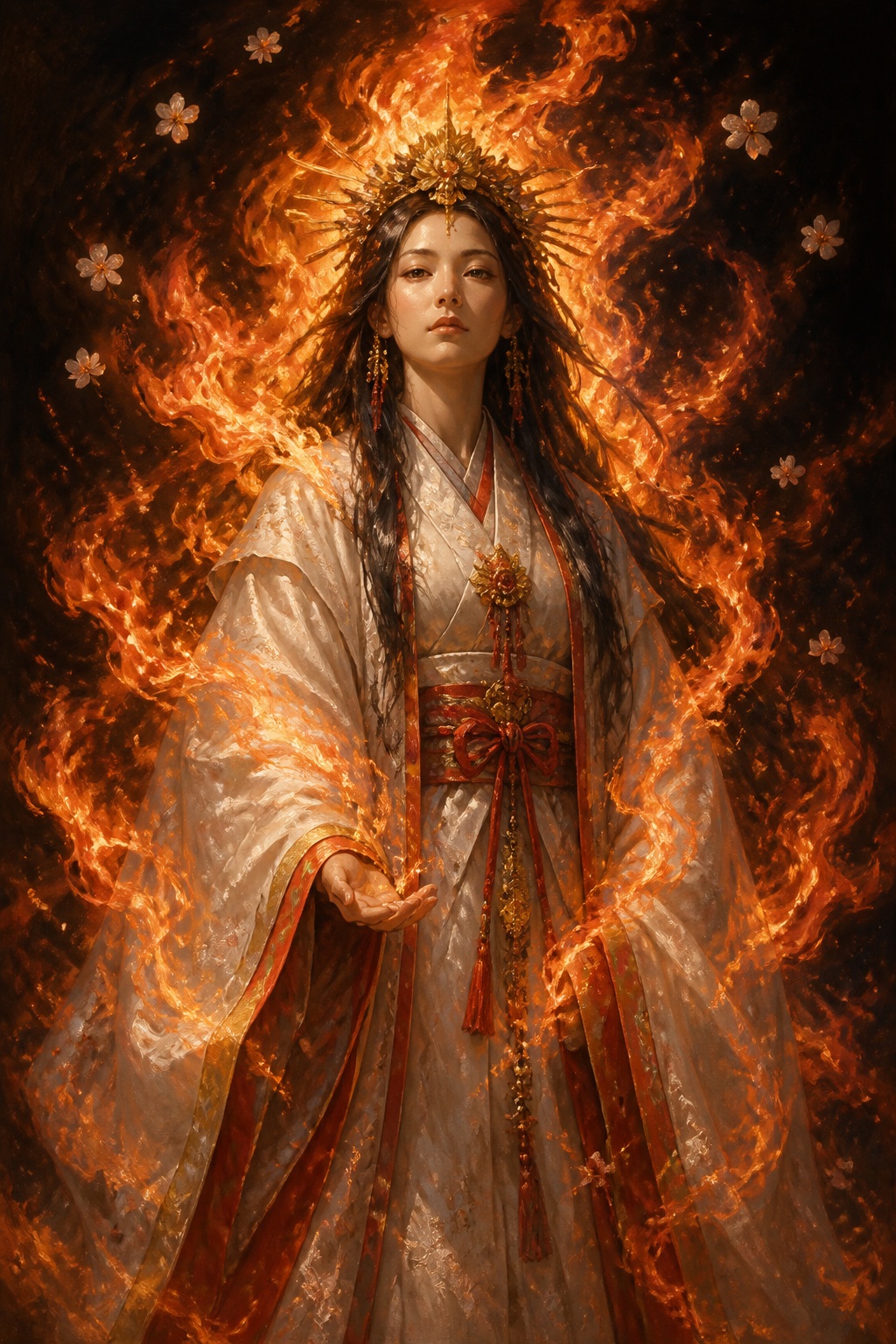
She conceived in that single night, and when her time came she told Ninigi so. He doubted the child was his: pregnant after one night, he said, it could not be his — it must be an Earthly Deity’s. She answered that if the child were an Earthly Deity’s, her delivery would go badly; if it were the Heavenly Deity’s own child, it would go well. Then, to settle the question the only way she could, she built a hall eight fathoms long without doors, went inside, plastered the entrance shut with earth, and set the hall on fire as her time came.
故後木花之佐久夜毗賣參出白:「妾妊身,今臨産時。是天神之御子,私不可産,故請。」尒詔:「佐久夜毗賣,一宿哉妊!是非我子,必國神之子。」尒答白:「吾妊之子,若國神之子者,産(時)不幸;若天神之御子者,幸。」即作無戶八尋殿,入其殿内,以土塗塞而方産時,以火著其殿而産也。故其火盛燒時所生之子名:火照命〈此者隼人阿多君之祖〉。次生子名:火須勢理命〈須勢理三字以音〉。次生子御名:火遠理命,亦名天津日高日子穗穗手見命〈三柱〉
“So later on Princess-Blossoming-Brilliantly-Like-the-Flowers-of-the-Trees waited on [His Augustness Prince Rice-ear-Ruddy-Plenty , and said: “I am pregnant, and now the time for my delivery approaches. It is not fit for me to be delivered of the august offspring of Heaven privately; so I tell thee.” Then [His Augustness Prince-Rice-ear-Ruddy-Plenty] said: “Princess-Blossoming-Brilliantly! what! pregnant after one night! It cannot be my child. It must surely be the child of an Earthly Deity.” Then she replied, saying: “If the child with which I am pregnant be the child of an Earthly Deity, my delivery will not be fortunate. If it be the august child of the Heavenly Deity, it will be fortunate;”—and thereupon she built a hall eight fathoms [long] without doors, went inside the hall and plastered up [the entrance] with earth; and when the time came for her delivery, she set fire to the hall and was delivered. So the name of the child that was born when the fire was burning most fiercely was His Augustness Fire-Shine (this is the ancestor of the Hayabito, Dukes of Ata); the name of the child born next was His Augustness Fire-Climax; the august name of the child born next was His Augustness Fire-Subside, another name for whom is His Augustness Heaven’s-Sun-Height-Prince-Great-Rice-ears-Lord-Ears (three Deities [in all]).” — Kojiki, Sect. XXXVIII, tr. Basil Hall Chamberlain (1882)
Three sons are born as the flames burn: Hoderi first, named at the fire’s fiercest and remembered as ancestor of the Hayato lords of Ata; then Hosuseri; then Hoori, also called Hikohohodemi. The ordeal proves exactly what she staked it on — the delivery goes well, and all three live.
Three sons, one line
Of the three, it is Hoori — Hikohohodemi — whose line the rest of the myth follows: his own descendants, a few generations on, include Jimmu, first Emperor of Japan, the line Ninigi-no-Mikoto had been sent down to found. Ko-no-hana-no-Sakuya-hime’s own name carries a claim inside the story itself: Ōyamatsumi’s message measures her against a flourishing “like unto the flowering of the blossoms of the trees,” and the text never says which tree — Chamberlain’s own footnote guesses “doubtless the cherry,” but that identification is his, not the chronicle’s. What the chronicle does give, twice over, is the doorless hall and the fire inside it: not proof that childbirth is safe, but proof of whose child this one was.