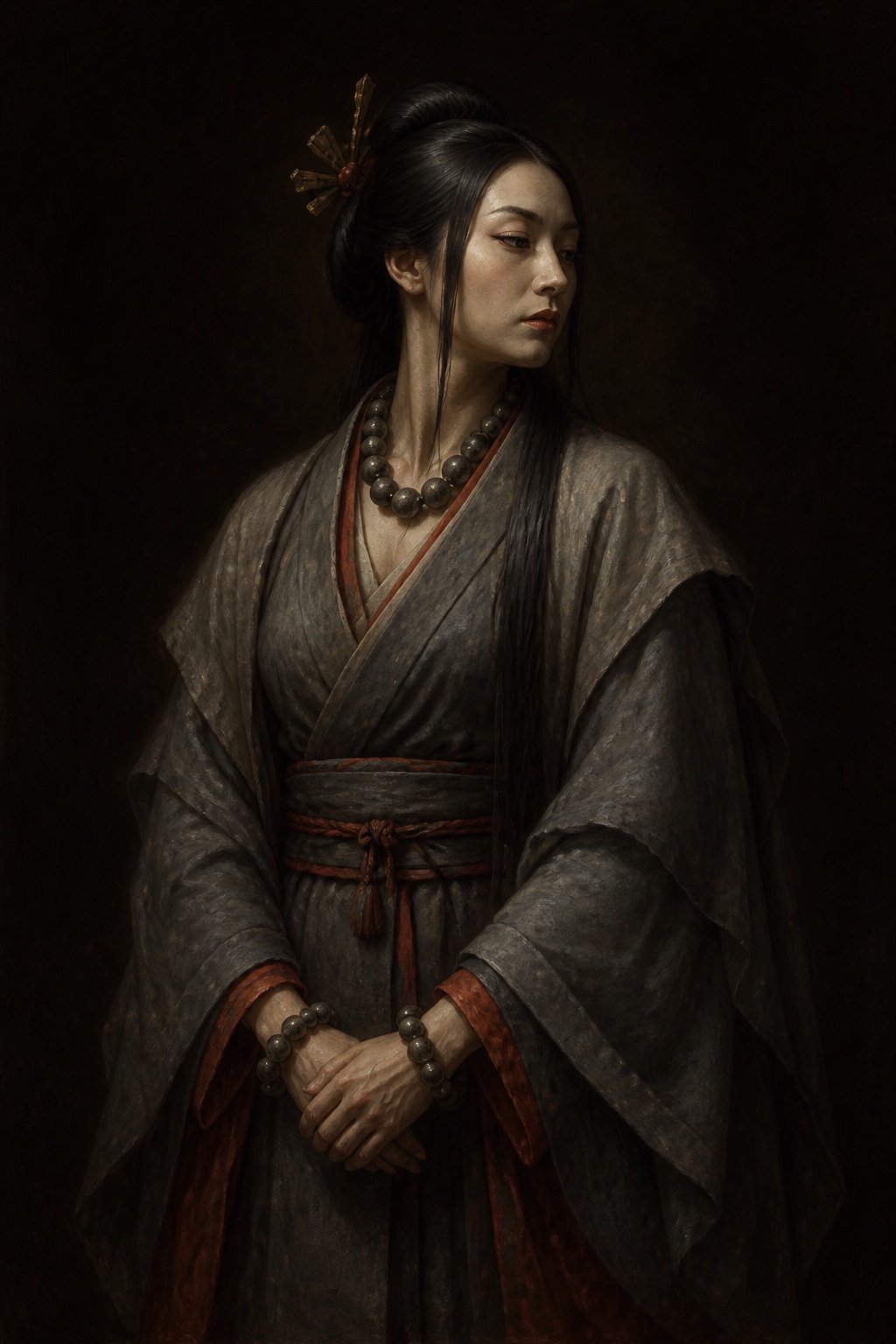
Sent home among the wedding gifts
Ninigi-no-Mikoto met a beautiful woman by the sea-shore and asked whose child she was. She answered that she was the daughter of Ōyamatsumi, and that she was also called Ko-no-hana-no-Sakuya-hime; asked whether she had kin, she said she had an elder sister, Iwanaga-hime. Ninigi-no-Mikoto asked Ōyamatsumi for his daughter, and Ōyamatsumi sent both daughters together, with a hundred tables of food and drink to offer them respectfully. Ninigi-no-Mikoto thought the elder sister ugly and would not take her, so she went home; he kept only Ko-no-hana-no-Sakuya-hime, the noted beauty, and in a single night she conceived. This is the Nihon Shoki’s own account of the same betrothal the Kojiki tells — the one already sourced, from Ōyamatsumi’s own message, in Ko-no-hana-no-Sakuya-hime’s entry — but past this point the two chronicles part ways entirely.
Her own curse, not her father’s
In the Kojiki it is Ōyamatsumi who speaks once his elder daughter is sent home — “covered with shame,” in Chamberlain’s translation, he sends Ninigi-no-Mikoto a message naming what the rejection will cost. The Nihon Shoki removes the father from the scene. There is no message from him at all: the text moves straight from the rejection to Iwanaga-hime’s own reaction — 磐長姫大慙而詛之曰, “greatly ashamed, and cursed, saying” — and what follows is hers.
時皇孫謂姉爲醜。不御而罷。妹有國色引而幸之。則一夜有身。故磐長姫大慙而詛之曰。假使天孫不斥妾而御者。生兒永壽有如磐石之常存。今既不然。唯弟獨見御。故其生兒。必如木花之移落。
Now the August Grandchild thought the elder sister ugly, and would not take her. So she went away. But the younger sister was a noted beauty. So he took her with him and favoured her, and in one night she became pregnant. Therefore Iha-naga-hime was greatly ashamed, and cursed him, saying:—‘If the August Grandchild had taken me and not rejected me, the children born to him would have been long-lived, and would have endured for ever like the massy rocks. But seeing that he has not done so, but has married my younger sister only, the children born to him will surely be decadent like the flowers of the trees.’ — Nihongi, Book II, tr. W. G. Aston (1896)
The bargain she states is her own name. The Kojiki calls her, in Chamberlain’s calque, “Princess-Long-as-the-Rocks,” sent by Ōyamatsumi so that the heavenly grandchild’s line might endure “like unto the enduring rocks”; here she claims that same permanence in her own voice, and its loss in the same breath — endurance “like the massy rocks” traded for a line that will fade “like the flowers of the trees.” This chronicle also spells her name and her father’s differently from the Kojiki’s — 磐長姫 and 大山祇神 here, against 石長比賣 and 大山津見神 there — a genuine difference between the two histories rather than an error in either; this entry keeps the Kojiki’s spelling in its own name, since that is the form her sister’s entry already links to. Aston himself romanizes her “Iha-naga-hime” rather than “Iwanaga-hime” — his own period spelling convention, not a mistake, and not a reason to depart from the form this wiki already uses for her.
One version: she spat and wept
The same page immediately appends a second telling, marked 一云, “one account says,” in which she does not merely speak the curse but 唾泣之曰 — spits and weeps as she utters it — and the wording itself changes along with the gesture. Where the first curse names only “the children born to him,” the offspring of the August Grandchild, this second version widens the claim to 顯見蒼生, “the race of visible mankind” entire, and it is this telling, not the first, that the chronicle explicitly credits as the reason human life is short at all.
一云。磐長姫耻恨而。唾泣之曰。顯見蒼生者。如木花之俄遷轉當衰去矣。此世人短折之緑也
Iha-naga-hime, in her shame and resentment, spat and wept. She said:—‘The race of visible mankind shall change swiftly like the flowers. of the trees, and shall decay and pass away.’ This is the reason why the life of man is so short. — Nihongi, Book II, tr. W. G. Aston (1896)
The stray mid-sentence period before “of the trees” is en.wikisource’s own transcription of this line, not a slip introduced here; it is kept as fetched rather than silently smoothed.
Two chronicles, two mouths
Between the two histories the same rejection produces the same reasoning three separate times, credited to two different speakers: Ōyamatsumi’s message in the Kojiki, and Iwanaga-hime’s own two curses — composed, then grieving — in the Nihon Shoki. Neither text ever explains why Ninigi-no-Mikoto found her 醜, ugly; it is his own verdict, reported rather than described, and neither chronicle gives her an age, a colouring, or a feature beyond that single word. What both give at length instead is what her own name already said before Ninigi-no-Mikoto ever judged her: 磐長, rock-long, an offer of permanence a passing judgment on her looks was enough to refuse.