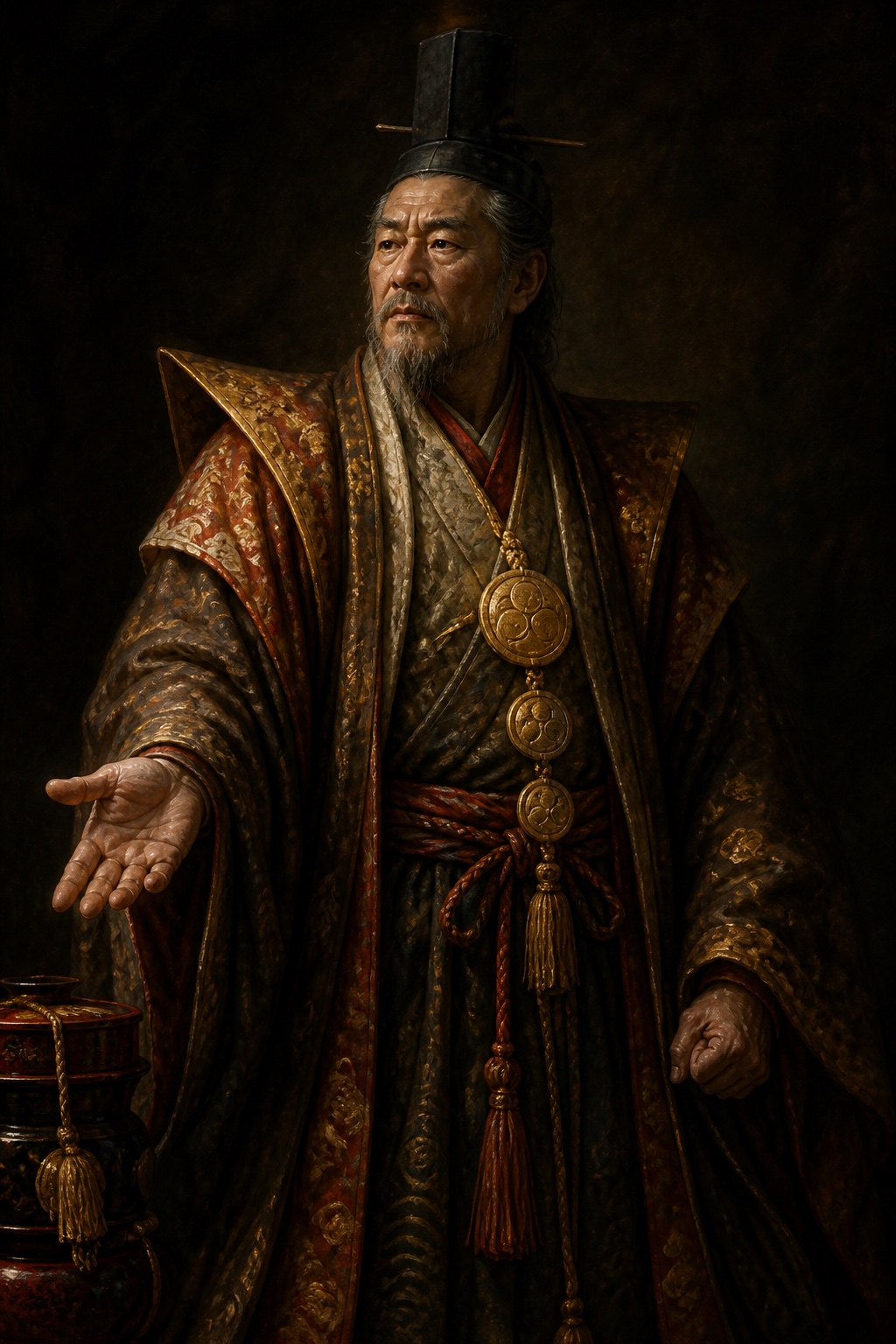
Joy, and a hundred tables of gifts
When Ninigi-no-Mikoto met a beautiful woman at the cape of Kasasa and asked whose daughter she was, she named herself the daughter of Ōyamatsumi — Chamberlain renders his name “the Deity Great-Mountain-Possessor” — under the further name Ko-no-hana-no-Sakuya-hime, and named her elder sister, Iwanaga-hime, when asked if she had siblings. Ninigi sent to her father asking for her. Ōyamatsumi’s answer was immediate and complete: he sent both daughters together, with bridal gifts loaded onto a hundred tables. Ninigi, alarmed at the sight of Iwanaga-hime, sent her straight back, keeping only Ko-no-hana-no-Sakuya-hime, whom he wedded for a single night. The paired gift Ōyamatsumi had sent with such evident satisfaction came back half-refused.
Shame, and the reason no emperor lives forever
Ōyamatsumi’s answer to that rejection is the text’s own explanation for why the imperial line does not live forever:
尒大山津見神因返石長比賣而大恥,白送言:「我之女二並立奉由者,使石長比賣者,天神御子之命,雖雪零風吹,恒如石而常堅不動坐;亦使木花之佐久夜比賣者,如木花之榮,榮坐。宇氣比弖〈自宇下四字以音〉貢進。此令返石長比賣而獨留木花之佐久夜毗賣故,天神御子之御壽者,木花之阿摩比能微〈此五字以音〉坐。」故是以至于今,天皇命等之御命不長也
“Then the Deity-Great-Mountain-Possessor was covered with shame at Princess Long-as-the-Rocks being sent back, and sent a message [to His Augustness Prince-Rice-ear-Ruddy-Plenty], saying: “My reason for respectfully presenting both my daughters together was that, by sending Princess-Long-as-the-Rocks, the august offspring of the Heavenly Deity, though the snow fall and the wind blow, might live eternally immovable like unto the enduring rocks, and again that by sending Princess-Blossoming-Brilliantly-Like-the-Flowers-of-the-Trees, [they] might live flourishingly like unto the flowering of the blossoms of the trees: to insure this, I offered them. But owing to thy thus sending back Princess Long-as-the-Rocks, and keeping only Princess-Blossoming-Brilliantly-Like-the-Flowers-of-the-Trees, the august offspring of the Heavenly Deity shall be but as frail as the flowers of the trees.” So it is for this reason that down to the present day the august lives of Their Augustnesses the Heavenly Sovereigns are not long.” — Kojiki, Sect. XXXVII, tr. Basil Hall Chamberlain (1882)
His speech recounts, in his own words, exactly what he had intended by sending both daughters together: Iwanaga-hime so that the heavenly grandchild’s life might endure “like unto the enduring rocks,” and Ko-no-hana-no-Sakuya-hime so that it might flourish “like unto the flowering of the blossoms of the trees.” Ninigi’s rejection of the elder sister undid half of that intention, and the text draws the consequence straight from the god’s own mouth: from that day to this, no emperor’s life has been long.
A father many times over
Ko-no-hana-no-Sakuya-hime and Iwanaga-hime were not his only daughters. The same genealogy names Kamu-Ōichi-hime, whom Susanoo marries; their children are Ōtoshi-no-kami, a deity of the harvest, and Ukanomitama-no-kami, a rice-spirit deity. A further daughter, Konohanachiru-hime, marries Susanoo’s own son Yashimajinumi. And when Susanoo later comes upon an old man and woman weeping over the daughter the eight-headed serpent Yamata-no-Orochi has come to devour, the old man answers Susanoo’s question about who he is by naming himself an earthly deity and a child of Ōyamatsumi, before giving his own name: Ashinazuchi, father of Kushinada-hime — making her, by that account, Ōyamatsumi’s granddaughter. None of it is Ōyamatsumi’s own doing; it is simply how often the genealogy circles back to him.
A rival account of his birth
The Kojiki’s own genealogy makes Ōyamatsumi one of the many deities born to Izanagi and Izanami as they made the land and its kami. The Nihon Shoki does not agree.