Weeping beside the river Hi
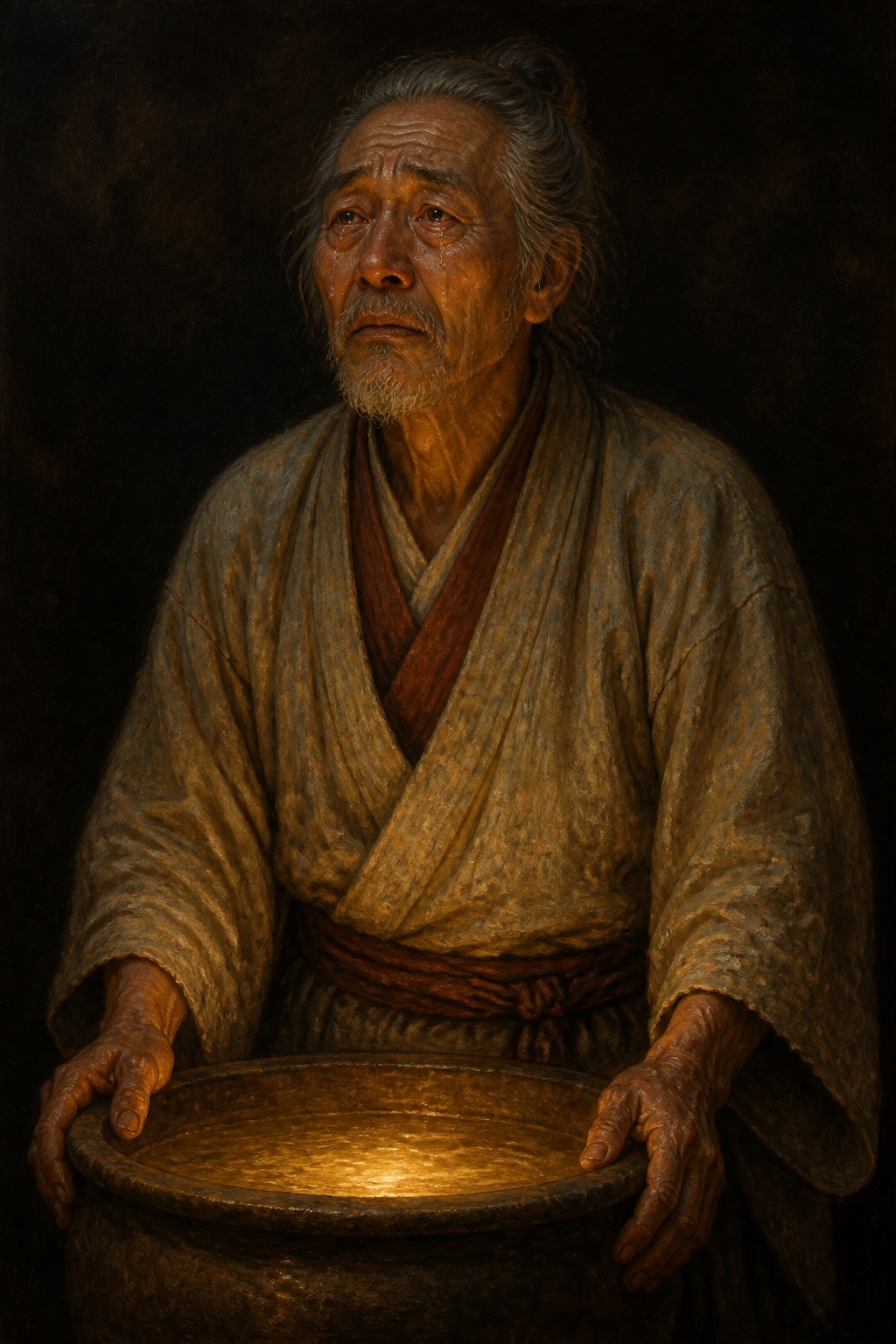
Susanoo, newly cast out of Heaven, follows a pair of chopsticks drifting down the river Hi in Izumo and climbs toward their source. There he comes upon an old man and an old woman weeping, with a young girl set between them. Asked who they are, it is the old man, Ashinazuchi, who answers for all three: they had eight daughters once; the eight-forked serpent of Koshi has come every year and devoured one; and this year — though the arithmetic makes the point without needing to say so — is the year it comes for the last, Kushinada-hime.
An earthly god, child of Ōyamatsumi
Ashinazuchi’s answer to Susanoo is a genealogy before it is a name. He calls himself “an Earthly Deity, child of the Deity Great-Mountain-Possessor” — Ōyamatsumi, whose daughters and grandchildren the Kojiki keeps finding reasons to name — and only then gives the three names outright: his own, his wife Tenazuchi’s, and his daughter Kushinada-hime’s. When Susanoo asks for her, and names himself in turn as elder brother to Amaterasu, it is Ashinazuchi and Tenazuchi together who consent to hand her over.
Instructed, and he did exactly that
Susanoo turns Kushinada-hime into a many-toothed comb and sticks it into his hair — out of the serpent’s reach and directly under his protection while he works — and turns to instruct her parents in what will actually kill it:
告其足名椎、手名椎神:「汝等,釀八塩折之酒,且作廻垣。於其垣作八門,每門結八佐受岐〈此三字以音〉 ,每其佐受岐置酒船而每船盛其八塩折酒而待。」故隨告而如此設備待之時
“said to the Deities Foot-Stroking-Elder and Hand-Stroking-Elder: “Do you distill some eight-fold refined liquor. Also make a fence round about, in that fence make eight gates, at each gate tie [together] eight platforms, on each platform put a liquor-vat, and into each vat pour the eight-fold refined liquor, and wait.” So as they waited after having thus prepared everything in accordance with his bidding” — Kojiki, Sect. XVIII, tr. Basil Hall Chamberlain (1882)
The serpent duly arrives, drinks itself insensible at the eight vats, and Susanoo cuts it apart — the whole trick worked entirely through Ashinazuchi’s hands, on Susanoo’s word alone.
Headman of Inada
A few lines later, once Susanoo has built his palace at Suga and composed the first poem, he calls Ashinazuchi back and rewards him:
於是喚其足名椎一作「鉄」神,告言:「汝者任我宫之首。」且負名號稻田宫主須賀之八耳神
“he called the Deity Foot-Stroking-Elder and said: “Thee do I appoint Headman of my palace;” and moreover bestowed on him the name of Master-of-the-Temple-of-Inada Eight-Eared-Deity-of-Suga” — Kojiki, Sect. XIX, tr. Basil Hall Chamberlain (1882)
Inada, 稻田, is the rice paddy — his daughter’s own name carries the same word — and it is this bestowed title, not hers, that gives Ashinazuchi his one attested domain.