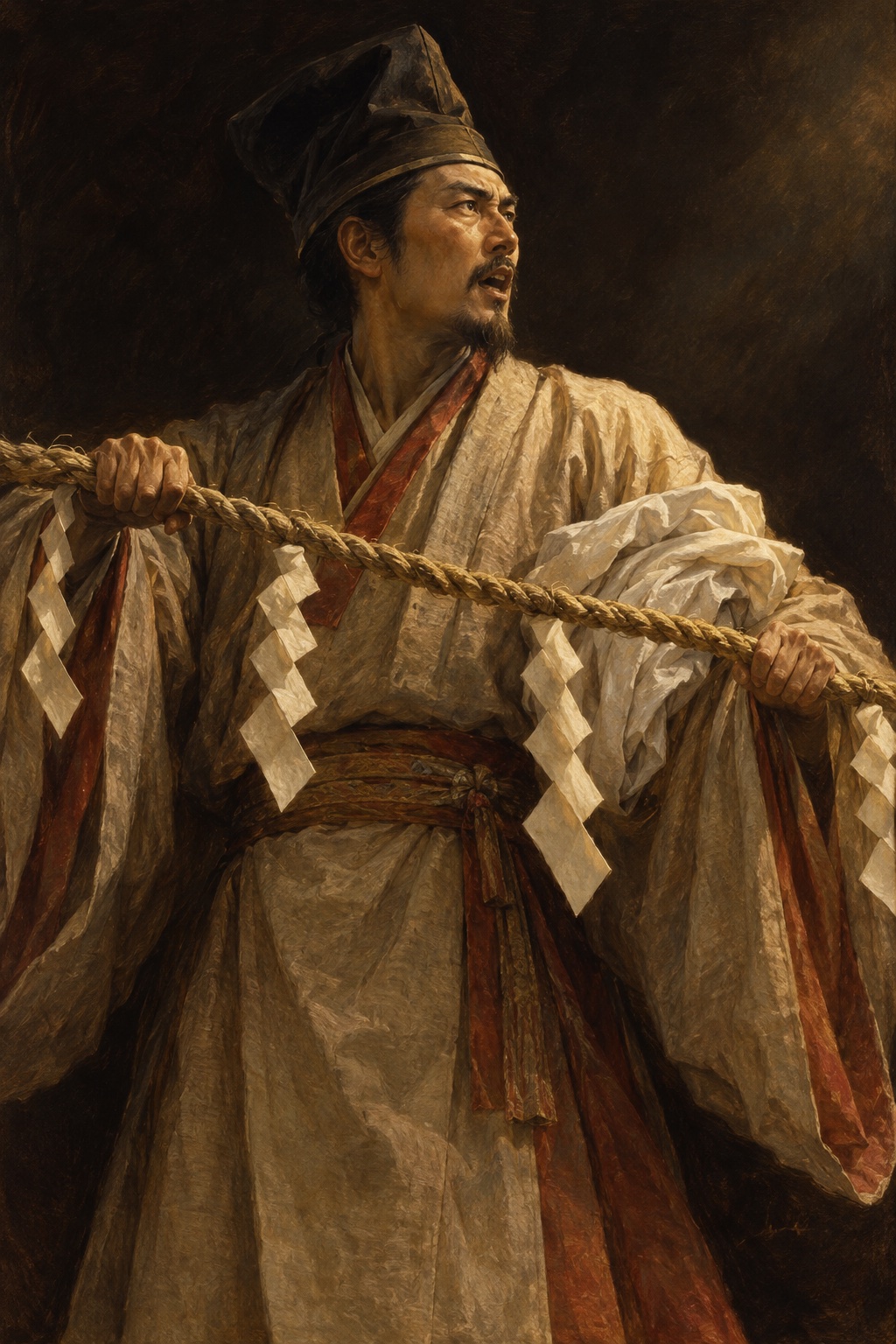
布刀御幣 — the hands that carry the offerings
Futotama is called into the Kojiki in the same breath as another god, and the chronicle keeps the two of them together for most of what follows. Susanoo’s violence in heaven has driven Amaterasu into the Heavenly Rock-Dwelling, the world has gone dark, and the eight hundred myriad deities are gathered in the bed of the Tranquil River of Heaven, where Omoikane has been told to think of a plan. Parts of that plan are already in other hands — Ishikoridome at the mirror, Tama-no-oya at the long string of curved jewels — when the assembly summons 天兒屋命、布刀玉命, Ame-no-Koyane and Futotama, as a pair, and sets them both to the divination with a stag’s shoulder-blade and the cherry-bark of the Heavenly Mount Kagu. That act is joint, and the chronicle never reports what came of it. Then a true sakaki of five hundred branches is torn up by the roots and dressed — the curved jewels on its upper branches, the eight-foot mirror on the middle ones, white and blue offerings on the lower — and the sentence finally splits the work in two.
此種種物者,布刀玉命、布刀御幣登取持而天兒屋命,布刀詔戶言,祷白
“His Augustness Grand-Jewel taking these divers things and holding them together with the grand august offerings, and His Augustness Heavenly-Beckoning-Ancestor-Lord prayerfully reciting grand liturgies” — Kojiki, Sect. XVI, tr. Basil Hall Chamberlain (1882)
取持 — he takes, and he holds. Chamberlain never romanises this god either. Across the whole of Section XVI he is only “His Augustness Grand-Jewel,” an English calque of 布刀玉命, and the syllables Futotama appear nowhere on the page. What he carries is a whole loaded tree and, with it, the 布刀御幣, the grand august offerings — the honorific 布刀 fastened to the things in his arms exactly as it is fastened to the words in the other god’s mouth. None of it is his own making: Ishikoridome cast the mirror, Tama-no-oya strung the jewels, and Futotama’s office is to bear them where they are wanted. That is how his hands appear again a few clauses later, when Ame-no-Uzume’s dance and the laughter of the assembly have drawn Amaterasu to open the rock door a crack. He and Ame-no-Koyane push the mirror out into the gap together — 指出其鏡, the clause quoted on Ame-no-Koyane’s page — and through the entire rescue the Kojiki gives him not one word of speech.
尻久米繩 — the rope and the sentence
The mirror does its work. Amaterasu finds the reflection stranger still, edges out past the door to look, and Ame-no-Tajikarao, hidden at the side of it, takes her august hand and pulls her clear. The darkness is over at that instant. What happens next is not part of the rescue at all, and it is the only thing in the Kojiki that Futotama does alone.
即布刀玉命,以尻久米〈此二字以音〉繩,控度其御後方, 白一作「自」言:「從此以内,不得還入!」
“His Augustness Grand-Jewel drew the bottom-tied rope along at her august back, and spoke, saying: ‘Thou must not go back further in than this!’” — Kojiki, Sect. XVI, tr. Basil Hall Chamberlain (1882)
控度其御後方 — he draws the rope across behind her, between the goddess and the door she has just come out of, and then he speaks. 從此以内,不得還入: from here inward, no going back. It is the one line of speech the chronicle ever puts in his mouth, and the mood of it is worth noticing. This is not a prayer and not a petition; nobody is being asked for anything. A god who has spent the entire episode carrying other gods’ handiwork turns and lays a prohibition on the highest deity in the book — and the Kojiki records no objection, no reply and no consequence. It says that he drew the rope, and that he spoke.
Two of the source page’s own marks stand inside the quoted line and are kept as printed. 〈此二字以音〉 directs that the two characters 尻久米 be taken for their sound rather than their sense, which is also why the rope’s name cannot be found as a single string on that page: the gloss sits between 尻久米 and 繩. And 一作「自」 is a textual note of the ordinary kind — another witness reads 自 where this one reads 白, the verb of speaking. Neither belongs to the myth, and this atlas edits out neither, on the same rule that keeps the annotations inside Kamimusubi’s quoted lines.
Where the rope came from, how it was made, and what a cord could do against a deity who has just walked out through a boulder, the chronicle does not say. Chamberlain gives 尻久米繩 as the bottom-tied rope and leaves it there. The force of the act is in the pairing rather than in the object: a line drawn behind a returning sun, and a sentence that makes the line mean something. Holding is what Futotama was given to do, and this is the moment he stops holding and ordains instead.
麗美 — the liturgy the other chronicle gives him
The Nihon Shoki writes his name with different characters — 太玉命 against the Kojiki’s 布刀玉命 — and tells the rock-cave crisis more than once. In its main narrative he stands beside Ame-no-Koyane as 忌部遠祖太玉命, distant ancestor of the Imbe, in the sentence quoted on Omoikane’s page; that sentence runs out on his name before it reaches a verb, so the main text shows him present and never shows him act. Among the 一書, the alternative writings the chronicle gathers after each episode, the third one goes considerably further.
乃使忌部首遠祖太玉命執取。而廣厚稱辭祈啓矣。于時日神聞之曰。頃者人雖多請。未有若此言之麗美者也
“Futo-dama no Mikoto, ancestor of the Imbe no Obito, was thereupon made to take these things in his hand, and, with lavish and earnest words of praise, to recite a liturgy. When the Sun-Goddess heard this, she said:—‘Though of late many prayers have been addressed to me, of none has the language been so beautiful as this.’” — Nihongi, Book I, tr. W. G. Aston (1896)
Aston romanises him “Futo-dama,” with a hyphen and a voiced second element; this atlas writes Futotama in its own prose and keeps the translator’s spelling inside the quotation, the same arrangement Ame-no-Koyane’s page makes for Aston’s two spellings of his name. 執取 is still the holding — the dressed tree goes into his hands here as it does in the Kojiki. It is what follows that has no counterpart: 廣厚稱辭祈啓矣, and the chronicle for once reports what the deity behind the door made of a prayer. 未有若此言之麗美者也.
Be exact about the reach of that. The passage ends on her verdict; it does not say the rock door opened because of the words, and neither does this entry. What it establishes is narrower and stranger than a cause. Of everything uttered at the rock-cave across both chronicles — Omoikane’s counsel, Ame-no-Uzume’s answer through the gap, the grand liturgy of Ame-no-Koyane — the one utterance a deity stops to praise belongs to the god whom the Kojiki never lets speak until the door is shut behind her. The two books do not agree about this figure, and an entry that smoothed the disagreement away would lose the most interesting thing about him.
忌部首等之祖 — the house that comes out of it
Both chronicles send him down a second time. When Amaterasu’s grandson Ninigi-no-Mikoto descends from heaven, Futotama goes with him as one of five, alongside Ame-no-Koyane, Ame-no-Uzume, Ishikoridome and Tama-no-oya — the same company that worked the rock-cave, dispatched again with a mandate in place of an emergency. The Kojiki closes its list of the five by glossing each name with the house that came from it, and disposes of the two ritualists in one breath: Ame-no-Koyane’s gloss is 中臣連等之祖, ancestor of the Nakatomi, and his is 布刀玉命者〈忌部首等之祖〉, ancestor of the Imbe Headmen. The Nihon Shoki says the same thing in its own characters and says it twice — 忌部遠祖太玉命 in the main narrative, 忌部首遠祖太玉命 in the passage above.
Two chronicles, two spellings of the name and two translators agree on that one fact, which is more agreement than this figure gets anywhere else. What they agree about is descent, though, and not office. Between the pair of them the ritual work of the rock-cave falls into two halves — a voice, and a pair of hands — and the Nihon Shoki’s third 一書 promptly swaps which god holds which half, which is a good reason to be careful about reading either book as a charter for anything. Whatever the historical Imbe did at court is institutional history that neither chronicle writes. What the chronicles do is stand an ancestor at the mouth of the cave with the offerings in his arms, and give him one line of speech: from here inward, no going back.