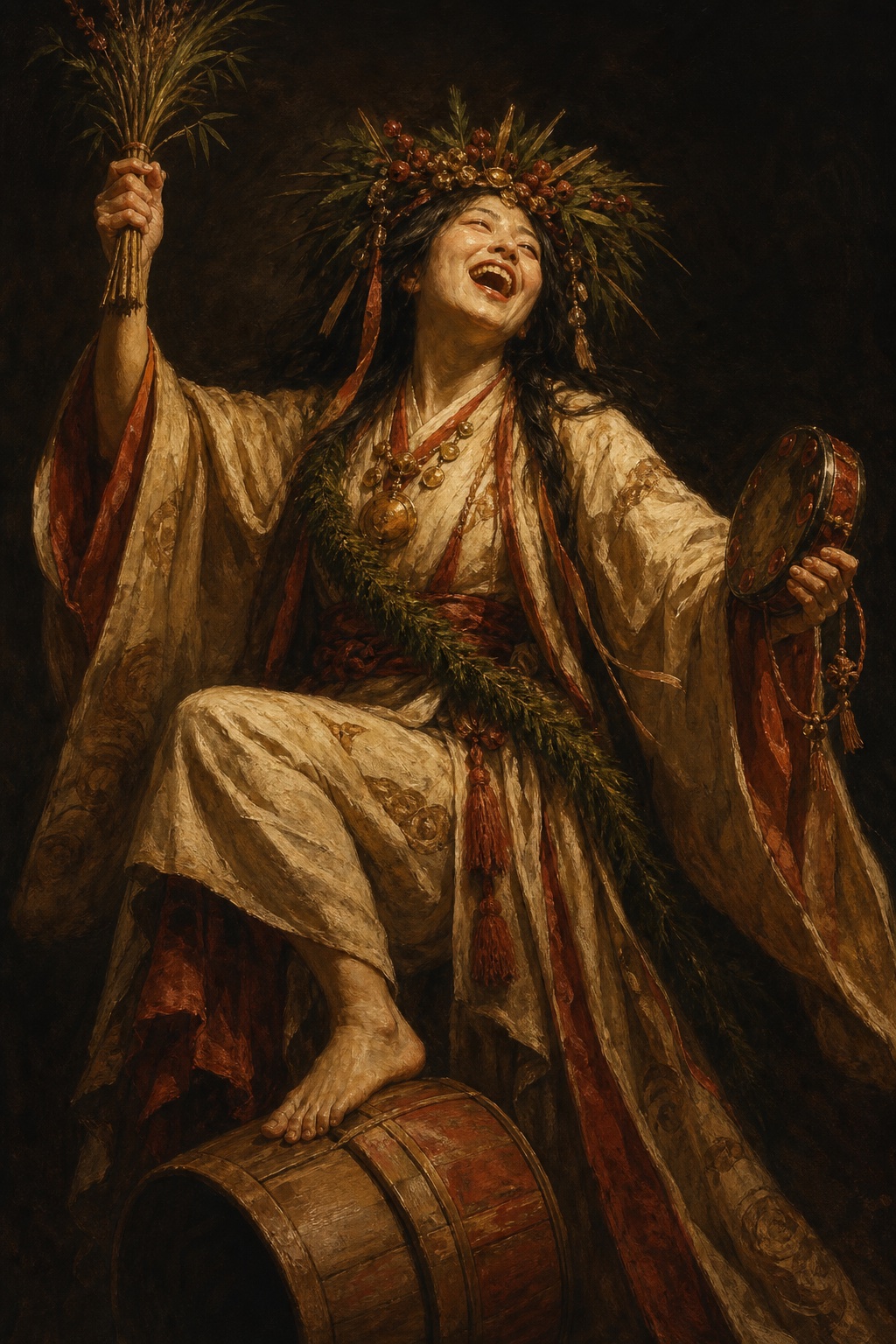
The dance before the Rock-Dwelling
Susanoo’s rampage in heaven — breaking down Amaterasu’s rice-field dikes, flinging a flayed horse into her weaving hall — drives the sun goddess to seal herself inside the Heavenly Rock-Dwelling, and the world goes dark. The eight hundred myriad gods gather at her door and settle on a plan to draw her out: a performance, staged right on the threshold, and the performer is Ame-no-Uzume.
天宇受賣命,手次繋天香山之天之日影而為鬘一作「縵」 (天)之真拆一作「折」而手草結天香山之小竹葉而〈訓小竹云佐佐〉 ,於天之石屋戶伏汙氣〈此二字以音〉而蹈登杼吕許志〈此五字以音〉 ,為神懸而掛出胸乳,裳緒忍垂於番登也。尒,高天原動而八百萬神共咲
“Her Augustness Heavenly-Alarming-Female hanging [round her] the heavenly clubmoss from the Heavenly Mount Kagu as a sash, and making the heavenly spindle-tree her head-dress, and binding the leaves of the bamboo-grass of the Heavenly Mount Kagu in a posy for her hands, and laying a sounding-board before the door of the Heavenly Rock-Dwelling, and stamping till she made it resound and doing as if possessed by a Deity, and pulling out the nipples of her breasts, pushing down her skirt-string usque ad privatas partes. Then the Plain of High Heaven shook, and the eight hundred myriad Deities laughed together” — Kojiki, Sect. XVI, tr. Basil Hall Chamberlain (1882)
“Her Augustness Heavenly-Alarming-Female” is Chamberlain’s own calque of her name, not an invented epithet. Every prop in the passage becomes one of her attributes: the club-moss sash and the spindle-tree headdress, both cut from the Heavenly Mount Kagu, the bamboo-grass posy bound for her hands, and the sounding-board — Chamberlain’s word for what the standard modern gloss calls the overturned tub — which she stamps into a drum under her own feet. Working herself into a trance, she then bares herself, and that, not the dance alone, is what the assembled gods roar at. Modern scholarship reads the exposure as ritual rather than indecent: an apotropaic or fertility rite, meant to provoke a burst of laughter powerful enough to counter the catastrophe of a vanished sun. The text itself stays matter-of-fact about it, narrating the act and its effect in the same unbroken sentence and moving straight on. The effect lands immediately — the noise of eight hundred myriad gods laughing at once is what makes Amaterasu, inside, curious enough to crack open the door and ask why the world seems to be celebrating in total darkness, which is the opening the rest of the plan has been waiting for.
Confronting Sarutahiko on the road
Generations later, heaven sends Amaterasu’s grandson Ninigi-no-Mikoto down to found the imperial line, and the descent stalls at the crossroads of Heaven, where a deity blocks the way — radiant enough, and frightening enough, that none of the escorting gods will approach him. Uzume is sent in their place, and she does not hesitate.
天鈿女乃露其胸乳。抑裳帶於臍下。而笑㖸向立。是時、衢神問曰。天鈿女、汝爲之何故耶。對曰。天照大神之子所幸道路。有如此居之者誰也。敢問之。衢神對曰。聞天照大神之子今當降行。故奉迎相待。吾名是猿田大神
“So Ame no Uzume forthwith bared her breasts and, pushing down the band of her garment below her navel, confronted him with a mocking laugh. Then the God of the cross-ways asked her, saying:—‘Ame no Uzume! What meanest thou by this behaviour?’ She answered and said:—‘I venture to ask who art thou that dost thus remain in the road by which the child of Ama-terasu no Oho-kami is to make his progress?’ The God of the cross-ways answered and said:—‘I have heard that the child of Ama-terasu no Oho-kami is now about to descend, and therefore I have come respectfully to meet and attend upon him. My name is Saruta-hiko no Oho-kami’” — Nihongi, Book II, tr. W. G. Aston (1896)
The gesture repeats the rock-cave performance almost prop for prop — bared, unafraid, played for effect — but the register has changed from celebration to confrontation, aimed straight at the obstacle rather than staged for an audience behind a closed door. It works at once: the god names himself and turns out to pose no threat at all, only a local deity of the crossroads who has come to guide Ninigi-no-Mikoto’s party down to earth. Heaven had judged Uzume uniquely equal to facing him down by the sheer force of her expression, before anyone knew that was all it would take. The name is worth a second look: the kanbun on zh.wikisource has him say 吾名是猿田大神 — Saruta-no-Ōkami — while Aston’s English gives “Saruta-hiko no Oho-kami”. 彦 appears nowhere on that page, so the hiko is an edition difference rather than a slip on either side. Later Shinto folk tradition remembers Uzume and Sarutahiko as a married pair, but that is a later elaboration neither Aston nor Chamberlain states; in the text itself what she wins from the encounter is his name and his submission, earned by confronting him when no other god would.
Escort of the descent
Ame-no-Uzume is one of five deities both the Kojiki and the Nihongi name as accompanying Ninigi-no-Mikoto’s descent to Takachiho, alongside Ame-no-Koyane, Futotama, Ishikoridome and Tama-no-oya. Her own task afterward, per the Kojiki, is escorting the pacified Sarutahiko home and taking his name for her own — the origin, in later tradition, of a hereditary priestly title, the Sarume. The two scenes together are usually read as the myth that grounds kagura, the sacred dance still performed at Shinto shrines today: laughter that draws a hidden god out into the open, and a mocking confrontation that talks a fearsome one down, are the two things Ame-no-Uzume is remembered for doing.