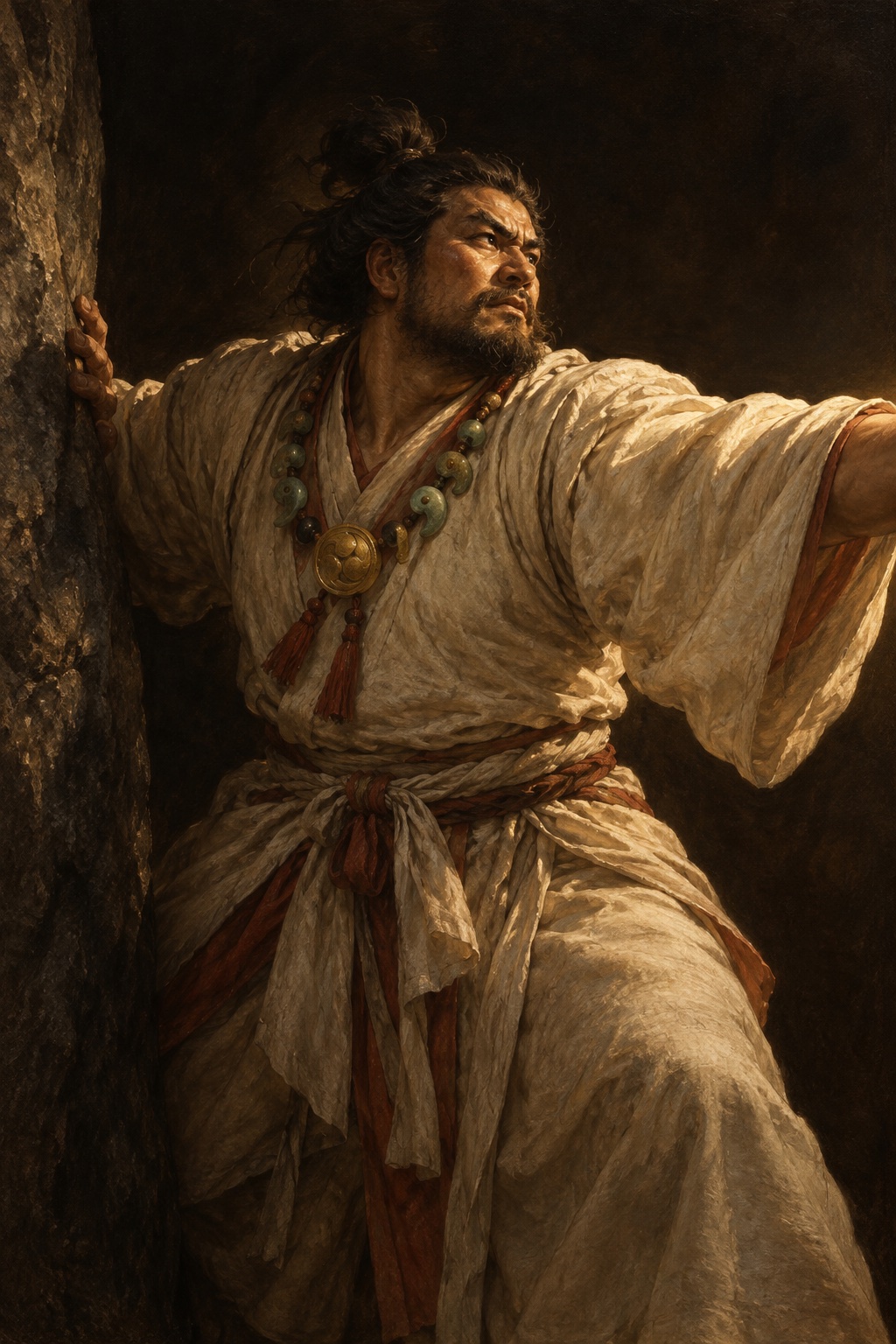
隱立戶掖 — hidden beside the door
Ame-no-Tajikarao has no arrival scene and no parentage; the Kojiki simply puts him in place. Susanoo’s violence in heaven has driven Amaterasu into the Heavenly Rock-Dwelling, the world has gone dark, and the eight hundred myriad deities have gathered in the bed of the Tranquil River of Heaven and told Omoikane to think of a plan. The chronicle then runs that plan as one enormous sentence, a clause for each god: a smith at the heavenly iron, Ishikoridome at the mirror, Tama-no-oya at the string of curved jewels, Ame-no-Koyane and Futotama at the divination and then at the dressed sakaki — Futotama holding it, Ame-no-Koyane reciting the grand liturgy over it. The very next clause is his, and it is one of the shortest in the sentence.
天手力男神,隱立戶掖
“the Heavenly Hand-Strength-Male-Deity standing hidden beside the door” — Kojiki, Sect. XVI, tr. Basil Hall Chamberlain (1882)
A name, a posture and a place — the clause gives nothing else. Chamberlain translates the name rather than transliterating it, as he does for Ame-no-Koyane and Futotama, and the syllables Ame-no-ta-jikara-wo-no-kami surface only in his notes; “Hand-Strength-Male” is a calque of 手力男, and the name is the whole of what the text ever says about his strength. He carries no object of his own, the way Futotama carries the offerings or Ishikoridome’s mirror hangs on the tree, and he is given no words. Notice, too, where he stands in the sentence. Every other clause around his is a rite already under way — divining, holding, reciting, and in the very next breath Ame-no-Uzume’s dance. His is the one clause in which nothing is being done yet. 隱立戶掖: he is hidden, and he is waiting, at the side of the door.
The Kojiki does not say who stationed him there. The Nihon Shoki’s main narrative does. In the same sentence that credits Omoikane with deep and far-reaching counsel, Omoikane gathers the long-singing birds of the Eternal Land and then — 亦以手力雄神立磐戶之側 — has the god stand beside the rock door; the passage is quoted on Omoikane’s page, and it is why this entry names Omoikane as the ally who posted him. The two chronicles do not describe the post in quite the same way. The Nihon Shoki writes 雄 where the Kojiki writes 男, and it has no 隱: in the second chronicle he simply stands beside the door. Only the Kojiki hides him.
取其御手引出 — the hand, not the door
What he is waiting for takes several more sentences to arrive. Ame-no-Uzume’s dance ends with the Plain of High Heaven shaking and the eight hundred myriad deities laughing together; Amaterasu, shut inside, finds this strange enough to open the rock door a crack and ask how heaven can be merry while the world is dark. Uzume answers that they rejoice because a deity nobler than she is present, and while she is still speaking Ame-no-Koyane and Futotama push the mirror forward into the gap and show it to Amaterasu — the clause quoted on Ame-no-Koyane’s page. The goddess is the subject of what follows.
逾思奇而稍自戶出而臨坐之時,其所隱立之(天)手力男神,取其御手引出
“more and more astonished, gradually came forth from the door and gazed upon it, whereupon the Heavenly-Hand-Strength-Male-Deity, who was standing hidden, took her august hand and drew her out” — Kojiki, Sect. XVI, tr. Basil Hall Chamberlain (1882)
其所隱立之 — the chronicle does not bother to reintroduce him. It points back to the earlier clause and names him by his post, the one who was standing hidden, so that the waiting and the act are stitched together across everything that happened in between. Then two verbs. 取其御手: he takes her hand, and the honorific 御 sits on the hand itself. 引出: he draws her out. That is the whole of the rescue as far as he is concerned, and it is worth being exact about what it is not. The Kojiki never has him touch the door. Amaterasu opens it herself, and she has already come part of the way out, more astonished still once the mirror is shown to her, when his hand closes on hers. Nor does the text describe any effort: no strain, no resistance, nothing the name’s promise of strength is ever tested against. What the chronicle does make plain is that of all the deities at the rock-cave he is the only one who lays a hand on her. The laughter, Uzume’s answer and the mirror all work on Amaterasu from a distance; he is the contact.
Two small matters of the page. At his first mention the source prints his name as 天手力男神, but here the 天 stands inside parentheses, (天)手力男神 — an editorial mark of the zh.wikisource text, kept as printed, like the parenthesised 天 inside the line quoted on Ame-no-Uzume’s page. Chamberlain’s English keeps “Heavenly” in both places, and changes only a hyphen. And the sentence does not end on him. In the next breath Futotama draws the shirikume rope across behind the goddess and forbids her to go back in, and only then do the Plain of High Heaven and the Central Land of Reed-Plains grow light again.
手力雄神 — the second chronicle
The Nihon Shoki tells the rock-cave crisis in its own characters and more than once. In its main narrative Amaterasu hears the noise of Ame-no-Uzume’s performance before the cave, wonders aloud how Uzume can be so merry when she had expected the land to lie in long night, opens the rock door a narrow space with her own hand and peeps out. No mirror is pushed forward at this point, and no one speaks to her. The god Omoikane posted beside the door acts at once.
時手力雄神則奉承天照大神之手引而奉出
“Then Ta-jikara-wo no Kami forthwith took Ama-terasu no Oho-kami by the hand, and led her out” — Nihongi, Book I, tr. W. G. Aston (1896)
It is the same act as the Kojiki’s, and the second chronicle agrees on the one thing that matters: the hand, not the door. The difference is in where the reverence sits. In the pull itself the Kojiki put its honorific on the goddess’s hand, 御手; the Nihon Shoki puts it on his actions instead, and puts it there twice — 奉承 as he takes the hand, 奉出 as he brings her out — the vocabulary of a servant handling what belongs to a superior. Aston’s English does not carry the honorifics over and keeps the plain sense, “took … by the hand, and led her out,” a gentler verb than Chamberlain’s “drew”. The name changes too. The main narrative writes 手力雄神 both times it names him, with 雄 for the Kojiki’s 男 and no 天 in front, and Aston romanises it “Ta-jikara-wo no Kami”; this atlas writes Ame-no-Tajikarao in its own prose and leaves every quotation in the spelling of the text it comes from.
坐佐那那縣也 — not one of the five
He appears once more in the Kojiki, generations later, when Amaterasu’s grandson Ninigi-no-Mikoto is sent down from heaven to rule the land below. The chronicle first names the company that descends with him — Ame-no-Koyane, Futotama, Ame-no-Uzume, Ishikoridome and Tama-no-oya, “in all five chiefs of companies” in Chamberlain’s English — and afterwards glosses each of the five with the house that claims descent from them. Ame-no-Tajikarao is not among them. He comes in the next sentence, which joins to Ninigi-no-Mikoto the curved jewels and the mirror that had lured Amaterasu from the cave, the sword Kusanagi, and three deities with them: 常世思金神、手力男神、天石門別神 — Omoikane, Ame-no-Tajikarao, and Ame-no-Iwato-wake, Chamberlain’s “Deity Heavenly-Rock-Door-Opener”. That sentence is quoted on Ninigi-no-Mikoto’s page. He goes down, then, not in the company of the five but in the gift, named alongside the regalia, and the Kojiki names no house descended from him.
The chronicle then says, one after another, where they come to rest, with a fourth deity slipped into the list. The mirror and Omoikane are worshipped at the temple of Isuzu; the Deity of Luxuriant-Food, who was no part of the gift, dwells at the outer temple of Watarahi; Ame-no-Iwato-wake, given two further names, is the deity of the August Gate. His own line comes last.
次,手力男神者,坐佐那那縣也
“The next, the Deity Hand-Strength-Male, dwells in Sanagata” — Kojiki, Sect. XXXIII, tr. Basil Hall Chamberlain (1882)
No temple, no office, no second name — only a place and one verb, 坐, dwells. It is the Kojiki’s last word on him. In both of these late clauses the 天 is gone from his name, and Chamberlain’s “Heavenly” goes with it. The chronicle does not say where Sanagata is.
One of Chamberlain’s footnotes to this section records a suggestion of the scholar Hirata: that Ame-no-Iwato-wake is not an independent deity but another name for Ame-no-Tajikarao. Chamberlain thinks the part Ame-no-Tajikarao plays at the rock-cave is warrant enough for the idea, and notes in the same breath that a little lower down in the section the two are mentioned separately again. The kanbun bears that out. It lists them as two deities, gives Ame-no-Iwato-wake his own names and his own charge at the gate, and gives Ame-no-Tajikarao this one line; this entry follows the text and treats them as two. In the Kojiki he never touches the door; in the one telling where he does, he pulls it open, and the light does the rest.