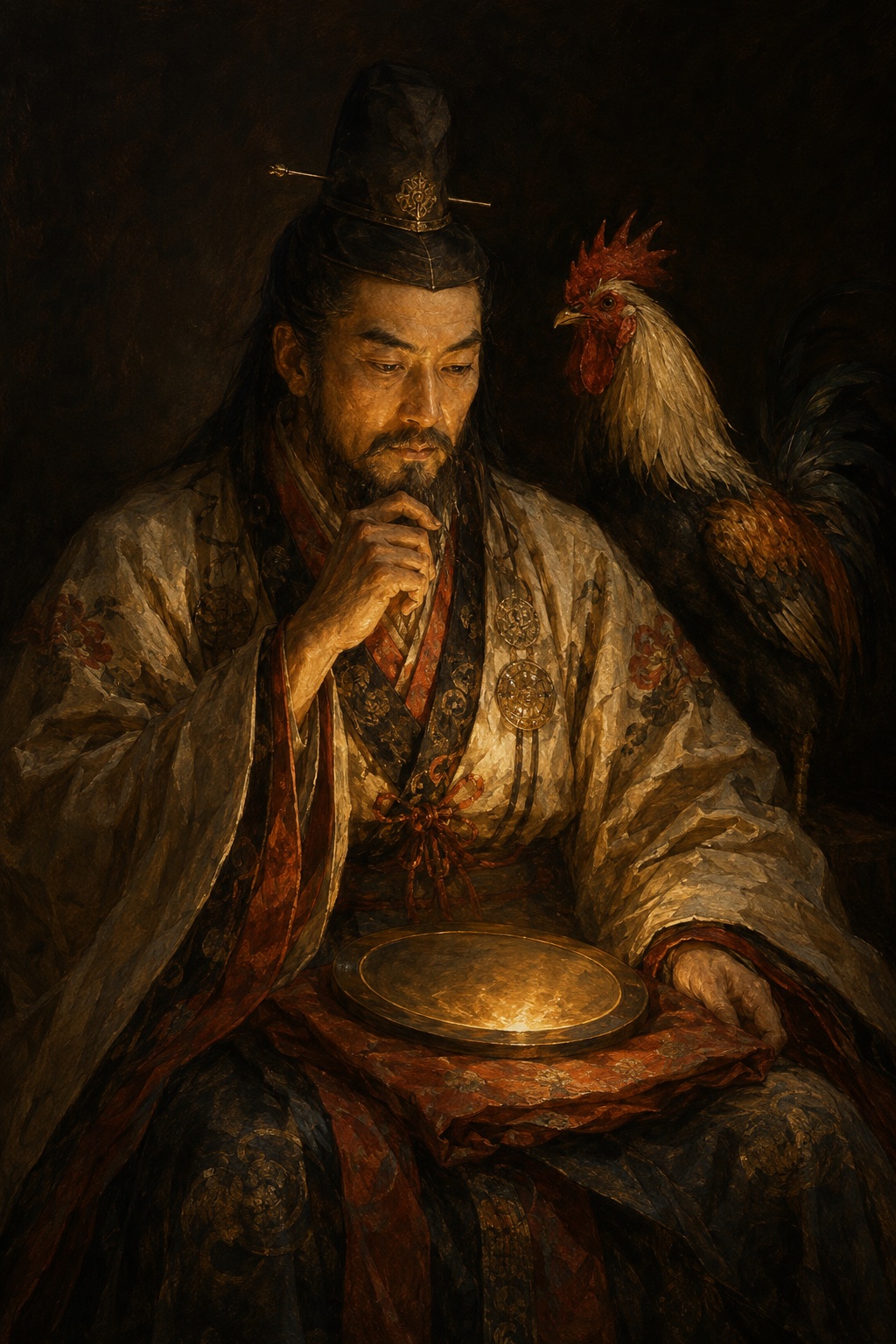
Bid to think of a plan
Susanoo’s rampage in heaven has driven Amaterasu to seal herself inside the Heavenly Rock-Dwelling, and the world has gone dark. The eight hundred myriad deities gather in the bed of the Tranquil River of Heaven to work out what to do, and this is where he enters the story — named for the first time by his parentage and his job in the same clause.
是以八百萬神,於天安之河原神集集而〈訓集云都度比〉 ,高御産巢日神之子思金神,令思〈訓金云加屋一作「尼」〉而,集常世長鳴鳥,令鳴而取天安河之河上之天堅石,取天金山之鐵而求鍛人天津麻羅而〈麻羅二字以音〉 ,科伊斯許理度賣命〈自伊下六字以音〉令作鏡
“Therefore did the eight hundred myriad Deities assemble in a divine assembly in the bed of the Tranquil River of Heaven, and bid the Deity Thought-Includer, child of the High-August-Producing-Wondrous-Deity think of a plan, assembling the long-singing birds of eternal night and making them sing, taking the hard rocks of Heaven from the river-bed of the Tranquil River of Heaven, and taking the iron from the Heavenly Metal-Mountains, calling in the smith Ama-tsu-ma-ra, charging Her Augustness I-shi-ko-ri-do-me to make a mirror” — Kojiki, Sect. XVI, tr. Basil Hall Chamberlain (1882)
“Child of the High-August-Producing-Wondrous-Deity” is Chamberlain’s calque for Takamimusubi, and the two facts — whose son he is, and what he is called — arrive in the same breath because the Kojiki treats them as one fact. He is not simply one of the eight hundred myriad gathered at the river-bed; he is the one they single out from among themselves and command to think, 令思, on their behalf. Everyone else named in the sentence is given a craft instead: Ama-tsu-ma-ra is the smith, Ishikoridome makes the mirror, the long-crowing birds themselves are gathered and made to sing. Omoikane’s own assignment carries no craft in it at all. He supplies the plan; every object the sentence goes on to list — the birds, the hard rock, the iron, the mirror — is that plan already being carried out by somebody else’s hands. The same unbroken sentence runs on past the mirror, through the jewels and the sakaki tree, to Ame-no-Uzume’s dance before the sealed door — the performance that finally draws Amaterasu out to see what the commotion is about.
Whom to send to pacify the earth
Generations later, a different crisis reaches the same river-bed. Amaterasu wants the Central Land of Reed-Plains for her own descendants, but the messengers already sent to prepare it keep failing to return. Takamimusubi and Amaterasu convene the eight hundred myriad deities again, and command Omoikane to think a second time — the same verb, 令思, put to him again.
尒高御産巢日神、天照大御神之命以,於天安河之河原,神集八百萬神集而思金神令思而詔:「此葦原中國者,我御子之所知國,言依所賜之國也。故以爲於此國道速振荒振國神等之多在,是使何神而將言趣?」尒思金神及八百萬神議,白之:「天菩比神,是可遣。」
“Then the High-August-Producing-Wondrous-Deity and the Heaven-Shining-Great-August-Deity commanded the eight hundred myriad Deities to assemble in a divine assembly in the bed of the Tranquil River of Heaven, and caused the Deity Thought-Includer to think [of a plan], and said: ‘This Central Land of Reed-Plains is the land with which we have deigned to charge our august child as the land which he shall govern. So as he deems that violent and savage Earthly Deities are numerous in this land, which Deity shall we send to subdue them?’ Then the Deity Thought-Includer and likewise the eight hundred myriad Deities took counsel and said: ‘The Deity Ame-no-ho-hi is the one that should be sent.’” — Kojiki, Sect. XXX, tr. Basil Hall Chamberlain (1882)
The answer he and the assembly reach is Ame-no-Hohi, and it is the wrong one: sent down, Ame-no-Hohi curries favour with Okuninushi instead and sends back no word for three years. The failure does not fall on Omoikane. The Kojiki has the assembly return to him afterward, and he names another envoy, Ame-no-Waka-hiko, who fails in turn — and the search for the right messenger runs on past both of them before it finally lands on Takemikazuchi, whose sword-point embassy the corpus already tells in full. Omoikane’s own part in that outcome never changes: he is asked, and he names somebody else to go.
深謀遠慮 — a second witness
The Nihon Shoki tells the rock-cave crisis too, in its own words, on the very page this wiki already draws on for Amaterasu’s retreat into the cave — and its account of the eighty myriad gods’ council picks up in the sentence directly following the one that ends “the alternation of night and day was unknown.” That silence is exactly where Omoikane appears.
于時八十萬神會合於天安河邊計其可祷之方。故思兼神深謀遠慮。遂聚常世之長鳴鳥。使互長鳴。亦以手力雄神立磐戶之側。而中臣連遠祖天兒屋命。忌部遠祖太玉命
“Then the eighty myriads of Gods met on the bank of the Tranquil River of Heaven, and considered in what manner they should supplicate her. Accordingly Omohi-kane no Kami, with profound device and far-reaching thought, at length gathered long-singing birds of the Eternal Land and made them utter their prolonged cry to one another. Moreover he made Ta-jikara-wo no Kami to stand beside the Rock-door. Then Ame no Koyane no Mikoto, ancestor of the Nakatomi no Muraji, and Futo-dama no Mikoto, ancestor of the Imibe” — Nihongi, Book I, tr. W. G. Aston (1896)
(The archive.org scan of Aston’s translation flattens several footnote reference marks into the running text at exactly this passage; they are omitted above as scanning apparatus, not as part of his prose.) The Nihon Shoki spells his name 思兼神, not the Kojiki’s 思金神 — a genuine difference between the two chronicles, not an error in either. 深謀遠慮, “profound device and far-reaching thought,” is the whole verdict this chronicle passes on him: no dialogue, no command spoken aloud, only the compliment and then the plan already running — the birds gathered, Ta-jikara-wo posted at the door, the ancestors of the Nakatomi and Imibe lines beginning their own parts in the rite that follows.
The plan outlives the act
No fetched text describes Omoikane’s body — no robe, no face, no implement in hand. What survives of him in both chronicles is entirely the shape of his function: he is consulted, he thinks, and everyone else moves. That holds even in his last appearance in the Kojiki. When Amaterasu’s grandson Ninigi-no-Mikoto is finally sent down to found the throne, the gods equip him with the sacred mirror and the sword and dispatch three attendants alongside him — “the Deity Thought-Includer” among them, in Chamberlain’s calque, riding along in the party of a plan he had set running generations earlier rather than doing anything himself one last time. Chichibu Shrine venerates him today under a fuller form of the same name, 八意思兼神, Yagokoro-Omoikane, as its principal deity — a later cultic title, not anything either chronicle states outright.