An enemy under the Seta bridge
The creature has one episode, and it is in the fifteenth book of the Taiheiki. It stands in the section on the fighting at Mii-dera and on that temple’s bell, and the section carries the tale of Tawara Tōda with it. The story does not begin with the creature. It begins with a man and a bridge. In the era 承平, the text says, there was a man called 俵藤太秀郷, Tawara Tōda Hidesato. One day he crossed 勢多の橋, the Seta bridge, alone, and found a 大蛇, a great serpent, lying across it. An ordinary man, the text says, would have fainted at the sight. Hidesato did not waver for a moment. He trod hard on the serpent’s back, crossed over it and walked on without looking round, and the serpent did not stir either.
Then a strange small man appeared in front of him and spoke.
我此橋の下に住事已に二千余年也。貴賎往来の人を量り見るに、今御辺程に剛なる人を未見ず。我に年来地を争ふ敵有て、動ば彼が為に被悩。可然は御辺我敵を討てたび候へ
“I have lived under this bridge for more than two thousand years. I have taken the measure of all who come and go, high and low, and never yet have I seen a man as bold as you. For years I have had an enemy who disputes the land with me, and all too often he afflicts me. If it may be, strike down my enemy for me.” — Taiheiki, Book XV; tr. Mythos Atlas
This is the first mention of the creature, and it is not a description. 年来地を争ふ敵 is an enemy who has disputed the land with the speaker for years. The text does not say which land, or how the quarrel began, and it gives the enemy no shape and no name. The speaker gives no name either. Only after the killing does the text call him 竜神, the dragon god. The episode never says in plain words that the man and the serpent on the bridge are one being. It leaves the reader to join them: the man lives under the bridge, and he praises Hidesato’s boldness just after Hidesato has walked over the serpent’s back.
Hidesato agrees without a question. He follows the man back toward Seta, and the two of them go down into the lake and on through the water to a gate and a palace. There the man puts on court dress and receives Hidesato as his guest. They feast for hours. Late in the night the household falls into alarm, because the hour has come when the enemy may attack.
Torches in its own hands
Hidesato has the five-man bow that he has kept by him all his life, and only three arrows. He waits for the enemy.
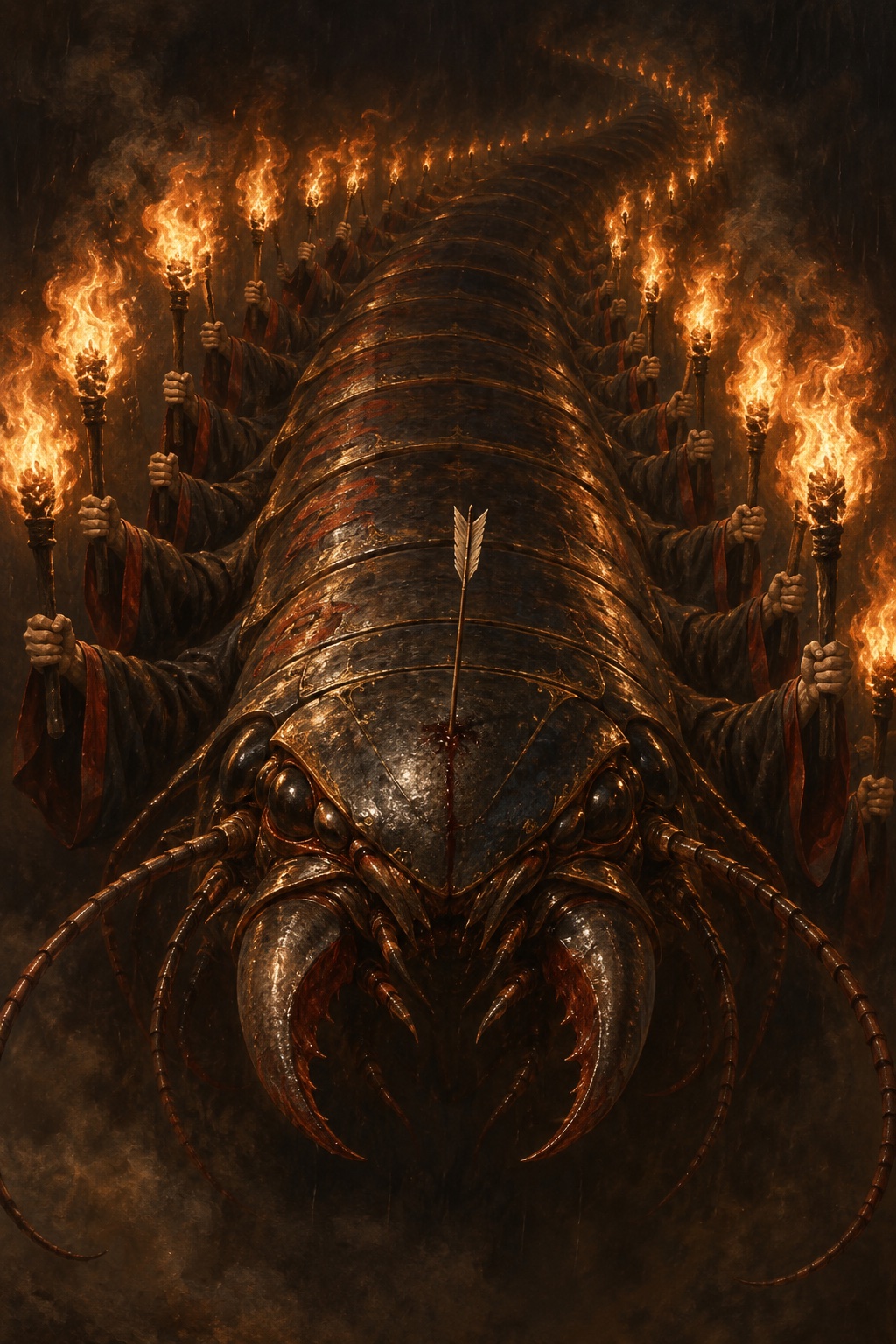
夜半過る程に雨風一通り過て、電火の激する事隙なし。暫有て比良の高峯の方より、焼松二三千がほど二行に燃て、中に嶋の如なる物、此龍宮城を指てぞ近付ける。事の体を能々見に、二行にとぼせる焼松は皆己が左右の手にともしたりと見へたり
“When midnight had passed, a burst of wind and rain went over, and the lightning flashed without a pause. After a while, from the direction of the high peaks of Hira, some two or three thousand pine torches came burning in two rows, and between them a thing like an island drew near, making for this dragon palace. When he looked closely at the shape of it, the torches burning in two rows were all, it seemed, lit in its own left and right hands.” — Taiheiki, Book XV; tr. Mythos Atlas
It comes 夜半過る程に, after midnight, in the lightning that follows a passing storm. The text sees it first as lights: 焼松, pine torches, two or three thousand of them, burning in two rows. Between the rows is 嶋の如なる物, a thing like an island, and it is making for 龍宮城, the dragon palace where Hidesato waits. It comes from the direction of 比良の高峯, the high peaks of Hira. The text writes 方より, from the direction of, and it does not say that the creature lives there.
Only a closer look explains the lights. 二行にとぼせる焼松, the torches burning in two rows, are all lit in its own hands, 左右の手, its left and right hands. The text writes 手, hands. It does not count them, and it says nothing of legs, eyes, colour or length. What it shows is light and bulk: two lines of fire, and something like an island moving between them. At this point the text still has no word for what the creature is.
Three arrows to the brow
Hidesato knows it at once, and the text gives the whole fight in one passage.
あはれ是は百足蜈蚣の化たるよと心得て、矢比近く成ければ、件の五人張に十五束三伏忘るゝ許引しぼりて、眉間の真中をぞ射たりける。其手答鉄を射る様に聞へて、筈を返してぞ不立ける。秀郷一の矢を射損て、不安思ひければ、二の矢を番て、一分も不違態前の矢所をぞ射たりける。此矢も又前の如くに躍り返て、是も身に不立けり。秀郷二つの矢をば皆射損じつ、憑所は矢一筋也。如何せんと思けるが、屹と案じ出したる事有て、此度射んとしける矢さきに、唾を吐懸て、又同矢所をぞ射たりける。此矢に毒を塗たる故にや依けん、又同矢坪を三度迄射たる故にや依けん、此矢眉間のたゞ中を徹りて喉の下迄羽ぶくら責てぞ立たりける。二三千見へつる焼松も、光忽に消て、島の如に有つる物、倒るゝ音大地を響かせり。立寄て是を見るに、果して百足の蜈蚣也
“Ah, he understood, this is a centipede that has changed its shape. When it came within bowshot, he drew that same five-man bow to fifteen fists and three fingers, so hard that he forgot all else, and shot at the very middle of its brow. The arrow struck with a sound as if he had shot at iron, sprang back and did not stick. Hidesato had failed with his first arrow and was uneasy, so he set a second arrow to the string and shot, not a hair’s breadth off, at the very place the first had struck. This arrow too leapt back as the first had done, and it did not stick in the body either. Hidesato had failed with both his arrows, and all he could rely on was a single arrow. He wondered what to do, but then a thought came to him. He spat on the point of the arrow he was about to shoot, and shot once more at the same place. Perhaps it was because poison had been smeared on this arrow, or perhaps it was because he had struck the same mark three times; this arrow went through the very middle of the brow and drove in to the feathers, down below the throat. The two or three thousand torches that had been seen went dark at once, and the thing like an island fell with a sound that shook the earth. When he went up to it and looked, it was, as he had thought, a centipede.” — Taiheiki, Book XV; tr. Mythos Atlas
The first thing the text gives is Hidesato’s judgement: 百足蜈蚣の化たる, a centipede in a changed form. He reads the island and the torches as the shape a centipede has taken, and the end of the passage proves him right.
He aims at one place, 眉間の真中, the middle of the brow, and he hits it three times. The first arrow strikes 鉄を射る様に, as if he had shot at iron, and springs back. The second hits the same spot and springs back too. With one arrow left he spits on its point, 唾を吐懸て, and shoots the same spot once more. The text then gives two reasons for what happens and does not choose between them. One is 毒を塗たる故にや, that poison had been smeared on the arrow. The other is 三度迄射たる故にや, the third hit on one mark. It does not say that the spit was poison, and it does not say that it was not. Either way, the third arrow goes through the middle of the brow and down to below the throat.
The death is told as the end of the lights. The torches go dark at once, 光忽に消て. They were in the creature’s own hands, and they go out with it. Then 島の如に有つる物, the thing that had been like an island, falls, and the sound shakes the earth. Only now, close up, does the text give the creature a plain word: 果して百足の蜈蚣也, it was a centipede, just as Hidesato had judged.
The dragon god’s gifts
With the enemy dead, the text at last names the man from under the bridge. 竜神は是を悦て: the dragon god rejoices, entertains Hidesato in many ways, and gives him five things. They are 太刀一振, a sword; 巻絹一, a roll of silk; 鎧一領, a suit of armour; 頚結たる俵一, a rice bale tied at the neck; and 赤銅の撞鐘一口, a temple bell of red copper. He also tells Hidesato that many of his descendants will become generals.
Two of the gifts reach beyond the story. When Hidesato is back in the capital, the silk never runs out however much of it he cuts, and the rice bale never empties however much he takes out of it, so that his storehouses fill with treasure. The text says that this is why he was called Tawara Tōda, after the bale, 俵. The bell ties the tale to the chronicle around it, because the section that tells the tale is about the fighting at Mii-dera and about that temple’s bell. The creature has no further part. The chronicle gives it this one night and no other episode.
A later name and Mount Mikami
The Taiheiki never calls the creature Ōmukade. Its words for it are 百足蜈蚣 and 百足の蜈蚣, and both mean simply a centipede. Before that it is 嶋の如なる物, a thing like an island, and in the dragon god’s request it is only 我敵, my enemy. Ōmukade, the great centipede, is the later conventional name. This atlas uses it for the entry in the same way that the entry on Ryōmen Sukuna uses a later name for a figure whom the chronicle calls otherwise.
The chronicle also gives the creature no home. It comes from the direction of the Hira peaks, and the text says no more than that. Mount Mikami is not in the Taiheiki. Of the sources behind this entry, only Yei Theodora Ozaki’s English retelling of 1908, “My Lord Bag of Rice”, places the creature there, in the Dragon King’s answer to the hero.
“The Dragon King replied that its home was on the mountain Mikami, but that as it came every night at a certain hour to the palace of the lake” — Japanese Fairy Tales, “My Lord Bag of Rice”, retold by Yei Theodora Ozaki (1908)
Ozaki’s preface says that she translated her tales from a modern version by Sadanami Sanjin, and that they are not literal translations. Her story is not a translation of the Taiheiki, and it differs from the chronicle in more than the mountain. She calls the hero Fujiwara Hidesato, a name the chronicle does not use; there he is 俵藤太秀郷, and after that simply 秀郷. Her centipede comes to the palace every night at a set hour, where the chronicle says only that the enemy troubles the dragon god all too often. Her centipede also has fireballs for eyes and light in its hundred feet, and the chronicle gives it neither.
What the Taiheiki itself gives is short and complete. It gives a direction, two rows of torches held in its own hands, a body like an island, a brow like iron, and a death by the third arrow, spat upon. It gives no name of the creature’s own, no home and no size.