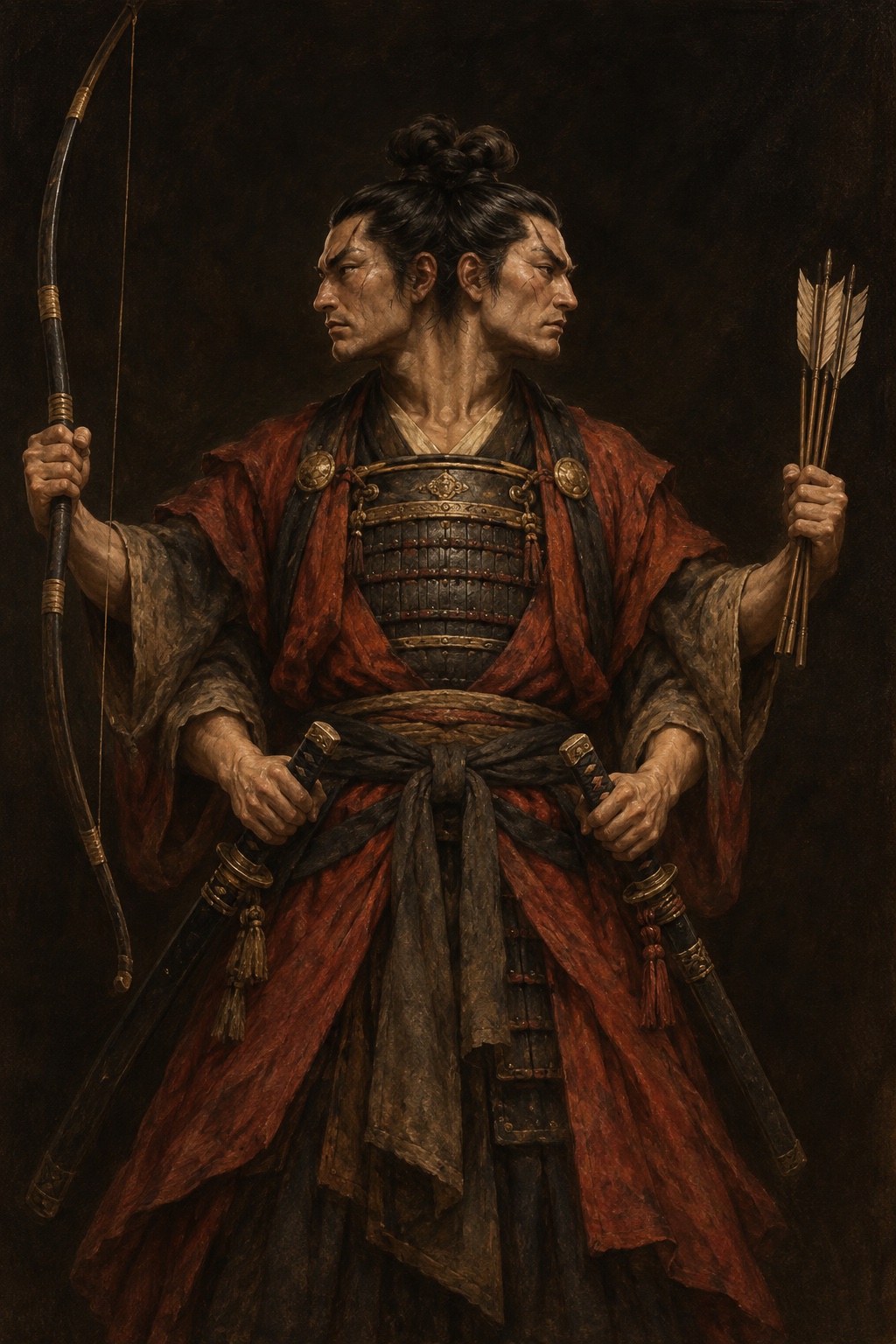
The man of Hida
The Nihon Shoki gives him one paragraph. It stands in the eleventh book, the annals of the emperor the chronicle calls 大鷦鷯天皇 — Oho-sazaki in Aston’s English, known as Nintoku — under the sixty-fifth year of the reign, which Aston dates A.D. 377. Nothing in the chronicle leads up to it, and the chronicle never names him again. The paragraph opens on a province and a man: 飛騨國有一人, in the province of Hida there was a man, and his name is given as 宿儺 and nothing more.
飛騨國有一人。曰宿儺。其爲人壹體有兩面。面各相背。頂合無項。各有手足。其有膝而無膕踵。
“In the province of Hida there was a man called Sukuna, who was so formed that on one trunk he had two faces. The faces were turned away from each other. The crowns met, and there was no nape of the neck. Each had hands and feet. There were knees, but no popliteal spaces or heels.” — Nihongi, Book XI, tr. W. G. Aston (1896)
The rest of this half of the paragraph is his body, described part by part. 壹體有兩面: one trunk, two faces. The faces look away from each other, the two crowns meet, and there is no nape. 各有手足, each side has its own hands and feet. He has knees, but no hollows behind them and no heels, and Aston gives the knee-hollow its anatomist’s name, the popliteal space. The chronicle does not explain the list, but it is consistent: the nape, the back of the knee and the heel are all parts on the back of an ordinary body, and a body with a face on each side has no back to carry them. The text counts his hands in its next sentence, where there are four. Of the lower body it says only that each side had hands and feet, and it gives no number for his legs.
The name under which he is usually known, Ryōmen Sukuna, joins two words from this passage: 兩面, the two faces of the description, and 宿儺, the name. The chronicle itself never writes the two together, and it never uses 兩面 as part of what he is called. It calls him 一人, a man. It does not call him a god or a demon; what is strange about him in its account is his body, not his nature.
Four hands and the imperial command
The second half of the paragraph turns from what he is to what he does. Aston prints one of his page references between the two halves, so the passage is quoted here in two parts, each with its own span of the original, rather than with the reference inside the quotation.
力多以輕捷。左右佩劔。四手並用弓矢。是以不隨皇命。掠略人民爲樂。於是。遣和珥臣祖難波根子武振熊而誅之。
“He was strong and nimble. He carried swords on his right and on his left side, and used bow and arrow with all four hands at once. On this account he was disobedient to the Imperial command, and took a pleasure in plundering the people. Hereupon the Emperor sent Naniha-neko Take-furu-kuma, ancestor of the Omi of Wani, who put him to death.” — Nihongi, Book XI, tr. W. G. Aston (1896)
力多以輕捷: much strength, and light and quick with it. Then the arms: a sword worn at the left and at the right, 左右佩劔, and bow and arrow used with all four hands together, 四手並用弓矢. A body that faces both ways is armed on both sides, and this is the only place where the text puts a number on his hands.
The next two characters are 是以, on this account, and they make everything before them the reason for what comes after. He did not follow the imperial command, 不隨皇命, and he took his pleasure in plundering the people, 掠略人民爲樂. The chronicle gives him no grievance, no demand and no ally, and it does not describe a single raid. His offence is stated in general terms, and the only cause it is given is the description that comes before it: the two faces, the four hands, the strength and the weapons.
The end takes one clause. 於是, hereupon, a man is sent, and he puts Sukuna to death. The kanbun gives 遣, sent, no subject; Aston supplies the Emperor. The verb for the killing is 誅, the word for putting an offender to death, and it records a punishment rather than a fight. The chronicle does not say where he was found, how he was killed or whether he resisted. A man who could use bow and arrow with four hands at once dies in two characters, 誅之.
Take-furu-kuma, ancestor of the Omi of Wani
The man who kills him is introduced by his house before his name. 和珥臣祖 comes first, the ancestor of the Omi of Wani, and then the name itself in two parts, 難波根子 and 武振熊, which Aston writes as Naniha-neko Take-furu-kuma. That is all the paragraph says of him. It gives him no speech, no stratagem and no reward, and the killing is one verb with Sukuna as its object.
The name 武振熊, with the same title 和珥臣祖, also appears in the chronicle’s ninth book, the book of the Empress Jingū. There the Empress orders him and a second commander to lead an army of several tens of thousands against Prince Oshikuma, and the name is written 武振熊 alone, without 難波根子. The chronicle does not say that the commander of that campaign and the man sent against Sukuna are one person, and this entry does not join them.
Taken whole, the record of Ryōmen Sukuna is short and complete. It gives a province but no place within it, a body but no parents, an offence but no words of his own, and an execution but no grave. It tells him in a fixed order: first the two faces and what they leave out, then the strength and the weapons, then the refusal of the command and the plunder, and last the man who is sent. Everything this atlas can say of him comes from those few sentences.