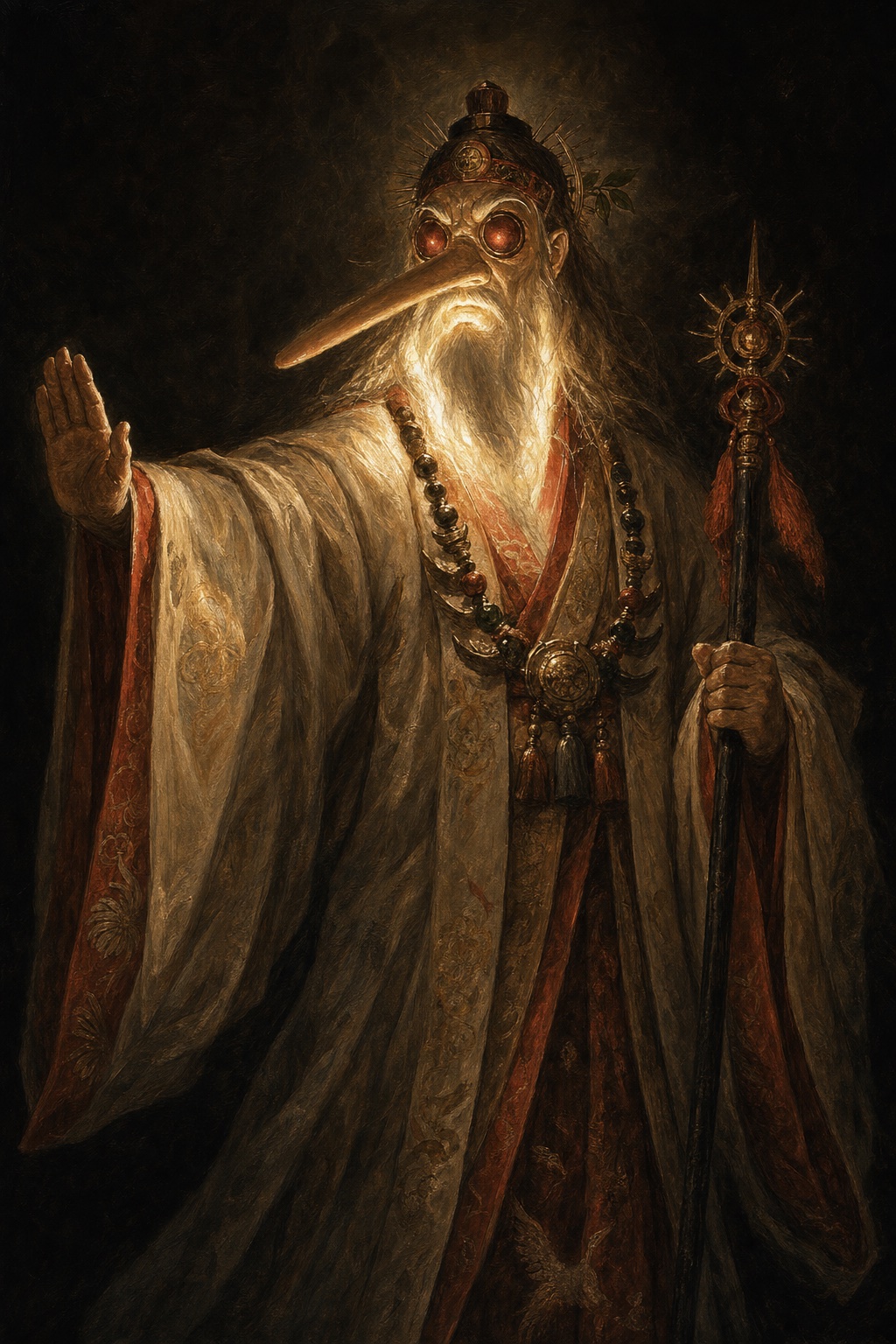
The radiant god at the crossroads
When Ninigi-no-Mikoto’s party prepares to leave Heaven for the land below, a scout goes ahead to clear the road, and comes back with a report frightening enough to stop the whole descent before it starts.
有一神。居天八達之衢。其鼻長七咫。背長七尺餘。當言七尋。且口尻明耀。眠如八咫鏡而赩然似赤酸醤也
“There is one God who dwells at the eight-cross-roads of Heaven, the length of whose nose is seven hands, the length of whose back is more than seven fathoms. Moreover, a light shines from his mouth and from his posteriors. His eye-balls are like an eight-hand mirror and have a ruddy glow like the Aka-kagachi” — Nihongi, Book II, tr. W. G. Aston (1896)
This is not a narrator’s description, and not Sarutahiko’s own word about himself — it is the scout’s report of what he has seen, carried back to the gathered gods before any of them dares approach. The proportions are not given for color: it is this report that leaves every escorting god too frightened to go near him, and immediately after hearing it they send an attendant deity to make inquiry rather than go themselves. The passage is worth reading exactly, because the popular image of Sarutahiko is not exactly this one. The ruddy glow sits in his eyes, compared to a mirror, not stated as a color of his face — a distinction later art blurs when it paints him red-faced outright. Nothing here mentions wings or a fan or any of the other trappings later tradition hangs on him as a proto-tengu; Aston gives a nose, a back, a light from his body, and bright ruddy eyes, and no more. One number is the kanbun’s own second thought: it writes 背長七尺餘 — a back more than seven shaku — and then corrects itself in the next breath, 當言七尋, “it should say seven fathoms,” which is the reading Aston translates.
An Earthly Deity offers himself as vanguard
Chamberlain’s Kojiki gives the fuller scene the scout was reporting on. Amaterasu and the High-Integrating Deity see the god’s refulgence reach from the Plain of High Heaven down to the earth below, and charge Ame-no-Uzume — judged by them alone equal to the task — to go and learn who is blocking the road.
尒日子番能迩迩藝命將天降之時,居天之八衢而上光高天原,下光葦原中國之神,於是有。故尒天照大御神、高木神之命以,詔天宇受賣神:「汝者雖有手弱女人,与伊牟迦布神〈自伊至布以音〉面勝神,故專汝往將問者:『吾御子為天降之道,誰如此而居?』」故問賜之時,答白:「僕者國神,名猿田毗古神也。所以出居者,聞天神御子天降坐,故仕奉御前而參向之侍
“So when His Augustness Prince-ear-Ruddy-Plenty was about to descend from Heaven, there was at the eight-forking road of Heaven a Deity whose refulgence reached upwards to the Plain of High Heaven and downwards to the Central Land of Reed-Plains. So then the Heaven-Shining-Great-August-Deity and the High-Integrating Deity commanded and charged the Heavenly-Alarming-Female-Deity [, saying]: “Though thou art but a delicate female, thou art a Deity who conquers in facing Deities. So be thou the one to go and ask thus: ‘This being the road by which our august child is about to descend from Heaven, who is it that is thus there?’ ” So to this gracious question he replied, saying “I am an Earthly Deity named the Deity Prince of Saruta. The reason for my coming here is that, having heard of the [intended] descent of the august child of the Heavenly Deities, I have come humbly to meet him and respectfully offer myself as His Augustness’s vanguard”” — Kojiki, Sect. XXXIII, tr. Basil Hall Chamberlain (1882)
Chamberlain gives no nose, no eyes, no measured body at all — only the radiance, and then the god’s own words once questioned. He names himself the Deity Prince of Saruta, and in the same breath calls himself an Earthly Deity: a kunitsukami, one of the gods native to the land below, set apart from the amatsukami, the heavenly gods who are about to descend upon it. He offers no resistance. He explains, unprompted once asked, that he has come to meet Ninigi’s party and to serve as its vanguard. What blocked the road, once questioned, turns out to have been waiting to guide it.
Guide of the descent
Sarutahiko keeps his word. He leads Ninigi-no-Mikoto’s party down through the parted clouds to Takachiho, the peak where the Kojiki has the heavenly grandchild found the line that becomes Japan’s imperial house. His own part in the story closes soon after: Ame-no-Uzume, the one god willing to face him down while he still looked like an obstacle, is given the task of escorting him home again once he is pacified, taking his name for her own — the origin, later tradition holds, of the hereditary Sarume priestly title. Later Shinto folk tradition goes further still and remembers Uzume and Sarutahiko as a married pair, but neither Aston nor Chamberlain says so; in the text itself, the crossroads scene ends with nothing more than his name freely given and his service freely offered. Today Sarutahiko is venerated chiefly as a guardian of roads, travel and right beginnings, at shrines such as the Tsubaki Grand Shrine and Ise’s own Sarutahiko Shrine — a devotion that follows naturally from a god first met barring one road, and then found leading the way down another.