科伊斯許理度賣命 — charged to make a mirror
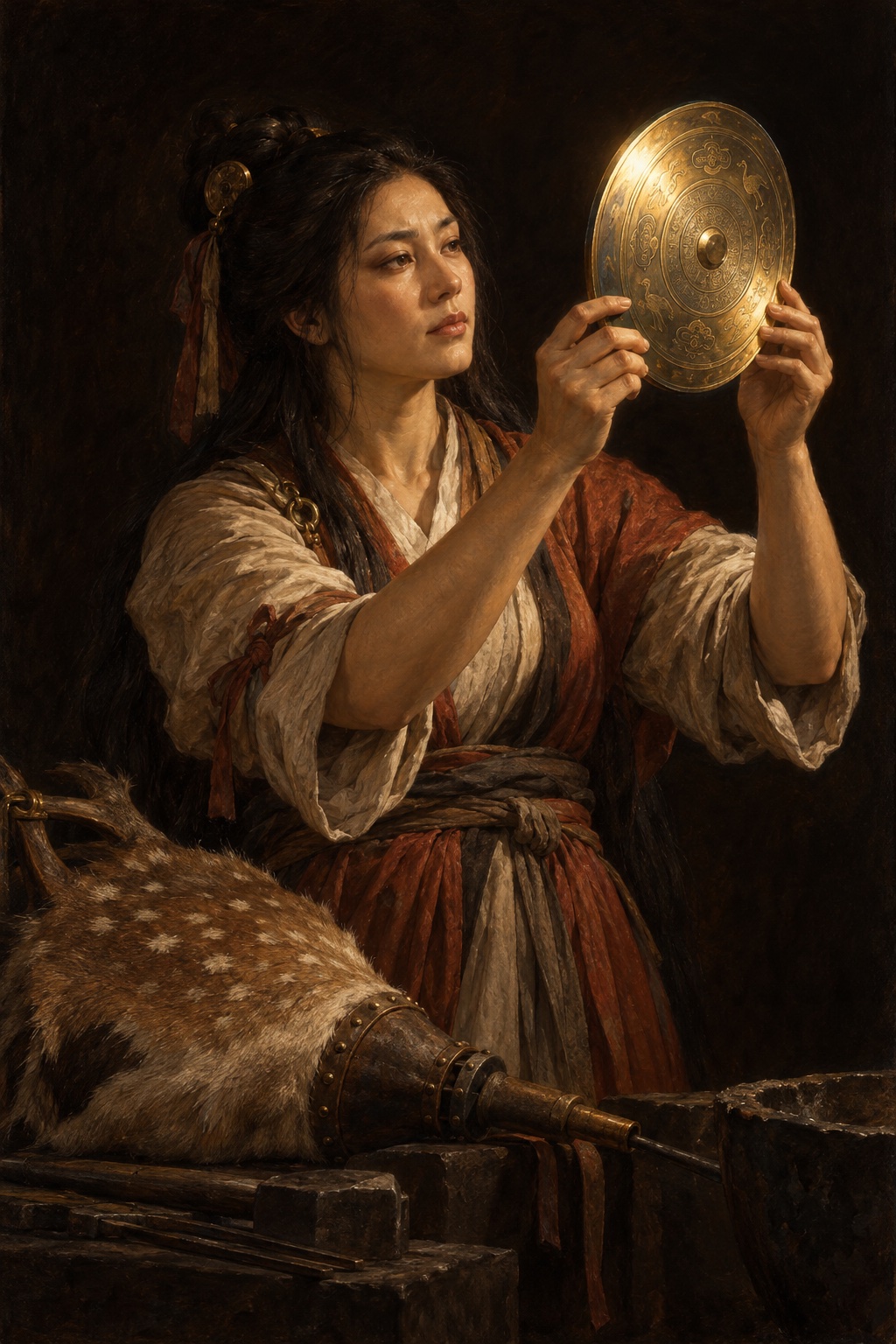
Susanoo’s violence in heaven has driven Amaterasu into the Heavenly Rock-Dwelling, and the world has gone dark. The eight hundred myriad deities gather in the bed of the Tranquil River of Heaven and set Omoikane to think of a plan, and the Kojiki then runs the whole of the preparation together in one long sentence. Ishikoridome’s entire part in the episode arrives at the end of it: iron is taken from the Heavenly Metal-Mountains, the smith Ama-tsu-ma-ra is called in, and she is charged to make a mirror.
是以八百萬神,於天安之河原神集集而〈訓集云都度比〉 ,高御産巢日神之子思金神,令思〈訓金云加屋一作「尼」〉而,集常世長鳴鳥,令鳴而取天安河之河上之天堅石,取天金山之鐵而求鍛人天津麻羅而〈麻羅二字以音〉 ,科伊斯許理度賣命〈自伊下六字以音〉令作鏡
“Therefore did the eight hundred myriad Deities assemble in a divine assembly in the bed of the Tranquil River of Heaven, and bid the Deity Thought-Includer, child of the High-August-Producing-Wondrous-Deity think of a plan, assembling the long-singing birds of eternal night and making them sing, taking the hard rocks of Heaven from the river-bed of the Tranquil River of Heaven, and taking the iron from the Heavenly Metal-Mountains, calling in the smith Ama-tsu-ma-ra, charging Her Augustness I-shi-ko-ri-do-me to make a mirror” — Kojiki, Sect. XVI, tr. Basil Hall Chamberlain (1882)
科 … 令作鏡 — she is charged, and caused to make a mirror. That is the only thing the Kojiki ever has anyone ask of her; in her two later appearances she is only named. The sentence sets the iron and the smith directly before her charge, but it never says how the three belong together — whether the iron is for her mirror, or whether Ama-tsu-ma-ra works beside her — and it says nothing at all about how the mirror is made. The small note inside the line matters more than it looks. 〈自伊下六字以音〉 tells the reader that the six characters from 伊 onward are to be read for their sound alone, so her name in the Kojiki is a string of phonetic signs with no meaning to recover from them. Chamberlain, who calques Omoikane as Thought-Includer and Futotama as Grand-Jewel, accordingly leaves her as I-shi-ko-ri-do-me, with no English meaning attached.
The mirror does real work in the rest of the scene, which cannot be said of the jewels commissioned from Tama-no-oya in the same breath. It is tied to the middle branches of the five-hundred-branched sakaki, and when Amaterasu opens the rock door a little to ask about the laughter outside, Ame-no-Koyane and Futotama push the mirror forward and show it to her. She comes slowly out of the door to gaze at it, and Ame-no-Tajikarao, standing hidden, takes her hand and draws her out. The object is at the centre of the climax; its maker is not mentioned again in the episode.
石凝姥爲冶工 — the smith of the first alternative writing
The Nihon Shoki tells the same crisis in its main narrative, and there an eight-hand mirror hangs on the middle branches of the sakaki without any maker named at all. Ishikoridome appears instead in the first of the alternative writings, the 一書, that follow the main text — under a different name, with a different title, and making a different thing. In this telling the gods meet in the High-market-place of Heaven, and Omoikane, son of Takamimusubi, proposes that an image of the goddess be made and that prayer be addressed to it.
故即以石凝姥爲冶工。採天香山之金
“They therefore proceeded to appoint Ishi-kori-dome as artisan, who, taking copper of the Mt. Kagu of Heaven” — Nihongi, Book I, tr. W. G. Aston (1896)
冶工, which Aston renders as artisan, is literally a worker who smelts metal, and in this version she does not wait for material to be brought to her: 採天香山之金, she takes the metal from the Heavenly Mount Kagu herself, which Aston reads as copper. What she makes of it comes in the next clause, which Aston renders as a Sun-spear. The transcription prints that clause with what appears to be a misprint in one of the two characters that name the object — the character for speech standing where Aston’s reading needs the character for the sun — so it is left out of the quotation here rather than copied wrong or silently corrected, and the passage is quoted as two lines on either side of it.
又全剥眞名鹿之皮。以作天羽鞴。用此奉造之神。是即紀伊國所坐日前神也
“Moreover, he stripped off in one piece the hide of a true stag, and made of it Heavenly bellows. The Goddess which he fashioned by this means is the Goddess Hi no mahe no Kami, who dwells in the province of Kiï” — Nihongi, Book I, tr. W. G. Aston (1896)
全剥眞名鹿之皮 — she flays a true stag whole, in one piece, and makes the hide into heavenly bellows, 天羽鞴. It is the most physical act either chronicle gives her. The Kojiki only charges her; here she takes, flays and makes with her own hands. Then the sentence closes on what all this produced: 用此奉造之神, “The Goddess which he fashioned by this means”, is Hi-no-mahe, the deity who dwells in the province of Kii. What she fashions is that deity; she does not become it. And the variant stops there. It never says whether the image drew Amaterasu out of the cave, and it never calls what she made a mirror. Aston writes “he” of the artisan, but the Nihon Shoki’s own spelling of her name ends in 姥, a character for an old woman, and the Kojiki calls her Her Augustness; this atlas follows the chronicles. Right after the passage the text glosses the reading of 石凝姥 with a second set of phonetic signs, 伊之居梨度咩 — the same sounds as the Kojiki’s 伊斯許理度賣, written with different characters.
凡五部神 — one of the five who go down
Generations later, Amaterasu’s grandson Ninigi-no-Mikoto is sent down from heaven to rule, and in the Kojiki five chiefs of companies are joined to him for the descent: Ame-no-Koyane, Futotama, Ame-no-Uzume, Ishikoridome and Tama-no-oya. With them go the curved jewels and the mirror that had drawn Amaterasu out of the Rock-Dwelling, and the sword. The Nihon Shoki tells the scene in the first alternative writing of its second book, not in the main narrative: Amaterasu gives Ninigi-no-Mikoto three treasures — the curved jewel of Yasaka gem, the eight-hand mirror and the sword Kusanagi — and joins five attendants to him.
又以中臣上祖天兒屋命。忌部上祖太玉命。猿女上祖天鈿女命。鏡作上祖石凝姥命。玉作上祖玉屋命。凡五部神使配侍焉
“Ame no Koyane no Mikoto, the first ancestor of the Naka-tomi, Futo-dama no Mikoto, the first ancestor of the Imbe, Ame no Uzume no Mikoto, the first ancestor of the Sarume, Ishi-kori-dome no Mikoto, the first ancestor of the mirror-makers, and Tamaya no Mikoto, the first ancestor of the jewel-makers, in all Gods of five Be” — Nihongi, Book II, tr. W. G. Aston (1896)
鏡作上祖石凝姥命 — here, and only here in the Nihon Shoki’s books of the gods, she stands next to a mirror at all, and she stands next to it as a title. The eight-hand mirror is handed to Ninigi-no-Mikoto in one clause and she is joined to him as first ancestor of the mirror-makers in the next, but the chronicle never says that the mirror in his hands is her work. Each of the five is labelled first ancestor of a hereditary group, a Be: the Nakatomi, the Imbe, the Sarume, the mirror-makers and the jewel-makers, 凡五部神, gods of five Be in all. Tama-no-oya appears here as 玉屋命, Aston’s Tamaya no Mikoto. Aston’s English for the sentence begins a little earlier, with the gift of the three treasures, but he prints a page reference inside it, so the quotation starts after that mark, with the first of the five names.
作鏡連等之祖 — the house named for the work
A few lines after the descent list, the Kojiki returns to the five and glosses each with the house that descends from them, in one formulaic run of six-character notes.
故其天兒屋命者〈中臣連等之祖〉 ,布刀玉命者〈忌部首等之祖〉 ,天宇受賣命者〈猿女君等之祖〉 ,伊斯許理度賣命者〈作鏡連等之祖〉 ,玉祖命者〈玉祖連等之祖
“Now His Augustness the Heavenly-Beckoning-Ancestor-Lord (is the ancestor of the Nakatomi Chieftains); His Augustness Grand Jewel (is the ancestor of the Imibe Headmen); Her Augustness the Heavenly-Alarming-Female (is the ancestress of the Duchesses of Saru ); Her Augustness I-shi-ko-ri-do-me (is the ancestress of the Mirror-Making Chieftains); His Augustness-Jewel-Ancestor (is the ancestor of the Jewel-Ancestor Chieftains” — Kojiki, Sect. XXXIII, tr. Basil Hall Chamberlain (1882)
伊斯許理度賣命者〈作鏡連等之祖〉 — ancestress of the Mirror-Making Chieftains. Tama-no-oya’s house, 玉祖連, carries his own name; hers carries no name at all, only the work. 作鏡, make-mirror, are the same two characters that closed her charge at the rock-cave, 令作鏡, so the Kojiki’s one command to her and the name of her descendants are written with the same words. The Nihon Shoki turns the pair around into 鏡作, mirror-making, but the title it gives her says the same thing.
Taken together, the two chronicles give her very little: a charge in one clause of the Kojiki, a smith’s scene in one alternative writing of the Nihon Shoki, and in both a line naming her the ancestress of the mirror-makers. Neither describes her body, her dress or her bearing, and in neither account of the age of the gods is she given a parent or a line of speech. What holds her record together is the object rather than the goddess. The Kojiki’s mirror is the one she is told to make, the one that draws Amaterasu out, and the one that goes down with Ninigi-no-Mikoto as the only piece of the regalia that comes with an instruction to reverence it as an august spirit — while the Nihon Shoki, which has her flay a stag and fashion a deity for Kii, leaves her tied to the mirror only by the name of her house.