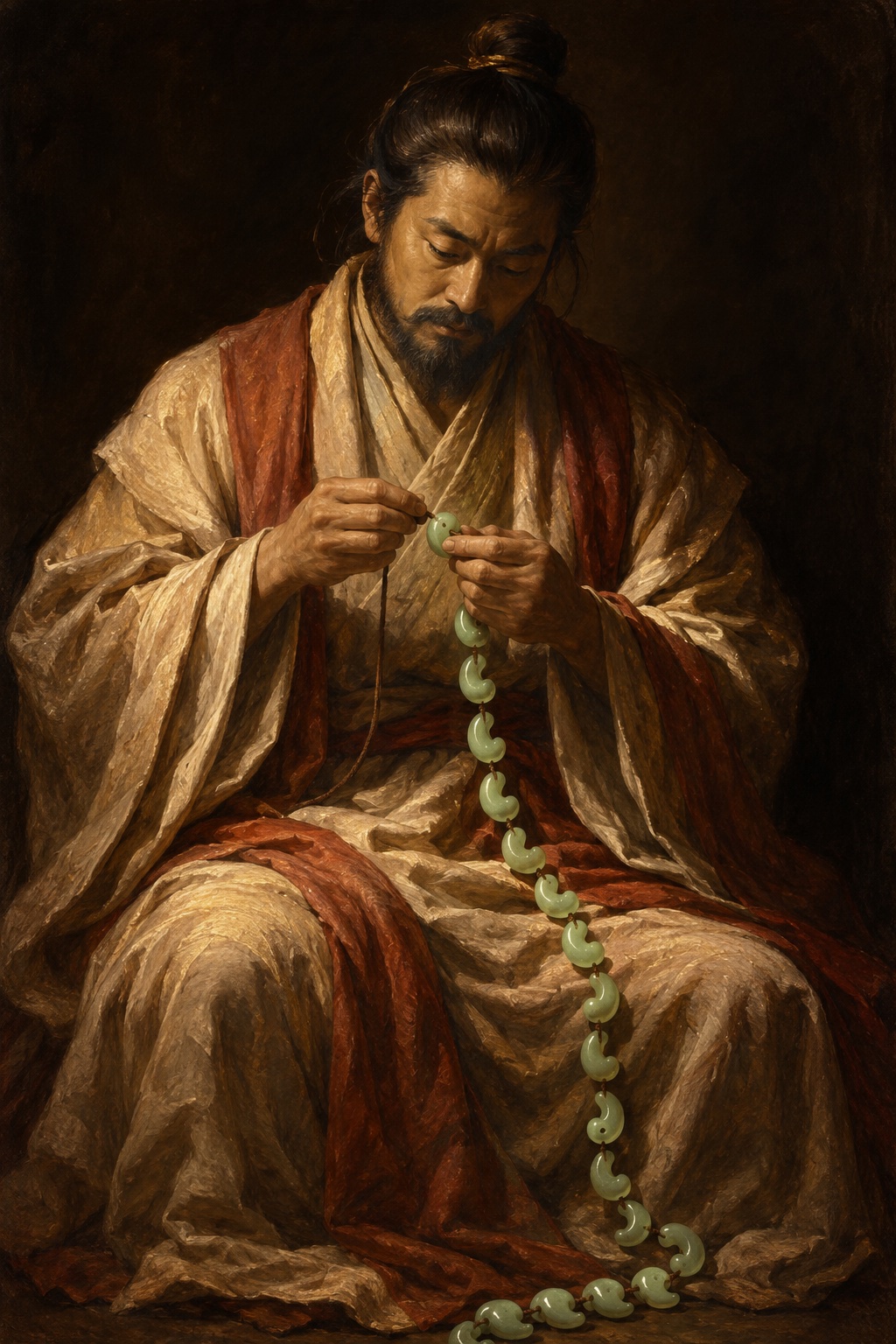
科玉祖命 — the one commission
Everything the Kojiki tells about Tama-no-oya sits inside a single sentence, and the sentence is not about him. Susanoo’s violence in heaven has driven Amaterasu into the Heavenly Rock-Dwelling, the world has gone dark, and the eight hundred myriad deities are gathered in the bed of the Tranquil River of Heaven, where Omoikane has been set to think of a plan. What the plan produces is a division of labour, and the chronicle runs the assignments together in one long breath: iron is taken from the Heavenly Metal-Mountains, the smith Ama-tsu-ma-ra is called in, Ishikoridome is charged to make a mirror — and then, in the same clause, without a pause and without a word of introduction, Tama-no-oya is charged to make the jewels.
科玉祖命一令作八尺勾 𤥼 一作「瓊」之五百津之御須麻流之珠
“charging His Augustness Jewel-Ancestor to make an augustly complete [string] of curved jewels eight feet [long],—of five hundred jewels” — Kojiki, Sect. XVI, tr. Basil Hall Chamberlain (1882)
科 … 令作 — he is charged, and caused to make. That is the only verb either chronicle ever gives him. He does not speak here, and he does not speak anywhere else; he is never described, never given a parent or a child, and the narrative moves straight on from this clause to Ame-no-Koyane and Futotama at the stag’s shoulder-blade without looking back at him once. What the sentence does describe, and at some length, is the thing rather than the maker: 之五百津之御須麻流之珠, a misumaru, a complete strung circlet, of five hundred 津 of jewels, eight feet long. The object is given more words than the god who is told to make it.
Two of the source page’s own editorial marks stand inside the quoted line and are kept here as printed, on the rule that keeps the annotations inside Futotama’s and Kamimusubi’s quoted lines rather than tidying them away. 一作「瓊」 is a textual note of the ordinary kind — another witness writes 瓊 where this one writes the rarer glyph for the curved jewel. The bare 一 wedged between the name and the verb is what is left of a second note of exactly that shape, one whose alternative reading has dropped out of the transmission and stranded its marker in the middle of the clause. And Chamberlain never romanises this god. Across the whole of Section XVI the syllables Tama-no-oya do not occur at all; he is only His Augustness Jewel-Ancestor, an English calque of 玉祖命, which is the same treatment the translator gives Futotama in the very next clause as His Augustness Grand-Jewel.
御須麻流之珠 — the string that outlasts the scene
The rescue works, and none of the credit attaches to him. His string of jewels is put upon the upper branches of the five-hundred-branched sakaki and the mirror tied to the middle ones, and the chronicle describes what hangs there in the very words it had used for the commission — an augustly complete string of curved jewels eight feet long, of five hundred jewels. Then Futotama carries the dressed tree, Ame-no-Uzume dances, the assembly laughs, Amaterasu slides the rock door open to find out what the noise is, and Ame-no-Tajikarao takes her august hand and pulls her clear. Tama-no-oya is in none of it. What makes his one commission worth a page is not what the jewels do that night but what becomes of them afterwards, because the chronicle picks the same object up again generations later, in a completely different kind of scene. Amaterasu’s grandson is being sent down from heaven to rule, and the deities who send him put three things into his hands.
於是副賜其遠岐斯〈此三字以音〉八尺勾𤥼鏡及草那藝釼,亦常世思金神、手力男神、天石門別神而詔者:「此之鏡者,專為我御魂而如拜吾前,伊都岐奉
“Thereupon they joined to him the eight-feet [long] curved jewels and mirror that had allured [the Heaven-Shining-Great-August-Deity from the Rock-Dwelling, ] and also the Herb-Quelling-Great-Sword, and likewise the Deity Thought-Includer, the Hand-Strength-Male-Deity, and the Deity Heavenly-Rock-Door-Opener of Eternal Night, and charged him thus: “Regard this mirror exactly as if it were our august spirit, and reverence it as if reverencing us” — Kojiki, Sect. XXXIII, tr. Basil Hall Chamberlain (1882)
八尺勾𤥼, the eight-foot curved jewels, and 鏡, the mirror — the two objects made at the mouth of the cave — now go to Ninigi-no-Mikoto together with 草那藝釼, the Herb-Quelling Great Sword, which reached heaven by an entirely different road. The identification is the chronicle’s own rather than this atlas’s inference: the kanbun marks 遠岐斯 to be taken for its sound, and Chamberlain reads the word as the verb of alluring, so that the jewels and mirror bestowed at the descent are named as the ones that had allured the goddess out of the Rock-Dwelling. The object that leaves the rock-cave episode is the object that was made inside it.
Notice, though, what the passage does not do. The charge that follows the gift is about the mirror and nothing else — 此之鏡者, as for this mirror — and it is the mirror that is to be regarded as an august spirit and reverenced; the jewels are handed over without a syllable of instruction attached to them. Nor is their maker named. Tama-no-oya is present at the descent, as one of five deities who go down with the grandson, but the chronicle at no point says that the jewels in Ninigi-no-Mikoto’s hands are his work. The line between the cave and the regalia runs through the object, not through any credit paid to the craftsman. That is nonetheless the whole case for this page. A commission handed out inside one episode, in a subordinate clause, produces the one thing from that episode which outlives it and goes on being carried.
玉祖連等之祖 — the house that takes his name
He goes down as one of five, and the Kojiki closes its roster of the five by glossing every name with the house descended from it. The five glosses run together in one formulaic string, each deity disposed of in six characters.
故其天兒屋命者〈中臣連等之祖〉 ,布刀玉命者〈忌部首等之祖〉 ,天宇受賣命者〈猿女君等之祖〉 ,伊斯許理度賣命者〈作鏡連等之祖〉 ,玉祖命者〈玉祖連等之祖
“Now His Augustness the Heavenly-Beckoning-Ancestor-Lord (is the ancestor of the Nakatomi Chieftains); His Augustness Grand Jewel (is the ancestor of the Imibe Headmen); Her Augustness the Heavenly-Alarming-Female (is the ancestress of the Duchesses of Saru ); Her Augustness I-shi-ko-ri-do-me (is the ancestress of the Mirror-Making Chieftains); His Augustness-Jewel-Ancestor (is the ancestor of the Jewel-Ancestor Chieftains” — Kojiki, Sect. XXXIII, tr. Basil Hall Chamberlain (1882)
玉祖命者〈玉祖連等之祖〉. It is the flattest sentence anywhere in his record and also the one that explains his name, because the house and the god are spelled with the same two characters: the Tamanooya are 玉祖連, and 玉祖 is him. The others in the list are glossed the same way — Ame-no-Koyane to the Nakatomi, Futotama to the Imbe, Ame-no-Uzume to the Sarume — and the two makers come last, side by side. Their houses are not named on the same principle, though. Ishikoridome’s is 作鏡連, the mirror-making chieftains, named for the work she was set to do; his is named for him. What the list does preserve is the adjacency: the two crafts sit together at the end of the roster exactly as the two commissions sat together in the clause that handed them out. No individual descendant of his is named, here or anywhere else.
Put everything the chronicle gives him side by side and it comes to very little: one verb, one object, one line of descent. There is no body, no dress, no temperament and no speech; there is no second scene to set against the first, and no episode in which he is anything but a name being assigned a task or a name being assigned a clan. What is unusual about him is the ratio rather than the quantity. The thing he is told to make in a single subordinate clause is the thing that outlasts the crisis it was made for — strung to bring a goddess back out of a cave, then carried down out of heaven beside the mirror and the sword — while the god who made it stays exactly the size of the clause he appears in.