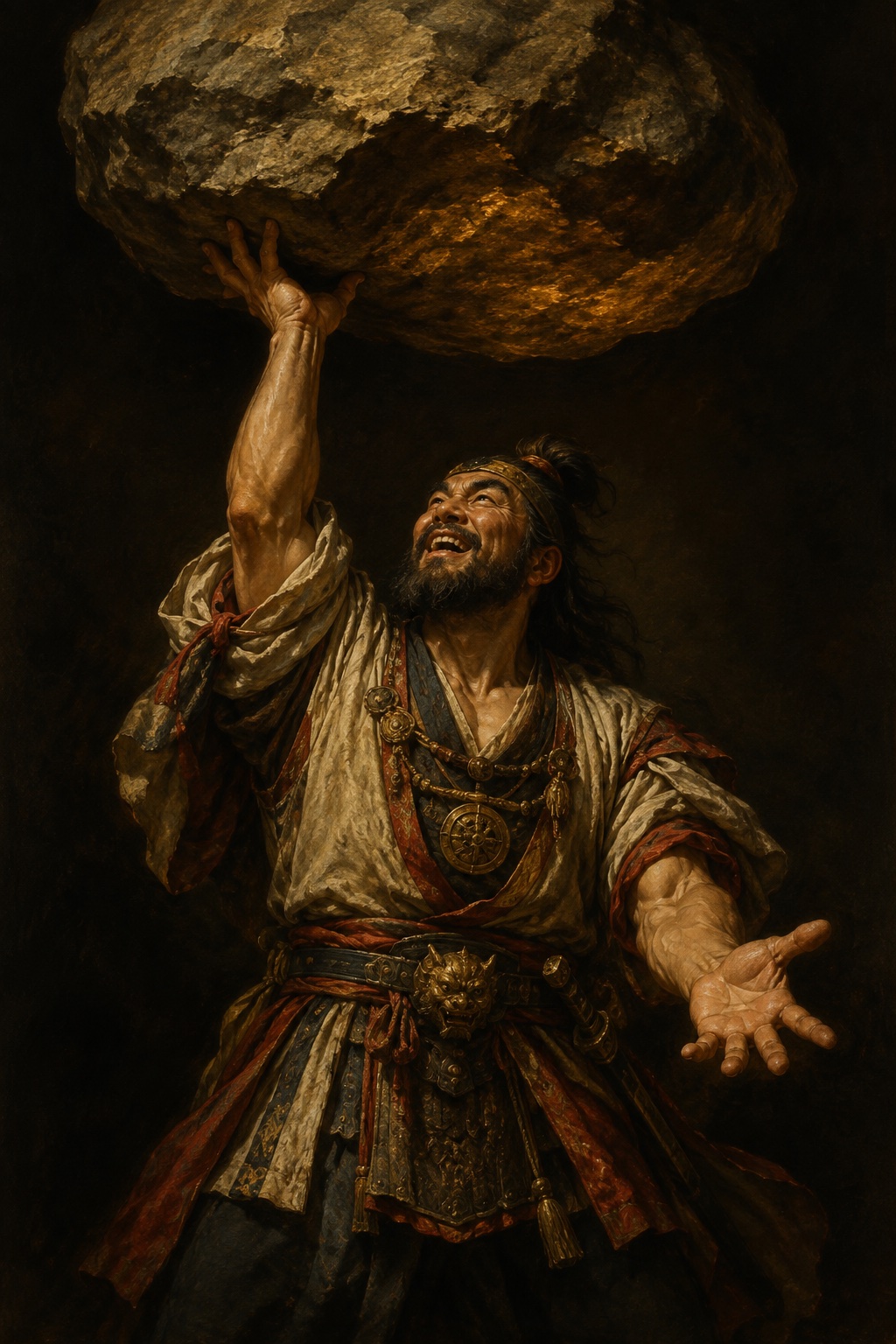
The second son
The transfer of the land is being negotiated over Takeminakata’s head. Takemikazuchi has come down from heaven, planted his sword point-up on the wave crests and sat on it, and asked Okuninushi to hand the country over. Okuninushi defers to his sons. The first, Kotoshironushi, agrees at once and capsizes his own boat to disappear. Asked whether there is anyone else who should speak, Okuninushi says there is one more, and no other.
其建御名方神,千引石擎手末而來,言:「誰來我國而忍忍如此物言?然欲為力競,故我先欲取其御手。」
“the Deity Brave-August-Name-Firm came up, bearing on the tips of his fingers a thousand-draught rock, and said: ‘Who it is that has come to our land, and thus secretly talks? If that be so, I should like to have a trial of strength. So I should like to begin by taking thine august hand.’” — Kojiki, Sect. XXXII, tr. Basil Hall Chamberlain
Everything about the entrance is a display. 千引石 is a rock that takes a thousand men to draw — the same measure of stone Izanagi uses to block the pass of Yomi — and he is carrying it 擎手末, held up on his fingertips. 忍忍 is the hard word in the line; Chamberlain reads it as talking secretly, others as talking high-handedly, and either way the complaint is about someone doing the deciding in his country without him.
Then he names the terms himself. He proposes the contest, and he proposes to start by taking the other god’s hand. Nobody makes him do this.
The hand of ice
He is given the hand.
故令取其御手者,即取成立冰,亦取成釼刄。故尒懼而退居
“So on his letting him take his august hand, his touch at once turned it into an icicle, and again his touch turned it into a sword-blade. So then he was frightened and drew back.” — Kojiki, Sect. XXXII, tr. Basil Hall Chamberlain
立冰 and 釼刄 — standing ice, then a sword’s edge. The hand he asked for changes twice while he is holding it, and the text spends four characters on his reaction: 懼而退居, frightened, he drew back. When Takemikazuchi takes his hand in return it is crushed like a young reed and thrown aside, and he runs.
This is the earliest wrestling bout in Japanese literature and Takeminakata loses it without either party moving from where they stand. He is also the only figure in the whole negotiation who fights, which is why the passage is his and not his brother’s: the Kojiki needed one son to refuse, so that the consent of the others would mean something.
The oath at the lake
The pursuit is short and the surrender is total.
恐,莫殺我!除此地者,不行他處,亦不違我父大國主神之命,不違八重事代主神之言。此葦原中國者,隨天神御子之命獻。」
“I will obey. Slay me not. I will go to no other place but this, neither will I go against the command of my father the Deity Master-of-the-Great-Land. I will not go against the words of the Deity Eight-Fold-Thing-Sign-Master. I will yield up this Central Land of Reed-Plains according to the command of the august child of the Heavenly Deities.” — Kojiki, Sect. XXXII, tr. Basil Hall Chamberlain
科野國之州羽海 is the Sea of Suwa in the land of Shinano, and the oath he swears there has an unusual shape. He is not asked to submit; he is about to be killed, and what he offers instead is a self-imposed confinement. 除此地者,不行他處 — apart from this place, I will go nowhere else. The god buys his life with his own geography.
Everything he then promises he had already refused a page earlier: his father’s command, his brother’s words, the yielding of the Central Land. The submission is complete and it is retrospective, which leaves him as the one participant in the kuni-yuzuri who ends up agreeing to every term he originally contested and getting a lake out of it. The great shrine at Suwa stands on the promise. A god who swore never to leave one place is, by that same sentence, a god permanently in residence — and the country’s oldest recorded loser became one of its most reliably present deities.