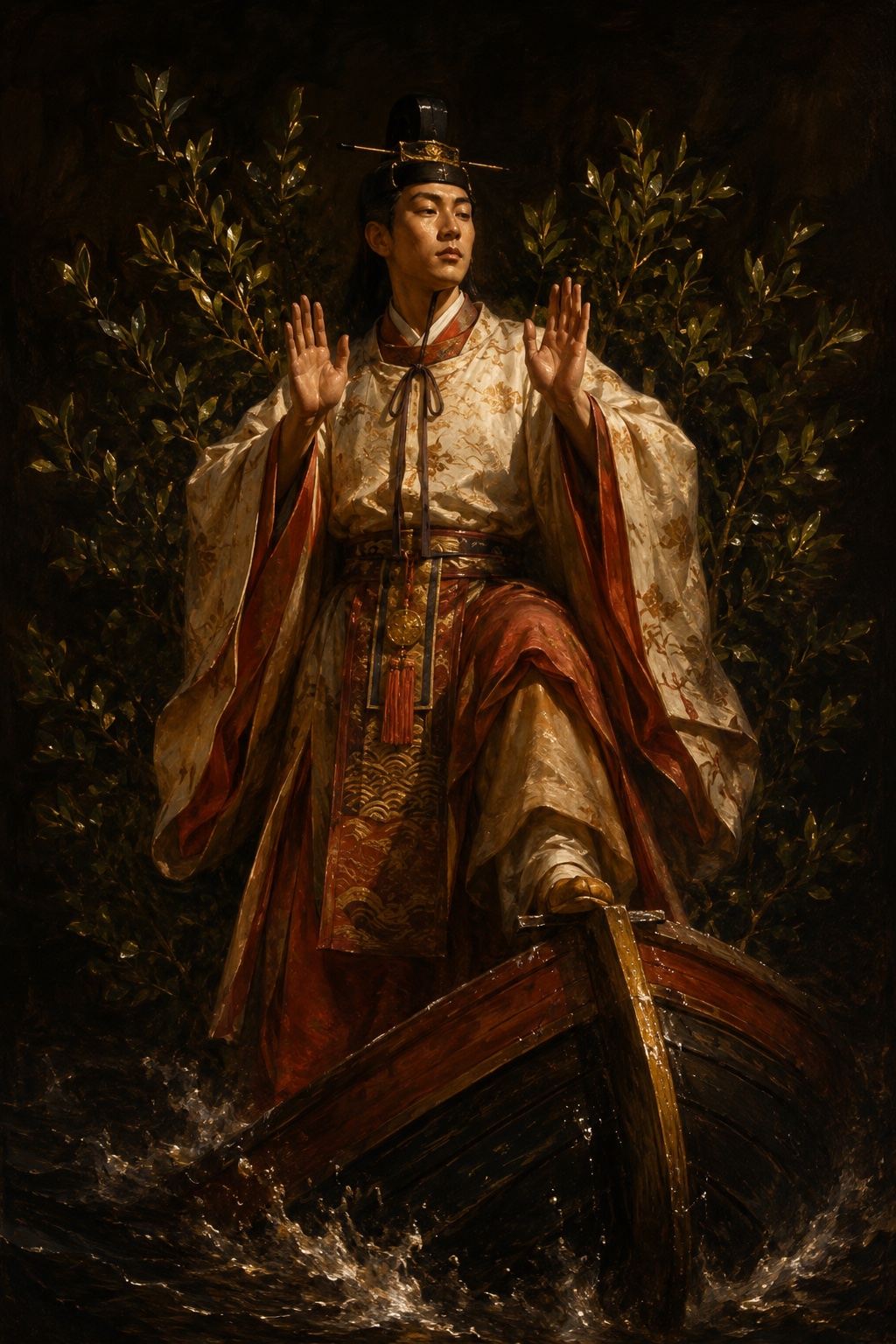
Away, catching fish
Takemikazuchi has planted his sword point-up in the surf and asked Okuninushi to hand over the country. Okuninushi will not answer. He refers the question to his son — and has to explain where the son is.
僕者不得白,我子八重言代主神,是可白。然,為鳥遊取魚而往御大之前,未還來
“I am unable to say. My child the Deity Eight-Fold-Thing-Sign-Master will be the one to tell you; but he is gone to Cape Miho to pursue birds and catch fish, and has not yet returned.” — Kojiki, Sect. XXXII, tr. Basil Hall Chamberlain
The detail is doing real work. The heavenly envoys have come with a demand that decides who owns the visible world, and the god whose word will settle it is out at 御大之前, the point of Miho, hunting birds and taking fish. He has to be sent for. 八重 is eightfold, an intensifier for plenty; 事代 is the standing-in-for or the speaking-for of a thing; the name is close to “the lord who speaks in the place of matters”, which is a description of an oracle and, here, a description of a proxy. Okuninushi does not delegate the decision because he is weak. He delegates it because that is what this son is for.
One sentence
The envoys send the Deity Bird-Boat to fetch him, and he does not need a second question.
故尒遣天鳥船神,徴來八重事代主神而問賜之時,語其父大神言:「恐之,此國者立奉天神之御子
“So Then the Deity Bird-Boat was sent to summon the Deity Eight-Fold-Thing-Sign-Master, who, on being graciously asked, spoke to the Great Deity his father, saying: ‘I will obey. [Do thou] respectfully present this land to the august child of the Heavenly Deity;’” — Kojiki, Sect. XXXII, tr. Basil Hall Chamberlain
恐之 is the word of a subject accepting a command from above — awe, and the acceptance that goes with it. Then 立奉, to set up and offer. Note who he says it to: not to the two armed gods standing on the water, but to 其父大神, his father the Great Deity. He is not surrendering. He is advising, the way a minister advises, and the advice is to give the country up.
The whole of the transfer of the land turns on this line. Everything after it — the brother who arrives with a boulder on his fingertips, the wrestling, the flight to Suwa — is the Kojiki dealing with the one son who disagreed. Consent came first, and it came from a god who had been out fishing.
He capsizes his own boat
What he does next is the strangest thing in the episode, and Chamberlain’s English is the only way to reach it: he trod on the edge of his boat so as to capsize it, clapped his heavenly departing hands in the fence of green branches, and disappeared.
The 青柴垣, the green-brushwood fence, is a screen of freshly cut branches — the kind of temporary enclosure raised for a rite. The reversed clap, 天逆手, is a gesture used nowhere in ordinary greeting and read since as a rite of sealing or of self-interment. He capsizes the vessel he arrived in, turns his own boat over the top of himself, and closes the green fence, and the text says 隱, he hid. He is not killed and he does not leave; he withdraws from the visible world in the same breath that hands the visible world over.
The Kojiki spends four characters on the boat and the fence and does not explain either. It is the only disappearance in the transfer of the land that the god performs on himself, and it is performed at the same place he was fetched from — the cape of Miho, where he had been fishing when the question arrived.
The father of an empress
The consenting god is not written out afterwards. The Nihon Shoki takes up his line at the founding of the imperial house: when the first emperor looks for a chief consort, someone at court names Himetataraisuzu-hime, the daughter of Kotoshironushi by Tamakushi-hime of the Mishima line, and calls her the finest beauty in the country. She is made chief consort, and the emperors descend from her.
So the god who gave away the country becomes the grandfather of the dynasty that received it. The chronicle settles by marriage what the envoys came to settle by force, and the family that yields is folded into the family that takes.