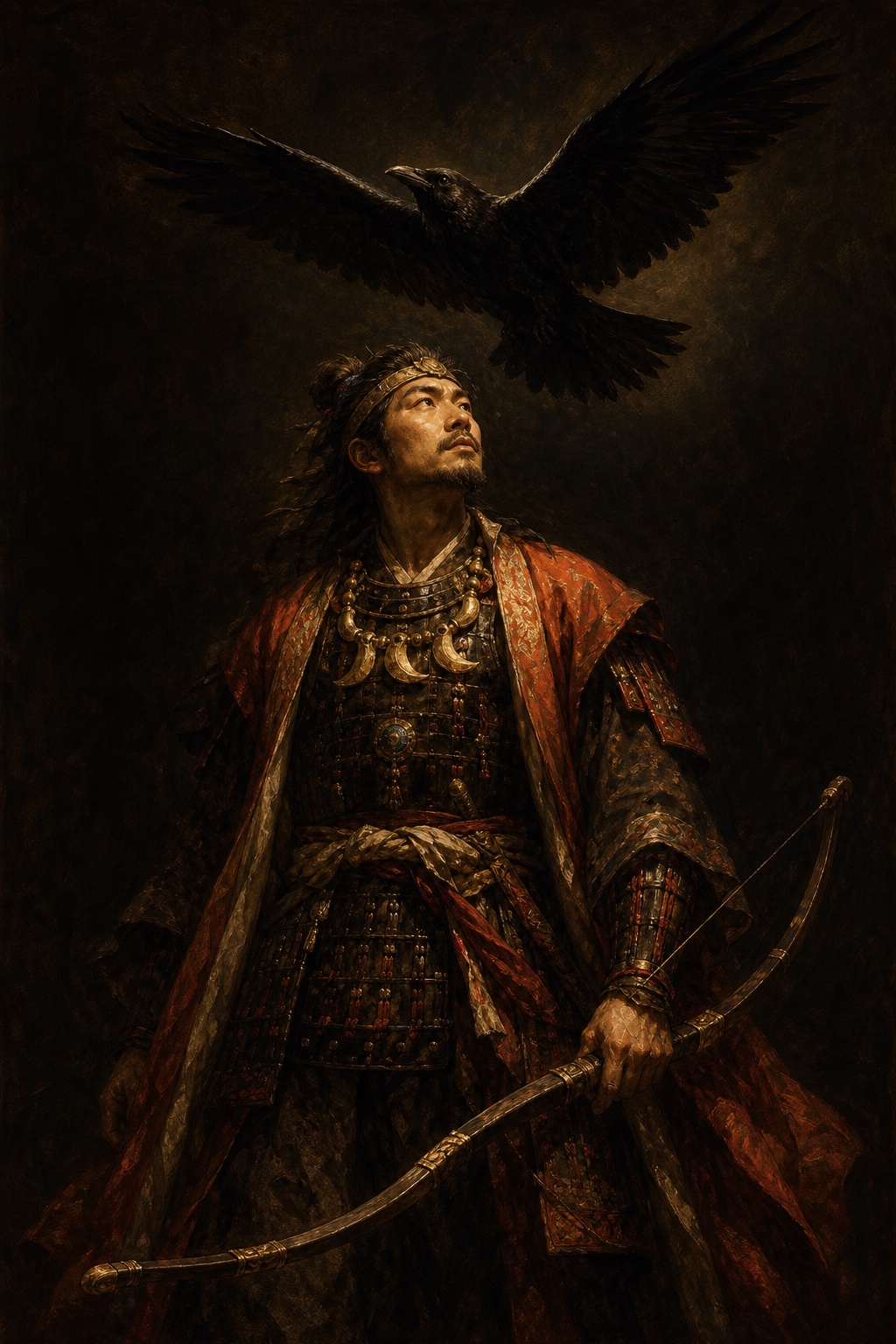
It were probably best to go east
The second volume of the Kojiki opens on two brothers in a palace at Takachiho, three generations after Ninigi-no-Mikoto came down from heaven onto that mountain, having what reads less like a divine commission than a practical conversation about relocating.
議云。坐何地者。平聞看天下之政。猶思東行
“By dwelling in what place shall we [most] quietly carry on the government of the Empire? It were probably best to go east” — Kojiki, Sect. XLIV, tr. Basil Hall Chamberlain (1882)
Nobody in heaven orders this. Amaterasu’s charter had put the family on Takachiho in the far southwest, and the move to Yamato — the move that makes the imperial house the imperial house — is decided by Kamu-yamato-ihare-biko and his elder brother Itsu-se on their own initiative, in a sentence with a shrug in it. “Jim-mu”, the name the world knows him by, appears nowhere in the narrative: Chamberlain notes that it means “divine valour” and is the canonical name conferred long afterwards, in the Chinese manner, on a man the text itself calls only Kamu-yamato-ihare-biko.
The journey east is slow in a way legend usually is not. They stop a year at Wokada in Tsukushi, seven years at Takeri, eight years at Takashima in Kibi; a man riding a tortoise-shell and angling in the Hayasuhi Channel is hauled aboard to pilot them because he knows the sea-path. Then at the haven of Shirakata the resistance begins, and Nagasune-biko of Tomi shoots Itsu-se through the hand.
Itsu-se’s response is the theological hinge of the whole campaign. It is not right, he says, for an august child of the Sun-Deity to fight facing the sun; that is why the arrow found him. He orders the army round to attack with the sun at his back, washes his blood in the sea of Chinu — and dies anyway, at the river-mouth of Wo, cursing the wretched villain’s hand. The correct ritual orientation is established, and the brother who worked it out does not live to use it.
A sword through the storehouse roof
In Kumanu the campaign stops dead: a savage deity appears, and the entire army, Kamu-yamato-ihare-biko included, falls prostrate and sleeps. What saves them is a dream that happens to somebody else. A local man, Takakurazhi, dreams that Amaterasu and the High-Integrating-Deity summon Takemikazuchi — Chamberlain’s “Brave-Awful-Possessing-Male-Deity” — and order him down to the Central Land of Reed-Plains, which is painfully uproarious.
He declines to go himself. Instead he will send the cross-sword with which he subdued the land in the first place, by perforating the ridge of Takakurazhi’s storehouse roof and dropping it through. Takakurazhi wakes, searches the storehouse, and the sword is there. He carries it to where the sleeping prince lies, and the prince rises saying “How long I have slept!” — and the savage deities of the mountains of Kumanu fall cut down of their own accord, without a blow being struck by anyone.
The crow eight feet long
Then the interior, and a warning against going any further unaided.
天神御子。自此於奧方莫使入幸。荒神甚多。今自天。遣八咫烏。故其八咫烏引道。從其立後應幸行
“August son of the Heavenly Deity! make no progress hence into the interior. The savage Deities are very numerous. I will now send from Heaven a crow eight feet [long]. So that crow eight feet [long] shall guide thee. Thou must make thy progress following after it as it goes” — Kojiki, Sect. XLVI, tr. Basil Hall Chamberlain (1882)
The kanbun writes the bird 八咫烏 and leaves it at that — Yatagarasu, three characters that decide nothing. Chamberlain’s note is candid that his rendering is a choice between commentators: he follows Tanigaha Shisei’s reading of “a crow eight feet long”, while Motowori understood the same characters to mean “an eight-headed crow”. The three-legged crow of later art and of the modern football association’s badge is a still later accretion; the Kojiki says only that it is enormous and that it is sent.
What it does is unusual for a divine intervention: it walks in front. The god does not clear the road, smite the savage deities, or grant a weapon. He supplies a guide, with the instruction to follow it wherever it goes — and the men the party then meets along the crow’s route, a fisherman in a weir, two beings with tails who come out of a shining well and out of the cliffs, all announce themselves as Earthly Deities and offer service. The conquest of the interior is conducted, in this stretch, almost entirely by introduction.
One hundred and thirty-seven years
The rest is settlement. Nigi-hayabi, who had descended from heaven earlier and independently, comes and submits, presenting his heavenly symbols; the empire is pacified; the sovereign, having already fathered two sons by Princess Ahira in Himuka, looks for a chief empress and finds I-suke-yori-hime, first among seven maidens on the moor of Takasazhi, courted in an exchange of songs. Then the register closes.
凡此神倭伊波禮毘古天皇。御年。壹佰參拾漆歳。御陵在畝火山之北方白檮尾上也
“Altogether the august years of this Heavenly Sovereign Kamu-yamato-ihare-biko were one hundred and thirty-seven. His august mausoleum is on the top of the Kashi Spur on the northern side of Mount Unebi” — Kojiki, Sect. LIV, tr. Basil Hall Chamberlain (1882)
That single sentence is where the Kojiki changes register for good. Everything before it is myth in the ordinary sense — gods, islands born of a spear, a sun hiding in a cave. Everything after it is a chronicle: sovereign, years, consort, children, tomb, repeated reign by reign for two more volumes. Jimmu is the seam, and the seam shows, because the formula that files him is the same formula used for emperors who plainly did exist.
What follows immediately is not glory but a succession crisis. Tagishi-mimi, his eldest son by Princess Ahira, marries the widowed empress and plots to kill his three younger half-brothers, until their mother warns them in a song about clouds rising from the River Sawi and the wind about to blow on Mount Unebi — the same mountain named in the burial notice above. The dynasty’s founding legend ends with his own children having to kill their own brother to keep it.