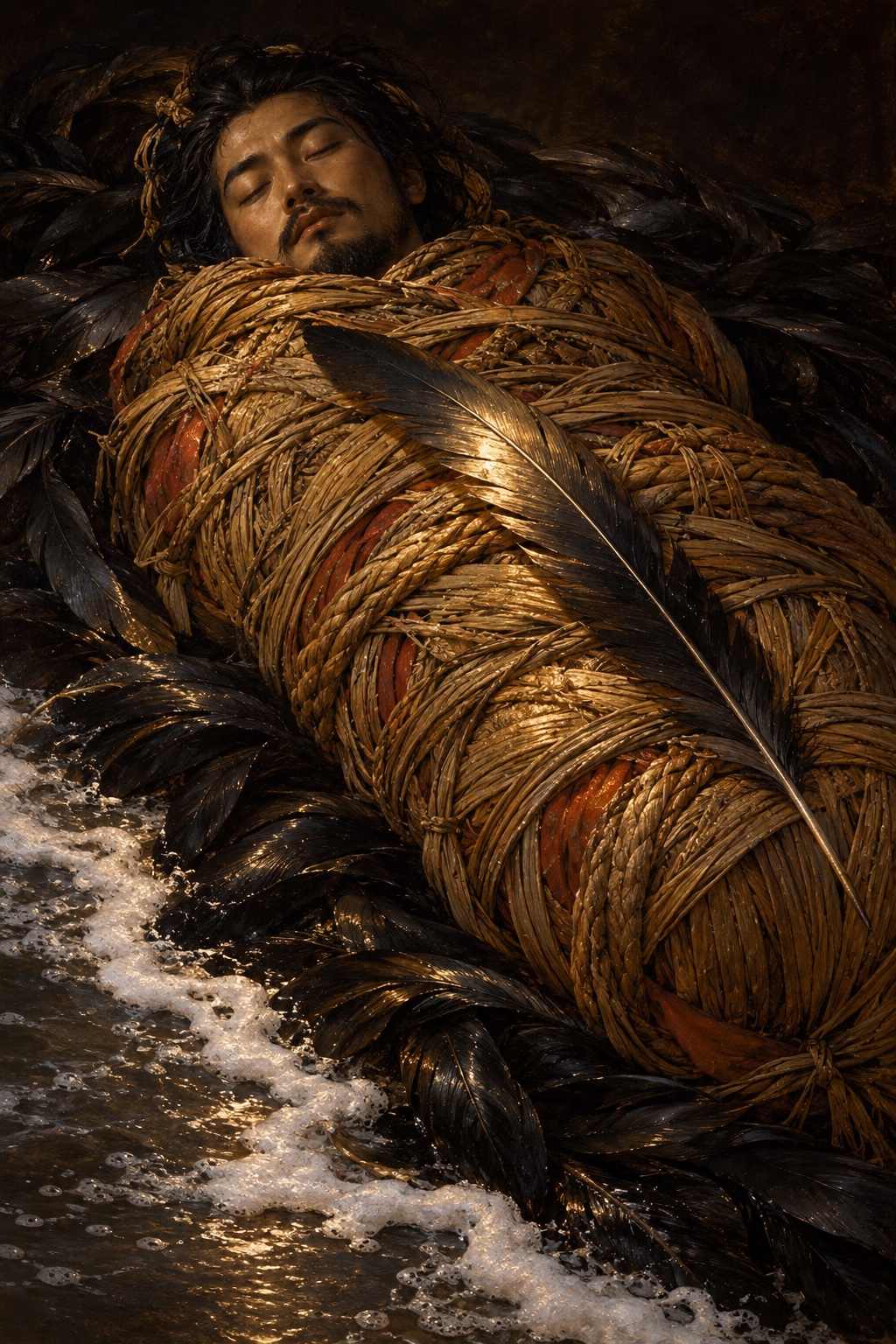
Born under an unfinished roof
Ugayafukiaezu’s story is told inside other people’s stories. Hoori’s entry follows his father to the palace under the sea and home again with the tide jewels; Toyotama-hime’s entry tells the birth from his mother’s side. Seen from the child’s side, the Kojiki is brief. His mother comes up out of the sea already pregnant, because, she says, the august child of a Heavenly Deity ought not to be born in the Sea-Plain. On the shore, 海邊波限, at the very limit of the waves, a parturition hall goes up, thatched 以鵜羽為葺草, with cormorants’ feathers. The thatch has not yet met across the roof, 葺合, when the birth will not wait, and she goes in under it as it is. She asks her husband not to look. He looks, sees her in her native shape, a wani eight fathoms long, and runs. She bears the child and leaves him where he lies, 生置其御子, then closes the sea-boundary behind her and goes down. Chamberlain’s note explains that boundary as the line dividing the dominions of the Sea-God from the world of men, and the first thing the text records of the child is that he was left on the shore beside it.
Then he is named, and the Kojiki gives the reason in a single word, 是以, therefore.
是以名其所産之御子,謂天津日高日子波限建鵜(葺)草葺不合命
“Therefore the name by which the august child whom she had borne was called was His Augustness Heaven’s-Sun-Height-Prince-Wave-limit-Brave-Cormorant-Thatch-Meeting-Incompletely.” — Kojiki, Sect. XLII, tr. Basil Hall Chamberlain (1882)
Everything in the name after its opening title comes from the birth. 波限, Wave-limit, is the place where the hall stood; 建 is Brave; 鵜(葺)草 is the cormorant thatch; and 葺不合 is the thatch that did not meet. Chamberlain gives the whole name in romanised form as Ama-tsu-hi-daka-hiko-nagisa-take-u-gaya-fuki-ahezu no mikoto, and this atlas writes its last stretch, Ugayafukiaezu. His notes record two other readings. The older editors read ahasezu where the text has ahezu, “causing to meet” instead of “meeting”. Moribe derived the name from umi-ga kayohi fuki-ahezu, which Chamberlain glosses as going and coming on sea and land and being unable to suckle, and Chamberlain closes that note with an exclamation mark.
The opening title is not his alone. 天津日高日子, Heaven’s-Sun-Height-Prince in Chamberlain’s English, also opens his father’s other name in the Kojiki, 天津日高日子穗穗手見命, and the name under which his grandfather Ninigi-no-Mikoto appears when he meets his bride, 天津日高日子番能迩迩藝能命. Grandfather, father and son carry the same title at the front of their names. In the son’s name, everything after the title describes the shore and the roof under which he was born.
Nursed by his mother’s sister
Toyotama-hime does not come back for him. The Kojiki says only one more thing about his infancy, and it says it in a clause inside the story of his parents’ songs: the child had to be nursed, 因治養其御子之緣, and it was her younger sister Tamayori-bime, Jewel-Good-Princess in Chamberlain’s English, who nursed him. It is by the nurse’s hand that the mother’s song goes up to the father.
然後者,雖恨其伺情,不忍戀心,因治養其御子之緣,附其弟玉依毗賣而獻歌之。其歌曰: 「阿加陀一作「院」麻波,袁佐閇比迦礼杼,斯良多麻能,岐美(能)何余一作「金」曾比斯,多布斗久阿理祁理。」尒其比古遲〈三字以音〉答歌曰: 「意岐都登理,加毛度久斯麻迩,和賀葦泥斯,伊毛波和須礼士,余能許登碁登迩
“Nevertheless afterwards, although angry at his having wished to peep, she could not restrain her loving heart, and she entrusted to her younger sister Jewel-Good-Princess, on the occasion of her nursing the august child, a Song to be presented [to His Augustness Fire-Subside]. The Song said: “As for red jewels, though even the string [they are strung on] shines, the aspect of [my] lord [who is] like unto white jewels is [more] illustrious.” Then her husband replied by a Song, which said: “As for my younger sister, whom I took to sleep [with me] on the island where light the wild-duck, the birds of the offing, I shall not forget her till the end of my life”” — Kojiki, Sect. XLII, tr. Basil Hall Chamberlain (1882)
The song does not name the child, but one reading finds him in it. Chamberlain’s notes give Moribe’s view that the red jewels are meant for the child, and that the song ranks the husband dearer to her even than her son. If Moribe is right, the one song in his story that may be about him puts him second. Another note explains the go-between: the mother did not return to the upper world, so she sent her message by her sister, who had consented to nurse the child. After the two songs the Kojiki turns to Hoori’s five hundred and eighty years in the palace of Takachiho and the place of his tomb. When it comes back to the son, he is grown, and he is marrying the woman who nursed him.
The four sons
The marriage is the last sentence of the first book of the Kojiki.
是天津日高日子波限建鹈葺草葺不合命一作「今命」 ,娶其姨,玉依毗卖命,生御子,名五濑命,次,稻冰命。次,御毛沼命。次,若御毛沼命,亦名豊御毛沼命,亦名神倭伊波礼毗古命。〈四柱〉故御毛沼命者,跳浪穗渡坐于常世国,稻冰命者,為妣國而入坐海原也
“His Augustness Heaven’s-Sun-Height-Prince-Wave-limit-Brave-Cormorant-Thatch-Meeting-Incompletely wedded his maternal aunt Her Augustness Jewel-Good-Princess, and begot august children named: His Augustness Five-Reaches; next His Augustness Boiled-Rice; next His Augustness August-Food-Master; next His Augustness Young-August-Food-Master, another name for whom is His Augustness Luxuriant-August-Food-Master, and another name is His Augustness Divine-Yamato-Ihare-Prince. So His Augustness August-Food-Master, treading on the crest of the waves, crossed over to the Eternal Land. His Augustness Boiled-Rice went into the Sea-Plain, it being his deceased mother’s land.” — Kojiki, Sect. XLIII, tr. Basil Hall Chamberlain (1882)
娶其姨: he took his 姨, his mother’s sister, as his wife, and Chamberlain renders her as his maternal aunt. The nurse of the one section is the wife of the next, and the Kojiki makes no remark on it. The online transcription prints this sentence in a mix of scripts. The name comes back as 鹈葺草葺不合命, with the simplified form of the cormorant character that the naming sentence printed as 鵜, and with another reading, 一作「今命」, noted beside it. The simplified 国 of 常世国 stands in the same sentence as the traditional 國 of 妣國.
The sentence counts the sons, 〈四柱〉, four. The first is 五濑命, Itsu-se, whom Chamberlain calls Five-Reaches; then 稻冰命, Ina-hi, Boiled-Rice; then 御毛沼命, Mi-ke-nu, August-Food-Master; and last 若御毛沼命, Young-August-Food-Master, who has two more names, 豊御毛沼命 and 神倭伊波礼毗古命, Divine-Yamato-Ihare-Prince. The youngest is the one this atlas calls Jimmu. Chamberlain notes that the last three names all relate to food. He takes Itsu-se from the reaches of a river, and records that Motowori and Moribe would read it as a corruption meaning powerful rice, which would bring it into line with the other three; he finds the derivation far-fetched. For Ina-hi he adds that Motowori’s derivation from ina-ihi, if correct, would give “Rice-Boiled-rice”.
Two of the four leave in the passage that names them. Mi-ke-nu treads on the crest of the waves and crosses over to the Eternal Land, 常世国. Ina-hi goes into the Sea-Plain, because it is his 妣國, in Chamberlain’s English his deceased mother’s land. The Kojiki has used that word before, for Susanoo. When Izanagi asked him why he wept instead of ruling what he had been given, Susanoo answered that he wished to depart to his deceased mother’s land, the Nether Distant Land. For Ina-hi the word means the sea, because his mother Tamayori-bime is the younger sister of Toyotama-hime, the Sea-Deity’s daughter.
The other two sons are still on land when the second book of the Kojiki opens. It begins with them: the youngest and his elder brother Itsu-se, in the palace of Takachiho, take counsel together and decide to go east.
A death in the western country
The first book of the Kojiki gives Ugayafukiaezu no death. It gave his father five hundred and eighty years and a tomb to the west of the mountain of Takachiho, and then it moved straight to the son’s marriage and the son’s sons; for the son himself it gives no age and no tomb. The Nihon Shoki does.
波瀲武鸕鷀草葺不合尊。以其姨玉依姫爲妃。生五瀨命。次稻飯命。次三毛入野命。次神日本磐余尊。凡生四男。久之波瀲武鸕鷀草葺不合尊崩於西洲之宮。因葬日向吾平山上陵
“Hiko-nagisa-take-u-gaya-fuki-ahezu no Mikoto took his aunt Tama-yori-hime as his consort, and had by her in all four male children, namely, Hiko-itsu-se no Mikoto, next Ina-ihi no Mikoto, next Mi-ke-iri-no no Mikoto, and next Kamu-yamato-Ihare-biko no Mikoto. Long after, Hiko-nagisa-take-u-gaya-fuki-ahezu no Mikoto died, in the palace of the western country, and was buried in the Misasagi on the top of Mount Ahira in Hiuga.” — Nihongi, Book II, tr. W. G. Aston (1896)
The chronicle writes his name with other characters, 波瀲武鸕鷀草葺不合尊, with 尊 in place of the Kojiki’s 命. Aston romanises it with the same nagisa and u-gaya as Chamberlain, and his note translates it as Prince-beach-brave-cormorant-rush-thatch-unfinished. The chronicle also makes his aunt his 妃, his consort. Its four sons are the Kojiki’s four in other spellings, 五瀨命, 稻飯命, 三毛入野命 and 神日本磐余尊, which Aston gives as Hiko-itsu-se, Ina-ihi, Mi-ke-iri-no and Kamu-yamato-Ihare-biko. Here nobody crosses the waves and nobody goes into the sea. The alternative writings after the main text do not agree on the list. One calls the youngest Sano, the name he had when young, and says that the title Kamu-yamato Ihare-biko was added after he had subdued the realm. Another puts Mikeno second and Ina-ihi third. The chronicle keeps the two departures for its next book, and puts them on the march east. In a storm at sea, Ina-ihi cries out that his ancestors were Heavenly Deities and his mother a goddess of the sea, draws his sword and plunges in. Mi-ke-iri-no says that his mother and his aunt are both Sea-Goddesses, asks why they raise great billows against the vessel, and then, treading upon the waves, goes to the Eternal Land.
Then, long after, he dies in 西洲之宮, the palace of the western country, and he is buried in the misasagi on top of Mount Ahira in Hiuga, 日向吾平山上陵. The same chronicle buried his father on the summit of Mount Takaya in Hiuga. That is all its main text tells of him after his birth: he takes a wife, he has four sons, and he dies. Neither work gives him a speech or a deed of his own. He is born under a roof that was not finished, nursed by the woman he later marries, and remembered as the father of four sons, the last of whom is Jimmu.