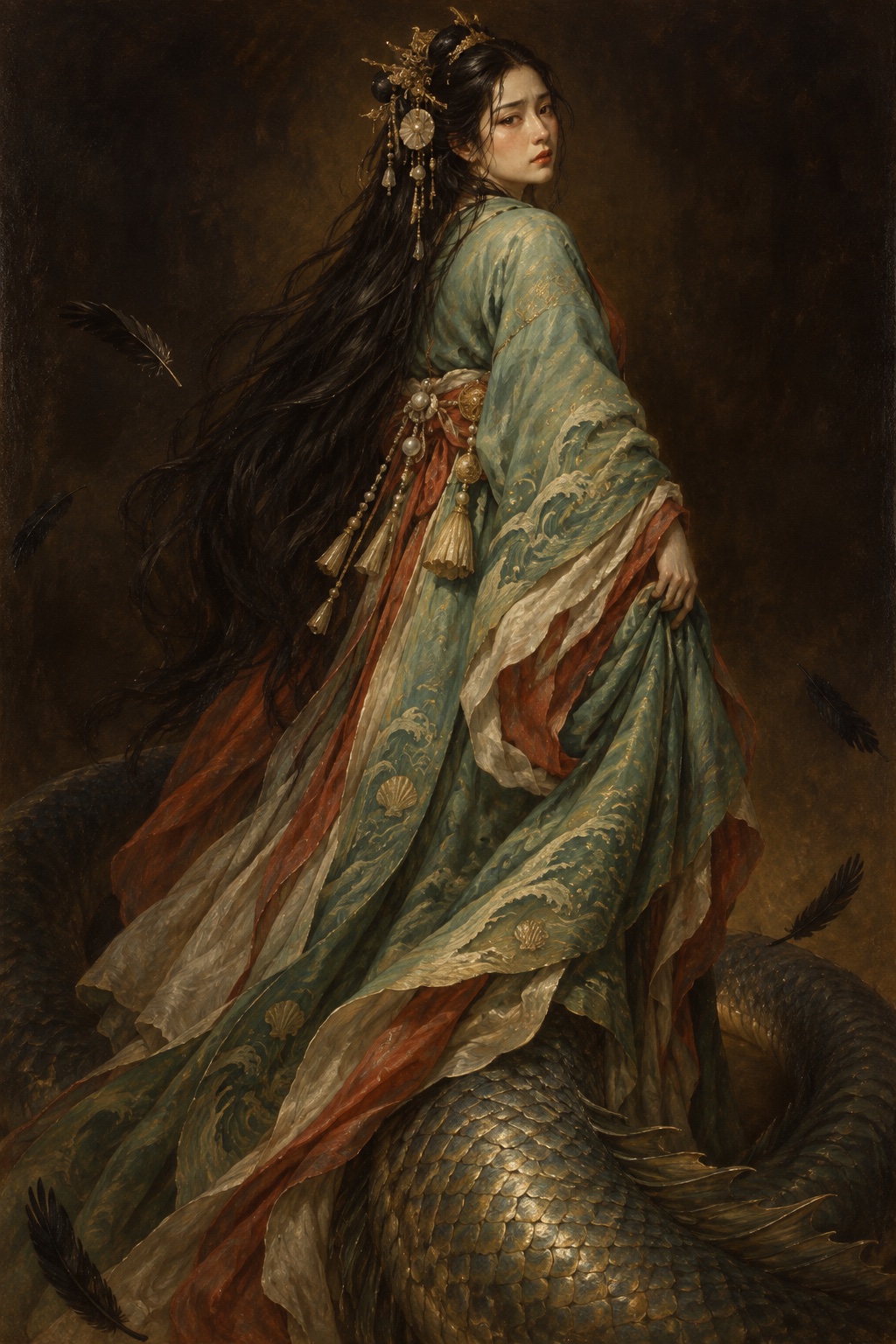
The hall at the limit of the waves
Hoori’s entry tells how her maidservants found him sitting in the katsura tree above her father’s well, how her eyes and his met, and how he stayed three years in the palace under the sea as her husband until a sigh in the night sent him home with the hook and the two tide jewels. Her own story begins where his leaves off, and it begins with her following him up. She arrives on the shore already pregnant, and the reason she gives for coming concerns the child rather than the husband: 天神之御子不可生海原, the august child of a Heavenly Deity should not be born in the sea.
於是海神之女豊玉毗賣命,自參出白之:「妾已妊身,今臨産時。此念,天神之御子不可生海原,故參出一作「於」到也。」尒即於其海邊波限一作「浪」 ,以鵜羽為葺草,造産殿。於是,其産殿未一作「生」葺合,不忍御腹之急,故入坐産殿。尒將方産之時,白其日子言:「凡他國人者,臨産時,以本國之形産生。故妾今以本身為産,願勿見妾。」於是思奇其言,竊伺其方産者,化八尋和迩而匍匐委虵,即見驚畏而遁退。尒豊玉毗賣命知其伺見之事,以爲心恥,乃生置其御子而白:「妾恒通海道,欲往來。然,伺見吾形,是甚恠一作「怍」之。」即塞海坂而返入
“Hereupon the Sea-Deity’s daughter Her Augustness Luxuriant-Jewel-Princess herself waited on [His Augustness Fire-Subside], and said: “I am already with child, and the time for my delivery now approaches. But methought that the august child of an Heavenly Deity ought not to be born in the Sea-Plain. So I have waited on thee here.” Then forthwith on the limit of the waves upon the sea-shore she built a parturition-hall, using cormorants’ feathers for thatch. Hereupon, before the thatch was completed, she was unable to restrain the urgency of her august womb. So she entered the parturition-hall. Then, when she was about to be delivered, she spoke to her husband [,saying]: “Whenever a foreigner is about to be delivered, she takes the shape of her native land to be delivered. So I now will take my native shape to be delivered. Pray look not upon me!” Hereupon [His Augustness Fire-Subside], thinking these words strange, stealthily peeped at the very moment of delivery, when she turned into a crocodile eight fathoms [long], and crawled and writhed about; and he forthwith, terrified at the sight, fled away. Then Her Augustness Luxuriant-Jewel-Princess knew that he had peeped; and she felt ashamed, and, straightway leaving the august child which she had borne, she said: “I had wished always to come and go across the sea-path. But thy having peeped at my [real] shape [makes me] very shame-faced,” —and she forthwith closed the sea-boundary, and went down again” — Kojiki, Sect. XLII, tr. Basil Hall Chamberlain (1882)
The hall stands 於其海邊波限, on the shore at the very limit of the waves — a gloss in the naming clause that follows has 波限 read as nagisa — which is to say on the line between her country and his. It is thatched with cormorant feathers, 以鵜羽為葺草, and it is never finished. 葺合, the thatch meeting across the roof, has not happened yet when the urgency of her womb overtakes her, and she goes in under it as it is. Then she makes a request that is also an explanation. 凡他國人者,臨産時,以本國之形産生 — anyone from another country gives birth, when the time comes, in the shape of that country — and so she will give birth in her own body, 本身, and she asks him not to look.
It is the second birth-hall in two generations. Hoori’s mother, Ko-no-hana-no-Sakuya-hime, answered a doubt about her child’s father by building a doorless hall eight fathoms long, sealing herself inside it and setting it on fire. The hall her daughter-in-law builds is the opposite of that one — unfinished overhead instead of shut on every side — and what it is meant to keep hidden is not the child’s parentage but the mother’s own shape.
Eight fathoms, crawling and writhing
He finds her words strange, and he looks. 竊伺 — he peeps, stealthily, at the very moment of the birth, and what he sees is 八尋和迩, a wani eight fathoms long, 匍匐委虵, crawling and writhing. Chamberlain translates 和迩 as “crocodile”; what animal the word means is not settled, and the chronicle does not say. The same word names the one-fathom wani that carried Hoori home from her father’s palace in a single day, so the chronicle has measured two of them, and she is eight times the length of the one that served as his ferry. The number also repeats his mother’s hall — 八尋 in both places — but here it measures a body rather than a building.
He is terrified and runs. The text says nothing more about the shape, only about what she does next. She knows that he has looked, and she is ashamed, 以爲心恥. 生置其御子 — she bears the child and leaves it where it is. Her parting words look back rather than forward: she had meant always to come and go by the sea-road, 恒通海道,欲往來, but he has seen her shape, and the shame of that is very great. Then 塞海坂: she closes the sea-boundary and goes back down behind it. Chamberlain’s notes show how much of that speech is an editor’s reading. Motowori took her verbs as causative — she had wished to let people come and go — and Chamberlain suspects he did so only to fit the wish to the closed boundary that follows, and to the fact that no path to the Sea-God’s palace now exists. Even the word for her shame is unsettled: the page prints 恠 with 怍 noted beside it as another reading, and Chamberlain’s “shame-faced” follows Motowori, who emended the 作 of the older editions to 怍.
The child is named for the roof. 是以名其所産之御子 — therefore the child she bore was named — 天津日高日子波限建鵜(葺)草葺不合命, which Chamberlain transliterates as Ama-tsu-hi-daka-hiko-nagisa-take-u-gaya-fuki-ahezu no mikoto and renders “His Augustness Heaven’s-Sun-Height-Prince-Wave-limit-Brave-Cormorant-Thatch-Meeting-Incompletely.” The wave-limit where the hall stood is in it, and the cormorant thatch, and the thatch that never met. Ugayafukiaezu, as this atlas writes him, is the last stretch of that name.
Red jewels and white jewels
She does not come back, and she does not stop loving him. 雖恨其伺情,不忍戀心: resentful as she is of his looking, she cannot hold back a loving heart. The child has to be nursed, and it is her younger sister Tamayori-bime who nurses it, so it is by the sister’s hand that her song goes up to Hoori.
然後者,雖恨其伺情,不忍戀心,因治養其御子之緣,附其弟玉依毗賣而獻歌之。其歌曰: 「阿加陀一作「院」麻波,袁佐閇比迦礼杼,斯良多麻能,岐美(能)何余一作「金」曾比斯,多布斗久阿理祁理。」尒其比古遲〈三字以音〉答歌曰: 「意岐都登理,加毛度久斯麻迩,和賀葦泥斯,伊毛波和須礼士,余能許登碁登迩
“Nevertheless afterwards, although angry at his having wished to peep, she could not restrain her loving heart, and she entrusted to her younger sister Jewel-Good-Princess, on the occasion of her nursing the august child, a Song to be presented [to His Augustness Fire-Subside]. The Song said: “As for red jewels, though even the string [they are strung on] shines, the aspect of [my] lord [who is] like unto white jewels is [more] illustrious.” Then her husband replied by a Song, which said: “As for my younger sister, whom I took to sleep [with me] on the island where light the wild-duck, the birds of the offing, I shall not forget her till the end of my life”” — Kojiki, Sect. XLII, tr. Basil Hall Chamberlain (1882)
The chronicle does not put her song into Chinese; it spells it. 阿加陀 and the characters after it are written for their sound, and what they spell is Japanese verse; the page’s two variant readings both fall in the middle of a word. Its image is two strings of jewels. Red jewels are bright enough that even the cord they hang on shines; the lord who is like white jewels is brighter still. Chamberlain’s notes give Motowori’s gloss, that this is simply how she expresses her loving feelings, and Moribe’s, that the red jewels stand for the child and the song ranks the husband dearer to her even than the son. Another note explains the go-between: the mother did not return to the upper world, and her sister had consented to act as the child’s nurse.
Hoori answers in verse, and neither song mentions the looking. He remembers the island where the wild ducks come down, the birds of the offing, and the younger sister he took there to sleep, and says he will not forget her as long as he lives. The younger sister of his song is not Tamayori-bime, who carries it; Chamberlain’s note paraphrases the line as a promise never to forget the one who was his wife in the realm of the Sea-God. After the two songs the chronicle turns straight to Hoori’s five hundred and eighty years in the palace of Takachiho and the place of his tomb. The nurse and the nursling meet again one generation on, in Jimmu’s entry, which names Ugayafukiaezu as his father and Tamayori-bime as his mother.