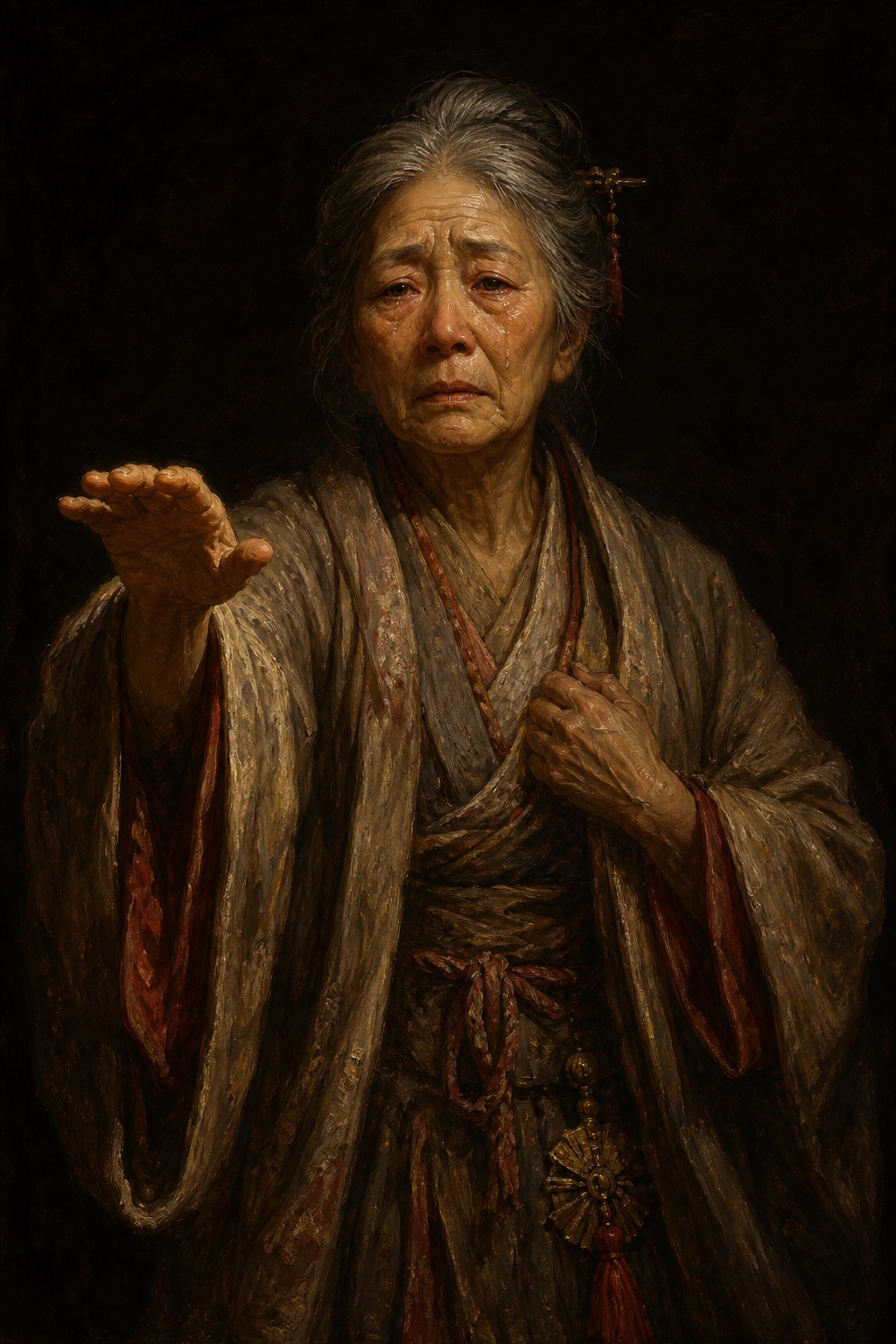
A name inside her husband’s answer
Tenazuchi enters the Kojiki without speaking. Susanoo, newly expelled from heaven, comes down to the head-waters of the river Hi and finds an old man and an old woman with a girl between them, and all three of them crying. He asks who they are, and it is the old man who answers — first with his father’s name, then with three names in one breath.
僕名謂足〈上〉名椎,妻名謂手〈上〉名椎,女名謂櫛名田比賣。」
“I am called by the name of Foot-Stroking-Elder, my wife is called by the name of Hand-Stroking-Elder, and my daughter is called by the name of Wondrous-Inada-Princess.” — Kojiki, Sect. XVIII, tr. Basil Hall Chamberlain (1882)
The pair of names is built as a pair. 足名椎 and 手名椎 differ in one character, foot against hand, and Chamberlain’s calques keep the symmetry: Foot-Stroking-Elder and Hand-Stroking-Elder. Nothing in the passage explains the stroking, and this entry does not supply a reason the text withholds. What the text does supply is the setting for it — the two of them with a child placed between them — so that the gesture the name records has an object, one daughter, and no others left.
Eight daughters and the year that came round
The reason for the crying is the second thing the old man says. They had eight daughters, 八稚女 in the kanbun; the eight-forked serpent of Koshi has come every year and taken one, and its time has come again. Kushinada-hime is the eighth. Both parents are 國神, Earthly Deities, and her husband is a child of Ōyamatsumi, the Great-Mountain-Possessor, whose descendants the chronicle names again and again; Tenazuchi’s own parentage the Kojiki never gives.
The serpent’s yearly appetite runs through the rice country, and their surviving daughter’s name carries 稻田, the rice-field, inside it. Read that way the eight daughters are eight harvests, and Tenazuchi is one of the two figures standing in front of the last one. The chronicle itself makes no such claim; it says only that they had eight, that seven are gone, and that they are weeping because it is that time of year again.
The one sentence, spoken in unison
Susanoo asks for the girl. The old man says he does not know who is asking. Susanoo names himself elder brother to Amaterasu and says he has just come down from heaven, and only then does the Kojiki, for the first and last time, let Tenazuchi speak — and it does not let her speak alone.
尒,足名椎、手名椎神白:「然坐者恐,立奉。」
Then the Deities Foot-Stroking-Elder and Hand-Stroking-Elder said: “If that be so, with reverence will we offer [her to thee].” — Kojiki, Sect. XVIII, tr. Basil Hall Chamberlain (1882)
The subject is 足名椎、手名椎神, both deities, and the verb 白 is single and shared. It is the grammar of a joint answer, not of a husband answering for his wife: whatever this costs, the text records the two of them paying it together. The sentence is also short to the point of curtness — an acknowledgement of rank, 恐, and then the offer. They have been asked for their eighth daughter by a god who has just given his name, and they consent in eight characters.
What happens to her afterwards
Nothing else in the chronicle is hers. Susanoo turns Kushinada-hime into a comb, puts her in his hair, and gives her parents their instructions — the eight-fold refined liquor, the fence with eight gates, a vat at each — and the instructions are addressed to both of them by name. After the serpent is killed, the Kojiki’s next section rewards the father alone: Ashinazuchi is appointed headman of Susanoo’s palace and given a new name to go with the office. Tenazuchi is not named in that section at all. She is present for the fear, present for the consent, present for the work, and absent from the settlement.