Struck off a blade, along with the blood
He begins as a by-product. When Izanagi draws his ten-grasp sword and beheads the fire-god Kagutsuchi, the blood that comes off the weapon makes deities wherever it lands — on the rocks at the point, on the rocks at the hilt, dripping between the fingers. Takemikazuchi is in the second group, born from the blood at the base of the blade, and the Kojiki gives him two further names in the same breath: 建布都神 and 豐布都神, both built on futsu, the sound of a sword cutting clean through.
That is his whole origin. He is not fathered, not born, not made. He is what happens when a sword is used, and every later thing he does is a variation on it.
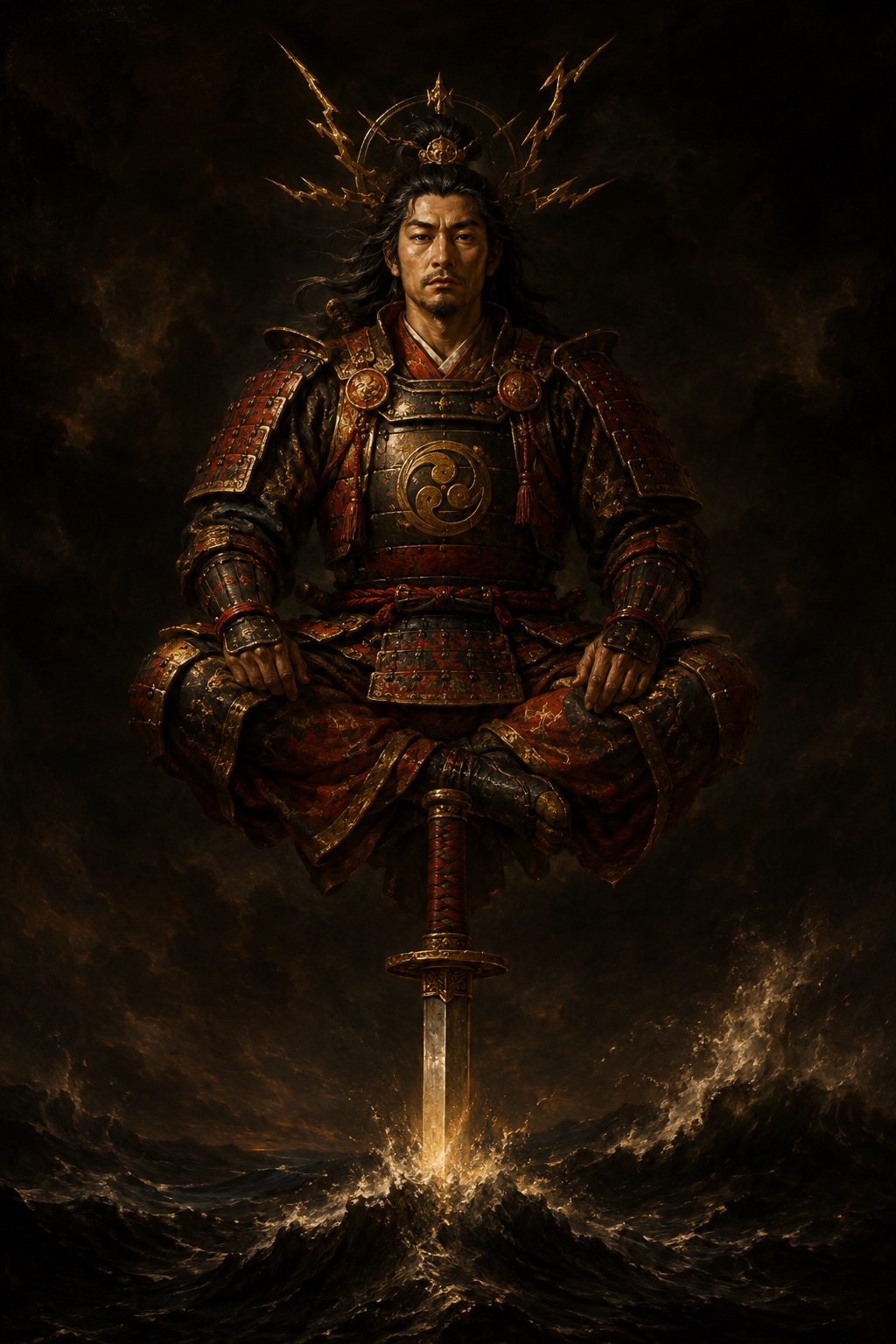
趺坐其釼前 — cross-legged on the point
Amaterasu wants the Central Land of Reed-Plains for her descendants, and the first envoys she sends do not come back. Asked whom to send next, the assembled deities name the sword-god Ame-no-Ohabari, who answers that his son should go instead. Takemikazuchi is dispatched with Ame-no-Torifune, and the two of them come down at the little shore of Inasa in Izumo.
拔十掬釼,逆刺立于浪穗,趺坐其釼前,問其大國主神言:「天照大御神、高木神之命以,問使之:『汝之宇志波祁流〈此五字以音〉葦原中國者,我御子之所知國。』言依賜,故汝心奈何?」
“Therefore these two Deities, descending to the little shore of Inasa in the land of Idzumo, drew their swords ten hand-breadths long, stuck them upside down on the crest of a wave, seated themselves cross-legged on the point of the swords, and asked the Deity Master-of-the-Great-Land, saying: ‘The Heaven-Shining-Great-August-Deity and the High-Integrating-Deity have charged us and sent us to ask, [saying]: “We have deigned to charge our august child with thy dominion, the Central Land of Reed-Plains, as the land which he should govern.” So how is thy heart?’” — Kojiki, Sect. XXXII, tr. Basil Hall Chamberlain
逆刺立 is to plant something the wrong way up, and 浪穗 is the ear or crest of a wave — the sword goes into moving water, point skyward. Then 趺坐, the cross-legged sitting posture, on 其釼前, the tip of it. Nothing in the passage explains how this is possible and nothing treats it as remarkable. The question that follows is put politely, in the grammar of a message from a superior, and it is asked by a god balanced on a sword-point in the surf. The demand and the posture are the same statement.
Ōkuninushi declines to answer for himself and refers the envoys to his sons, which is how the negotiation begins.
The hand that became ice and then a blade
One son, Kotoshironushi, agrees at once and hides himself away. The other does not.
故令取其御手者,即取成立冰,亦取成釼刄。故尒懼而退居
“So on his letting him take his august hand, his touch at once turned it into an icicle, and again his touch turned it into a sword-blade. So then he was frightened and drew back.” — Kojiki, Sect. XXXII, tr. Basil Hall Chamberlain
Takeminakata arrives carrying a boulder on his fingertips, asks who is talking that way in his country, and proposes a trial of strength — beginning, he says, by taking Takemikazuchi’s hand. He is given it. The hand becomes 立冰, standing ice, and then 釼刄, a sword’s edge. Takeminakata lets go and backs away, and when Takemikazuchi takes his hand in return he crushes it like a young reed and throws it aside. This is the earliest description of a wrestling bout in Japanese literature, and it is decided before either party has taken a step.
Note what the god does not do. He wins twice, and kills nobody: Takeminakata flees to the lake at Suwa and is spared there on his promise not to leave it. The mission was to obtain a country by consent, and it succeeds by consent — spectacularly intimidated consent.
One sword or two
Chamberlain’s English says the two deities drew their swords and seated themselves on the points of the swords, plural throughout. The Kojiki says 拔十掬釼 with no subject and no number, and every verb after it is equally unmarked. Whether Ame-no-Torifune also planted a blade and sat on it, or whether the whole tableau is Takemikazuchi’s alone, is a decision the translator has to make and the original does not.
The image that survived into later cult is the singular one. Takemikazuchi becomes the god of Kashima and, in the Kojiki’s own second book, the source of the sword that revives Jimmu’s army in Kumano — sent down at Amaterasu’s word when the whole expedition has collapsed asleep. He does not go himself that time. He sends the sword, which by then amounts to the same thing.