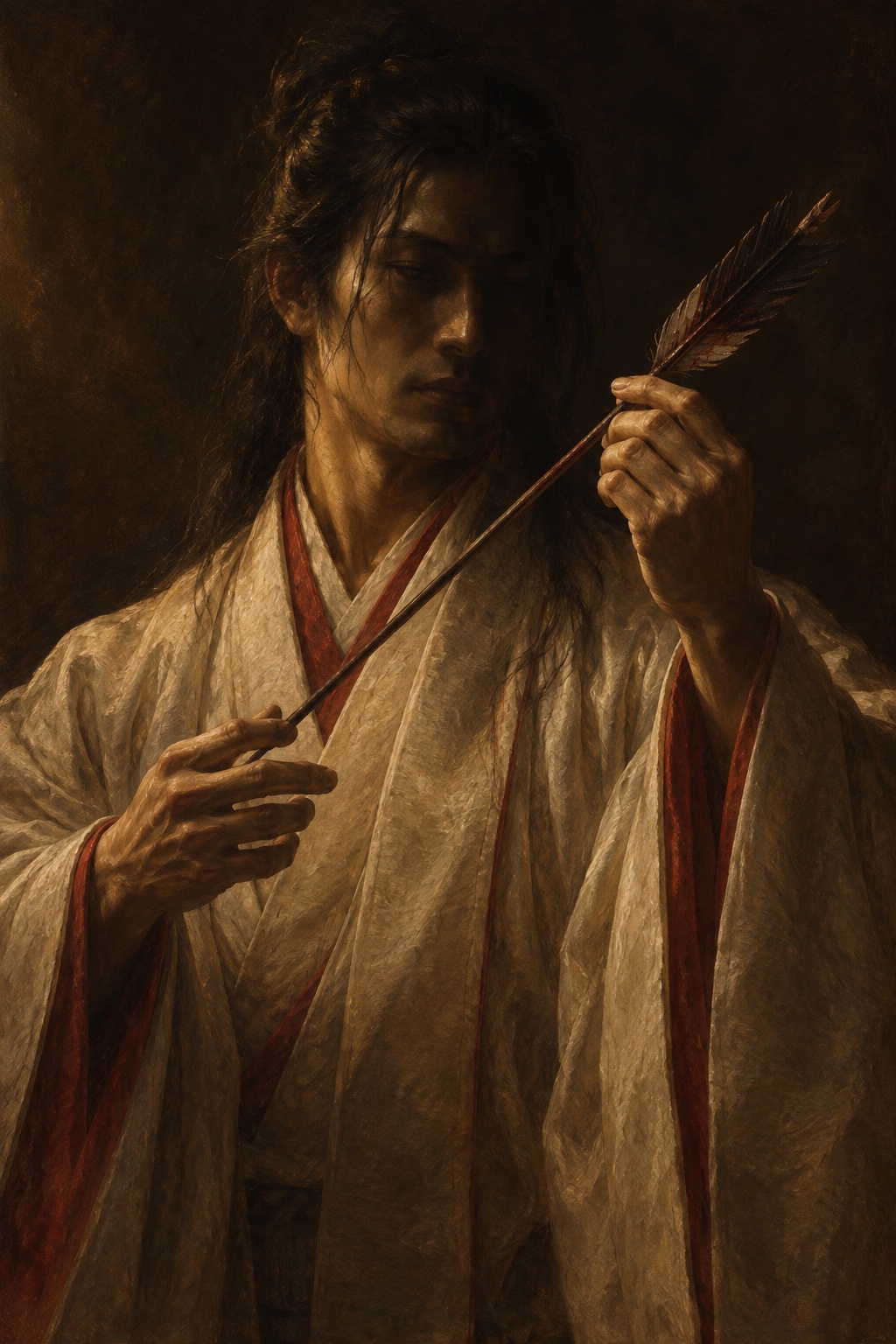
Second in the Kojiki’s first sentence
The Kojiki names three deities before anything exists to be named, and Takamimusubi is the second of the three. The sentence that produces him also disposes of him.
天地初發之時,於高天原成神名,天之御中主神。〈訓高下天云阿麻。下效此〉次高御産一作「座」巢日神,次神産巢日神。此三柱神者,並獨神成坐而隱身也
“…when the Heaven and Earth began were the Deity Master-of-the-August-Centre-of-Heaven, next the High-August-Producing-Wondrous Deity, next the Divine-Producing-Wondrous-Deity. These three Deities were all Deities born alone, and hid their persons.” — Kojiki, Sect. I, tr. Basil Hall Chamberlain (1882)
“The High-August-Producing-Wondrous Deity” is not a title the chronicle confers on him. It is Chamberlain taking 高御産巢日神 apart and reassembling it in English, morpheme by morpheme — high, august, producing, wondrous, deity — and his own footnote to this line declines to stand behind the last piece of it. He writes that it is open to doubt whether the syllable bi, “instead of signifying ‘wondrous,’ may not simply be a verbal termination,” in which case musubi would mean not “wondrous producing” but simply “producing.” The name is very nearly everything this passage supplies about him, and the translator will not vouch for all of it.
隱身 is the other half of what it supplies: they hid their persons. Nothing in the Kojiki undoes that. No later passage gives this deity a face, a garment, a posture, an age or a place to stand; when he acts, the text records a hand, a voice or a command and never the body they belong to. What it does not do is remove him from the story. The deity who hid at the beginning of Book I is still issuing orders at the end of it, and still issuing them in Book II, generations after the world below has been settled — which makes him an unusual kind of figure in this chronicle, one who is continuously present and never once described.
之命以 — a command issued by two
Amaterasu wants the Central Land of Reed-Plains for her descendants and cannot get a messenger to come back from it. The scene in which the problem is put to the assembled gods is also the scene that establishes the grammar of everything Takamimusubi will do for the rest of the book.
尒高御産巢日神、天照大御神之命以,於天安河之河原,神集八百萬神集而思金神令思而詔:「此葦原中國者,我御子之所知國,言依所賜之國也。故以爲於此國道速振荒振國神等之多在,是使何神而將言趣?」尒思金神及八百萬神議,白之:「天菩比神,是可遣。」
“Then the High-August-Producing-Wondrous-Deity and the Heaven-Shining-Great-August-Deity commanded the eight hundred myriad Deities to assemble in a divine assembly in the bed of the Tranquil River of Heaven, and caused the Deity Thought-Includer to think [of a plan], and said: ‘This Central Land of Reed-Plains is the land with which we have deigned to charge our august child as the land which he shall govern. So as he deems that violent and savage Earthly Deities are numerous in this land, which Deity shall we send to subdue them?’ Then the Deity Thought-Includer and likewise the eight hundred myriad Deities took counsel and said: ‘The Deity Ame-no-ho-hi is the one that should be sent.’” — Kojiki, Sect. XXX, tr. Basil Hall Chamberlain (1882)
之命以 is the hinge: by the command of. Two deities are named in front of it, Takamimusubi first and Amaterasu second, and one command comes out of the pair of them. This is the shape of the whole campaign to take the land below — the convening of the assembly here, the charge laid on Ame-no-Uzume at the crossroads, the dispatch of Takemikazuchi to Izumo, the sending of Ninigi-no-Mikoto with the regalia. Through the whole of Book I the two names stand together every time he acts, with exactly one exception — the arrow. The only other place he speaks alone comes generations later, in Book II, inside a stranger’s dream.
What he does not do is think. 思金神令思 — he causes Omoikane to think, a causative laid on somebody else’s faculty, and the plan that comes back is not his. It is also wrong: Ame-no-Hohi goes down, attaches himself to Okuninushi and sends no word for three years. The assembly reconvenes, and the second choice is Ame-no-Wakahiko, son of the Deity Heaven’s-Earth-Spirit. He is given the heavenly true deer-bow and the heavenly feathered arrows and sent. Those two objects are the reason this entry has an episode at all — they are heaven’s property, lent, and the whole of what follows turns on the fact that the lender can recognise them again.
The arrow comes back up, and the name changes
Eight years pass with no report from Ame-no-Wakahiko. A pheasant — 鳴女, the one Chamberlain calls the Name-Crying-Female — is sent down to ask why. She perches at his gate and delivers the question; Ame-no-Sagume hears the bird, tells him its cry is thoroughly ill-omened and that it should be shot dead; and he takes the bow and arrows heaven gave him and shoots it. The arrow goes through the pheasant’s breast and does not stop. It flies on up to the bed of the Tranquil River of Heaven, where the council is still sitting — and in the clause that reports its arrival, the Kojiki changes what it calls him, and then stops the narrative to say so: 是高木神者,高御産巢日神之別名, this Takagi-no-kami is another name for Takamimusubi-no-kami.
Chamberlain changes with it. Section XXXI opens on “the High-August-Producing-Wondrous-Deity,” shortens that once in passing to “the Producing-Wondrous-Deity,” and then, from the moment the arrow reaches the river-bed, writes “the High-Integrating-Deity” and nothing else — and translates the chronicle’s own aside where it stands: This “High-Integrating-Deity” is another name for the High-August-Producing-Wondrous-Deity. The switch is not drift between one section and the next. It happens inside a single section, at a single sentence, and both the chronicle and its translator break off to flag it. Afterwards Book I never writes 高御産巢日神 again: six further mentions on that page, all of them 高木神.
故高木神取其矢見者,血着其矢羽。於是高木神告之:「此矢者,所賜天若日子之矢。」即示諸神等詔者:「或天若日子不誤命,為射惡神之矢之至者,不中天若日子;或有邪心者,天若日子於此矢麻賀礼!
“So, on the High-Integrating-Deity taking up the arrow and looking at it [he saw that] there was blood adhering to the feathers of the arrow. Thereupon the High-Integrating-Deity, saying: “This arrow is the arrow that was bestowed on the Heavenly-Young-Prince,” showed it to all the Deities, and said: “If this be an arrow shot at the evil Deities by the Heavenly-Young-Prince in obedience to our command, let it not hit him. If he has a foul heart, let the Heavenly-Young-Prince perish by this arrow.”” — Kojiki, Sect. XXXI, tr. Basil Hall Chamberlain (1882)
血着其矢羽 is the whole of the evidence: blood adhering to the feathers. He recognises the shaft before he reads the blood — 此矢者,所賜天若日子之矢, this is the arrow that was bestowed on the Heavenly-Young-Prince — and recognition is possible only because the weapon left heaven as a loan. Then he does the one thing in this entry that nobody has told him to do and that he does not delegate: he shows the arrow to the assembled deities and speaks a conditional over it. If the shot was obedient, let it miss. If the heart is foul, let the man die by it. It is the only sentence of judgment he passes anywhere in the Kojiki, and he passes it over an object rather than on a person.
The quotation breaks here because the next three characters, 麻賀礼, are written for their sound and not their sense — the chronicle’s own annotation, 〈此三字以音〉, says exactly that — and the zh.wikisource text of Book I carries a stray space in front of that annotation which the Kojiki does not have. The passage is quoted in two pieces around the space rather than reproduced with it.
云而取其矢,自其矢穴衝返下者,中天若日子寢朝床之高胸坂以死
“With these words, he took the arrow and thrust it back down through the arrow’s hole, so that it hit the Heavenly-Young-Prince on the top of his breast as he was sleeping on his couch, so that he died.” — Kojiki, Sect. XXXI, tr. Basil Hall Chamberlain (1882)
自其矢穴 — by the arrow’s own hole. The shaft goes back down the opening it made coming up, which is the chronicle’s way of saying that nothing new is introduced: the weapon, the wound and the route are all already there. The condition is never tested against anything; the throw is the test and the verdict at once. 取其矢 occurs twice in the passage, once for the taking up and once for the taking back, and those two hands are the only physical acts the Kojiki ever attributes to this deity directly. Even here it gives a hand and a verb and no body to attach them to. The man dies asleep on his morning couch, killed at the far end of a hole in the sky by a god nobody has ever seen.
高木神之女 — the daughter inside the brackets
Izumo is handed over at last, and heaven turns to sending someone down to hold it. Amaterasu’s own son Ame-no-Oshihomimi is the obvious candidate and was the original one, and he declines: while the preparations were being made a child was born to him, and it is the child who should go instead. At that point the Kojiki stops the narration for a genealogical aside, and Chamberlain brackets it off from the sentences around it because he reads it as an insertion rather than as the story carrying on.
此御子者,御合高木神之女萬幡豊秋津師比賣命,生子:天火明命、次日子番能迩迩迩藝命二柱也。
“[As for this august child, he was augustly joined to Her Augustness Myriad-Looms-Luxuriant-Dragon-fly-Island-Princess, daughter of the High-Integrating-Deity, and begot children: His Augustness-Heavenly Rice-ear-Ruddy, and next His Augustness Prince-Rice-ear-Ruddy-Plenty.]” — Kojiki, Sect. XXXIII, tr. Basil Hall Chamberlain (1882)
御合高木神之女 — augustly joined to the daughter of Takagi-no-kami. That clause, inside a parenthesis, inside a refusal, is the whole textual basis of the relationship, and it settles the chronicle’s central claim. The second of the two sons named here is Ninigi-no-Mikoto, the grandson who goes down in his father’s place with the mirror, the sword and the curved jewels. He is Amaterasu’s grandson through his father and Takamimusubi’s through his mother. The line of sovereigns the Kojiki was written to establish descends from both of the deities whose joint command has been running the book.
Two features of the passage are the source page’s own rather than the story’s. The mother’s name is 萬幡豊秋津師比賣命, which Chamberlain renders piece by piece as Her Augustness Myriad-Looms-Luxuriant-Dragon-fly-Island-Princess; the Nihon Shoki puts a differently named figure, Taku-hata-chi-chi-hime, in the identical position as this deity’s daughter and Ninigi’s mother. And the page writes 日子番能迩迩迩藝命 with three 迩 here where two sentences later it uses two — quoted as the page has it, not corrected to match.
Reported at two removes, in a stranger’s dream
Generations later, in Book II, the chronicle has finished with heaven and is following a man walking east. At Kumanu the campaign stops dead: a savage deity appears and the whole army, the future first sovereign included, falls prostrate and sleeps. Nothing descends to wake them. What happens instead is that a local man called Takakurazhi has a dream, and afterwards repeats it out loud.
高倉下答曰。己夢云。天照大神。高木神。二柱神之命以。召建御雷神而詔。葦原中國者。伊多玖佐夜藝帝阿理那理。〈此十一字以音。〉我之御子等。不平坐良志。〈此二字以音。〉其葦原中國者。專汝所言向之國故。汝建御雷神可降。
“Takakurazhi replied, saying: “I was told in a dream that the two Deities the Heaven-Shining-Great-Deity and the High Integrating Deity commanded and summoned the Brave-Awful-Possessing-Male-Deity, and charged him [thus]: ‘The Central Land of Reed-Plains is painfully uproarious,—it is. Our august children must he ill at ease. As [therefore] the Central Land of Reed-Plains is a land which thou specially subduedst, thou the Brave-Awful-Possessing-Male-Deity shalt descend [thither].’”” — Kojiki, Sect. XLV, tr. Basil Hall Chamberlain (1882)
The distance here is extraordinary even by this deity’s standards. The order is reported speech, inside a dream, recounted by a stranger, to a man who has only just woken up — and it is not carried out by the one who receives it either. Takemikazuchi declines to descend in person and sends his sword down instead, through the ridge of Takakurazhi’s storehouse roof, and it is the sword that cuts down the savage deities of the mountains of Kumanu without anybody striking a blow. Two small things in the passage belong to the page rather than the myth: Chamberlain drops the hyphens here and writes “the High Integrating Deity,” and the printed text carries a plain misprint in the summons — “Our august children must he ill at ease,” where the sense requires be. Both are left as the source has them.
Then, in the same unbroken run of kanbun, a second order, and this one has only one name in front of it. 於是亦。高木大神之命以覺白之 — thereupon, again, by the command of the great Takagi deity, he was instructed in a dream and spoke of it. Chamberlain gives the clause as “Then His Augustness the Great-High-Integrating-Deity again commanded and taught, saying,” and what follows is the warning not to press into the interior and the promise of a crow eight feet long to walk in front of the army. Amaterasu is not in that sentence, and the name is not the usual one: the chronicle has added 大 to make him 高木大神, the great Takagi, and the translator adds “Great-” to keep up. The last command the Kojiki records from the deity who hid his person in its first sentence is one he gives alone, under the longest name he is ever given, into the sleep of a man he has never met.