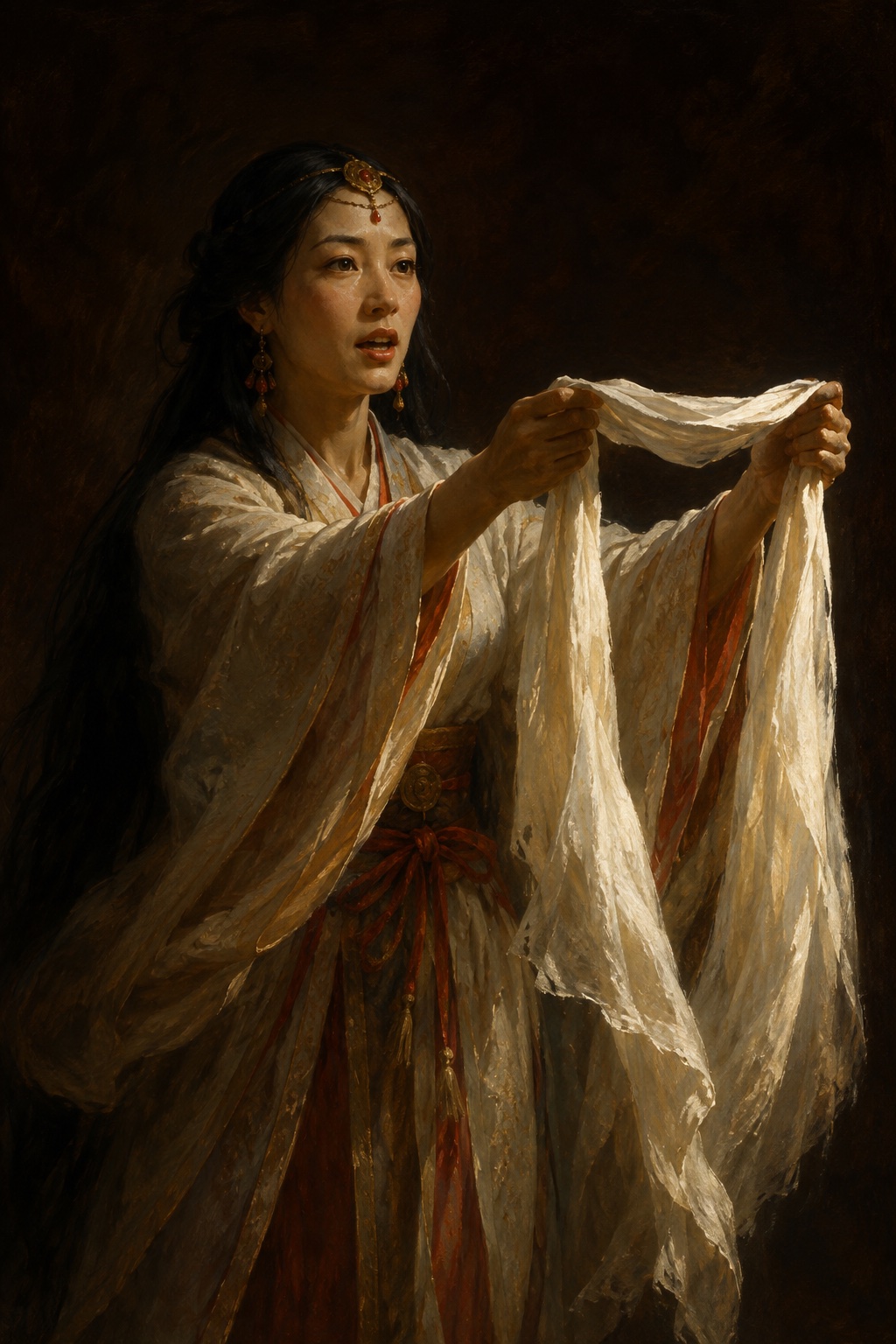
比礼 — two scarves against her father’s traps
Suseri-bime is Susanoo’s daughter, and the Kojiki introduces her the moment Okuninushi arrives in the Nether-Distant-Land as a fugitive from his own eighty brothers: he sees her, she sees him, and the two marry before either father has any say in it. Chamberlain never renders her name as “Suseri-bime” — his English calls her only “the Forward-Princess,” an epithet rather than a transliteration, and it is the only name this translation ever gives her.
Susanoo does not accept the marriage. He puts his new son-in-law to sleep in a room of snakes, and the next night sends him into a room of centipedes and wasps. Both times, Suseri-bime has already acted before either room is opened.
於是其妻須勢理毗賣命,以虵比礼〈二字以音〉授其夫云:「其虵將咋,以此比礼,三擧打撥。」故如教者,虵自靜,故平寢出之。亦來日夜者,入呉公与蜂室,且授呉公蜂之比礼教如先。故平出之
“Hereupon his wife, Her Augustness the Forward-Princess, gave her husband a snake-scarf, saying: “When the snakes are about to bite thee, drive them away by waving this scarf thrice.” So, on his doing as she had instructed, the snakes became quiet, so that he came forth after calm slumbers. Again on the night of the next day [the Impetuous-Male-Deity] put him into the centipede and wasp-house; but as she again gave him a centipede and wasp-scarf, and instructed him as before, he came forth calmly.” — Kojiki, Sect. XXIII, tr. Basil Hall Chamberlain (1882)
She 授 — hands over — the 比礼, the scarf, and speaks the instruction herself rather than leaving him to guess at it: three wavings turn back the snakes, three more turn back the centipedes and wasps. The Kojiki reports her action in nearly the same words on both nights — same gift, same instruction, same result — which is its way of saying that Okuninushi survives his father-in-law’s traps because of her, not because of anything he does himself.
嫡妻 — named chief wife, over her father’s shout
The pair still have to get past Susanoo himself. Once he discovers what has happened, he chases the fleeing couple to the pass at the edge of his own realm, and what he shouts after them there is the moment the Kojiki fixes his daughter’s rank in words rather than leaving it to be inferred.
其我之女須世理毗賣,為嫡妻
“…and making my daughter the Forward-Princess thy consort…” — Kojiki, Sect. XXIII, tr. Basil Hall Chamberlain (1882)
The clause is a fragment of a much longer command: in the same breath Susanoo tells his son-in-law to hunt down the eighty brothers, take the title of Deity Master-of-the-Great-Land, and sink the pillars of a palace into the bedrock of the country he is being handed. None of that changes what the fragment itself does — it is Susanoo’s own furious voice that makes his daughter 嫡妻, chief wife, of the very god he has just finished trying to kill.
The clause also spells her name 須世理毗賣, with 世, three sentences after the same page spelled it 須勢理毗賣, with 勢, in the passage quoted above. The Kojiki is not consistent about her name even inside one short episode, and this wiki’s own 須勢理毘賣 follows neither spelling exactly — only the form already established across the corpus.
嫉妬 — her jealousy, and the pledge that follows it
Years later, a fresh scandal touches the marriage: Okuninushi goes wooing again, this time Nunakawa-hime in the land of Koshi, and the next episode of the Kojiki opens by naming what that does to his wife.
又其神之適后須勢理毗賣命,甚為嫉妬
“Again this Deity’s Chief Empress, Her Augustness the Forward-Princess, was very jealous.” — Kojiki, Sect. XXV, tr. Basil Hall Chamberlain (1882)
嫉妬 — jealousy: the Kojiki commits to her feeling before it shows her doing anything about it, the reverse of the scarves scene, where she acted first and the text never said what she felt. What she does with the feeling is stage a leaving that never quite happens. Okuninushi saddles his horse as if to ride after the other woman; Suseri-bime answers him with a formal song rather than a scene of temper, he sings back in kind, and the exchange ends with her pouring him the pledge-cup of liquor that binds them back together as husband and wife. Across the three passages this entry quotes, she is given the fullest sustained voice anyone keeps in Susanoo’s court — first the instruction that saves her husband’s life, then the shout that names her, then a jealousy stated as plainly as it is resolved.