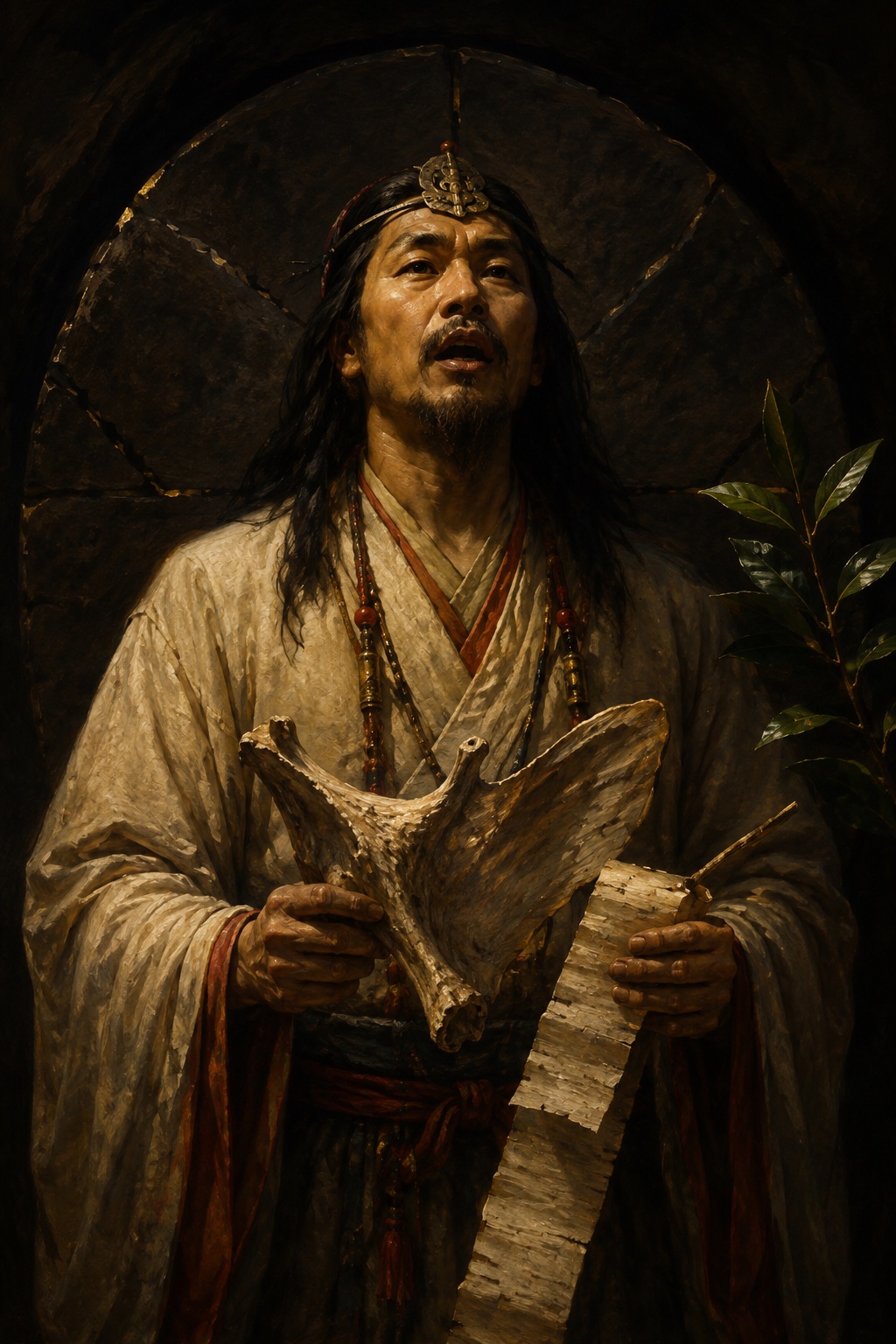
占合 — the stag’s shoulder-blade and the cherry-bark
Ame-no-Koyane enters the Kojiki in the middle of an emergency. Susanoo’s violence in heaven has driven Amaterasu into the Heavenly Rock-Dwelling, the world has gone dark, and the eight hundred myriad deities are gathered in the bed of the Tranquil River of Heaven, where Omoikane has been told to think of a plan. That plan is already running in other hands — a smith at the heavenly iron, Ishikoridome at the mirror, Tama-no-oya at the string of curved jewels — when the assembly calls in two gods more, and calls them in together.
召天兒屋命、布刀玉命〈布刀二字以音。下效此〉而内拔天香山之真男鹿之肩拔而取天香山之天之波波迦〈此三字以音。木名〉而令占合麻迦那波
“summoning His Augustness Heavenly-Beckoning-Ancestor-Lord and His Augustness Grand-Jewel, and causing them to pull out with a complete pulling the shoulder [-blade] of a true stag from the Heavenly Mount Kagu, and take cherry-bark from the Heavenly Mount Kagu, and perform divination” — Kojiki, Sect. XVI, tr. Basil Hall Chamberlain (1882)
Chamberlain never romanises the name. Across the whole of Section XVI this god is only “His Augustness Heavenly-Beckoning-Ancestor-Lord,” an English calque of 天兒屋命, and the syllables Koyane appear nowhere on the page. What he and Futotama are set to do is 令占合, Chamberlain’s “perform divination,” using two things fetched from one mountain: the shoulder-blade of a stag and bark from the cherry of the Heavenly Mount Kagu. The standard modern reading of that pair of objects is scapulimancy — the bone scorched over a fire of the bark, the cracks read for an answer — but the chronicle says none of that, and it never reports what the answer was. The divination is the first thing the two of them do, they do it jointly, and the sentence moves straight on to the tree.
布刀詔戶言 — the grand liturgy at the door
The same unbroken sentence keeps going. A true sakaki of five hundred branches is pulled up by the roots from the Heavenly Mount Kagu; the long string of curved jewels goes on its upper branches, the mirror eight feet long on the middle ones, and white and blue pacificatory offerings on the lower. That stretch is described here rather than quoted, because Chamberlain’s printed text carries an error in exactly those words — the offerings are banged upon the lower branches where the sense is hanging — and the house rule is to move a quotation off a damaged line rather than repair it silently. With the tree dressed, the sentence at last divides the work between the two gods it summoned.
此種種物者,布刀玉命、布刀御幣登取持而天兒屋命,布刀詔戶言,祷白
“His Augustness Grand-Jewel taking these divers things and holding them together with the grand august offerings, and His Augustness Heavenly-Beckoning-Ancestor-Lord prayerfully reciting grand liturgies” — Kojiki, Sect. XVI, tr. Basil Hall Chamberlain (1882)
Futotama holds; Ame-no-Koyane speaks. That is the whole of the division, and the speaking half is what the rest of his reputation rests on. 布刀詔戶言 is the Kojiki’s own name for the words — Chamberlain’s “grand liturgies” — and the chronicle prints not one line of them: what survives is the fact of an utterance and the honorific 布刀 fastened to it. Later Japanese usage calls the form futonorito, but that is a modern convenience; neither chronicle romanises anything of the sort, and the Nihon Shoki does not use this term at all. Notice, too, what the sentence does not do. It does not pause for him. The recitation is one clause among several running at once — Ame-no-Tajikarao is already standing hidden beside the door, and Ame-no-Uzume’s dance begins in the very next breath — and nowhere in Chamberlain’s section does the text say the liturgy accomplished anything. It says he recited it.
The mirror, and what opened the door
What the plan does accomplish, it accomplishes through noise. Uzume’s performance ends with the Plain of High Heaven shaking and the eight hundred myriad deities laughing together; Amaterasu, shut inside, thinks this strange enough to open the rock door a crack and ask how heaven can be merry with the world in darkness. Uzume answers that they rejoice because a deity nobler than she is present — and while Uzume is still speaking, the two who divined and prayed step back in.
如此言之間,天兒屋命、布刀玉命指出其鏡,示奉天照大御神
“While she was thus speaking, His Augustness Heavenly-Beckoning-Ancestor-Lord and His Augustness Grand-Jewel pushed forward the mirror and respectfully showed it to the Heaven-Shining-Great-August-Deity” — Kojiki, Sect. XVI, tr. Basil Hall Chamberlain (1882)
指出其鏡 — they push the mirror out into the gap. The mirror is not his; Ishikoridome made it, and it hangs from the tree Futotama carries. His part is to hold it where the light will fall on the face behind the door. Amaterasu thinks it stranger still, edges out of the door to look, and Ame-no-Tajikarao takes her hand — the rescue is over. That what holds her at the gap is her own reflection is the usual reading of the scene rather than anything the sentence says. It is worth being exact about what the Kojiki credits to whom, because the temptation runs the other way: the laughter draws the question, Uzume’s answer sharpens it, the mirror keeps the goddess at the opening, and the strong-armed god does the pulling. The liturgy is never named among the causes.
太諄辭 — the second chronicle’s liturgy
The Nihon Shoki tells the rock-cave crisis more than once. Its main narrative gives Ame-no-Koyane and Futotama the sakaki and the prayer jointly, in the passage this wiki already quotes on Omoikane’s page. Two further tellings sit among the chronicle’s 一書, the alternative writings it gathers after each episode, and both passages below come from the same one — the third. They are two moments in a single account, not two witnesses agreeing with each other.
至於日神閉居于天石窟也。諸神遣中臣連遠祖興台產靈兒天兒屋命而使祈焉
“When the Sun-Goddess came to shut herself up in the Rock-cave of Heaven, all the Gods sent the child of Kogoto Musubi, Ama no Koyane no Mikoto, the ancestor of the Nakatomi no Muraji, and made him recite a liturgy” — Nihongi, Book I, tr. W. G. Aston (1896)
One sentence carries the only parentage he is ever given. 興台產靈兒, Aston’s “the child of Kogoto Musubi,” has no counterpart in the Kojiki, which introduces him with no father at all, and none in the Nihon Shoki’s own main text. (Aston romanises the name two ways on one page — “Ame no Koyane no Mikoto” in the main narrative, “Ama no Koyane no Mikoto” inside the 一書 — and each quotation here keeps the spelling of the passage it comes from.) The same sentence delivers the clan in the same breath: 中臣連遠祖, distant ancestor of the Nakatomi no Muraji, named as such at the moment the gods send him to pray.
Then this telling takes the words back out of his mouth. He goes on to uproot the sakaki of the Heavenly Mount Kagu and hang the eight-hand mirror, the curved jewels and the offering-cloth on its branches himself — and it is Futotama who is then made to take the tree in his hands and, 而廣厚稱辭祈啓矣, recite the liturgy of praise. That is the exact reverse of the Kojiki’s arrangement, where Futotama holds and Ame-no-Koyane speaks, and the chronicle presses the point: what the sun deity hears through the door and calls more beautiful than any prayer yet offered is Futotama’s speech, not his. The two chronicles are not one story, and an entry that merged them would hand him a recitation the Nihon Shoki awards elsewhere.
His own recitation in this 一書 arrives later, after the door is open and the assembly has turned on the god who caused the trouble.
乃使天兒屋命掌其解除之太諄辭而宣之焉
“Then they caused Ama no Koyane no Mikoto to take charge of his Great Purification Liturgy, and made him recite it” — Nihongi, Book I, tr. W. G. Aston (1896)
解除 is the purification, the rite later Japanese calls harae. The gods lay the 千座置戶 penalty on Susanoo, dispose of his finger-nails and toe-nails as the cast-off matter of the offence, and put the liturgy of the rite — 其解除之太諄辭 — into Ame-no-Koyane’s charge. 太諄辭 is the Nihon Shoki’s word where the Kojiki wrote 布刀詔戶言, and neither chronicle ever borrows the other’s. Between the two of them the shape of a single office emerges: a voice that speaks over the dressed tree, and the same voice that speaks a pollution away once it has been paid for. Both chronicles then send him down with Amaterasu’s grandson Ninigi-no-Mikoto, one of five who accompany the descent alongside Futotama, Ame-no-Uzume, Ishikoridome and Tama-no-oya, and the Kojiki closes that list by glossing each name with the house it founded — his is 中臣連等之祖, ancestor of the Nakatomi. That the historical Nakatomi held the hereditary charge of reciting norito at court ritual is later institutional history rather than anything either chronicle states; what the chronicles do is write the office back into the rock-cave and give it a first holder.