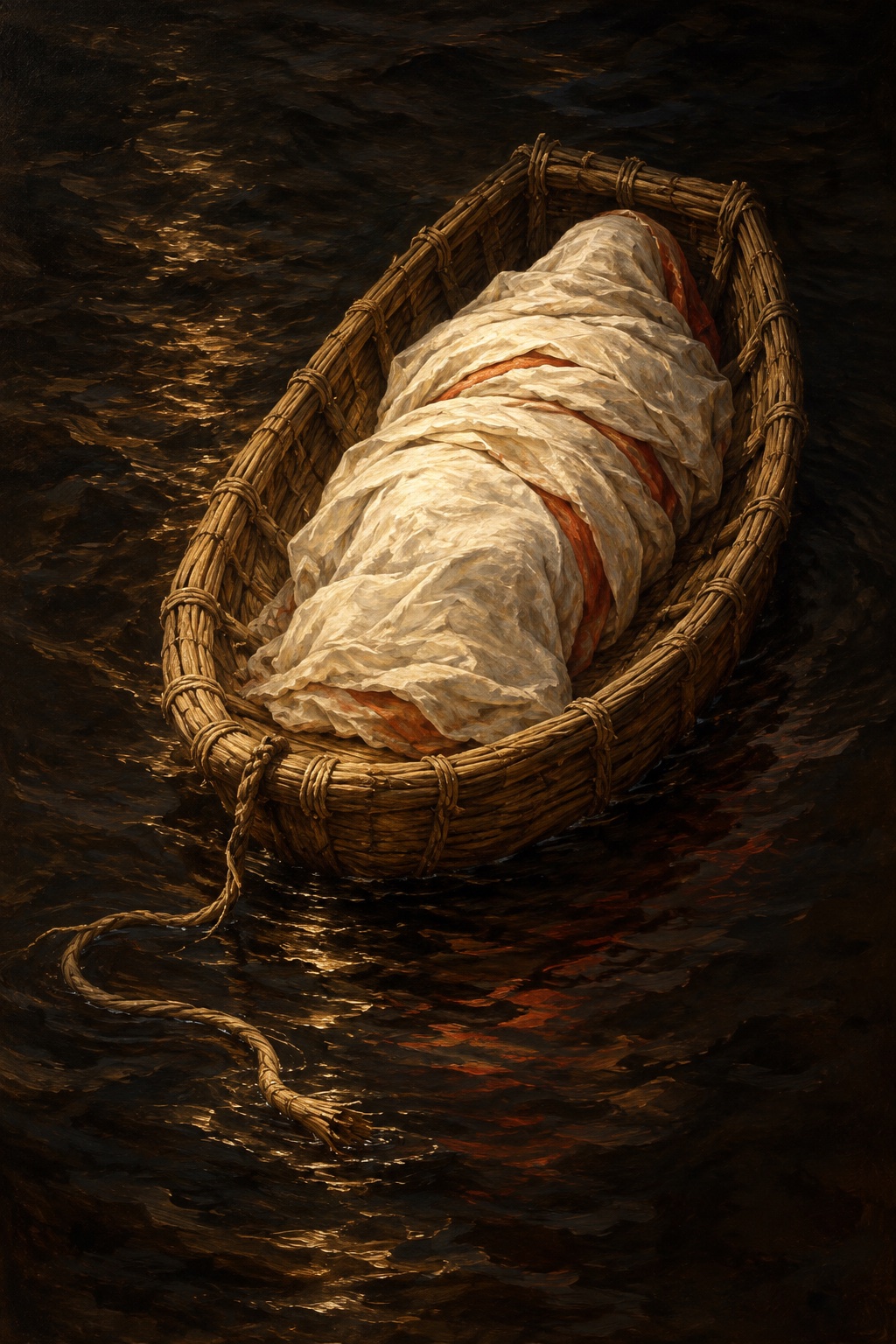
The child of the first circuit
The Kojiki tells the child’s birth and loss in two sentences. Izanagi and Izanami have agreed to go round the heavenly august pillar from opposite sides and to meet. When they meet, Izanami speaks first and praises the youth in front of her, and Izanagi answers her. Then he tells his sister that it is not good for the woman to speak first. Chamberlain did not put this part into English: his translation of 1882 gives the courtship and the birth in Latin, and in the Latin the child’s name is Hirudinem. The kanbun says that the pair began in the bridal chamber all the same, and that the child they bore was 水蛭子. The next sentence is the first one that Chamberlain renders in English, and it is the end of the child’s story in the Kojiki.
此子者入葦船而流去。次生淡嶋,是亦不入子之例
“This child they placed in a boat of reeds, and let it float away. Next they gave birth to the Island of Aha. This likewise is not reckoned among their children.” — Kojiki, Sect. IV, tr. Basil Hall Chamberlain (1882)
That is all. The Kojiki gives the child no age and no description. The boat is 葦船, a boat of reeds, and the child goes where the water takes it. The text does not say what the parents felt or what they intended, and it does not follow the boat. In the kanbun of Book I, the boat of reeds occurs only in this sentence.
The name comes to English in two forms. Chamberlain, outside the Latin, calls the child the Leech-Child; Aston’s Nihongi writes the leech-child, for the 蛭兒 of the Nihon Shoki. This atlas writes Hiruko.
The divination of the Heavenly Deities
The pair do not decide for themselves what went wrong. In the Kojiki they consult each other after the Island of Aha, judge that their children are not good, and go up to ask the Heavenly Deities.
於是二柱神議云:「今吾所生之子不良,猶宜白天神之御所。」即共參上,請天神之命。尒天神之命以,布斗麻迩尒〈上〉〈此五字以音〉卜相而詔之:「因女先言而不良,亦還降改言
“Hereupon the two Deities took counsel, saying: “The children to whom we have now given birth are not good. It will be best to announce this in the august place of the Heavenly Deities.” They ascended forthwith to Heaven and enquired of Their Augustnesses the Heavenly Deities. Then the Heavenly Deities commanded and found out by grand divination, and ordered them, saying: “They were not good because the woman spoke first. Descend back again and amend your words.”” — Kojiki, Sect. V, tr. Basil Hall Chamberlain (1882)
The Heavenly Deities do not answer from knowledge. They find the answer by divination, and only then give the reason. The kanbun spells the rite with five characters used for their sound, 布斗麻迩尒, as its own note says; Chamberlain renders it grand divination. Izanagi had said before the birth that it was not good for the woman to speak first, but it is the divination that joins that fault to the children. The pair go back down and go round the heavenly august pillar again as before. This time the Male-Who-Invites, Chamberlain’s name for Izanagi, speaks first, and the births begin again.
The Nihon Shoki tells the scene more than once, and the child is not in every telling. In the main text the woman speaks first, the male deity is displeased at once and says that he, as the man, should by right have spoken first, and they go round again before anything is born. The first birth there is the island of Ahaji, which Aston’s English says was reckoned as the placenta. It is the first of the alternative writings after the main text that tells the story the way the Kojiki does. In that writing the woman speaks first and nobody objects. The first child is the leech, and the parents place it in a reed-boat at once and send it adrift. Then the island follows.
次生淡洲,此亦不以充兒數。故還復上詣於天,具奏其狀。時天神以太占而卜合之,乃教曰:「婦人之辭,其已先揚乎?宜更還去
“Their next was the Island of Ahaji. This also was not included in the number of their children. Wherefore they returned up again to Heaven, and fully reported the circumstances. Then the Heavenly Gods divined this by the greater divination. Upon which they instructed them, saying:—“It was by reason of the woman’s having spoken first; ye had best return thither again.”” — Nihongi, Book I, tr. W. G. Aston (1896)
The chronicle names the rite 太占, which Aston renders the greater divination, and its answer is the Kojiki’s answer. In both works the parents report and the Heavenly Deities divine. Neither work lets Izanagi or Izanami explain the child. The explanation comes from Heaven, and it comes by divination.
Three years without standing
The main text of the Nihon Shoki puts the child somewhere else entirely. After the islands, Izanagi and Izanami produce the sea, the rivers and the mountains, then the ancestors of the trees and of the grasses. Then they ask each other why, when they have made the country of eight great islands with its mountains, rivers, grasses and trees, they should not produce a ruler for all under heaven. The child they produce next is the sun goddess, whom a note in the text also calls Amaterasu. Her light shines through the whole world, and her parents rejoice that among their many children there is none so wonderful. Heaven and earth are not yet far apart, so they send her up to Heaven by the pillar. The moon god Tsukuyomi comes next, with a radiance second to the sun’s, and they send him up to Heaven too. The next is the leech-child.
次生蛭兒,雖已三歲,脚猶不立,故載之於天磐櫲樟船而順風放棄
“Next they produced the leech-child, which even at the age of three years could not stand upright. They therefore placed it in the rock-camphor-wood boat of Heaven, and abandoned it to the winds.” — Nihongi, Book I, tr. W. G. Aston (1896)
The main text gives one reason, and it is not the pillar. It has no divination and no woman who speaks first. Its only cause is 故, therefore: the child was already three years old and 脚猶不立, still could not stand, and therefore it was put in the boat. That is all the chronicle says about the child. The boat is not the Kojiki’s boat. It is not made of reeds; it is 天磐櫲樟船, the rock-camphor-wood boat of Heaven in Aston’s English. And it does not float away on the water: the kanbun ends with 順風放棄, given up to the wind.
The next child is Susanoo. He is brave and cruel and weeps all the time, the chronicle says, so that many people die young and the green mountains wither. His parents tell him that he is unfit to rule and must go far away to the Nether Land, and they drive him out. Of the four children born after the parents ask for a ruler, two are sent up to Heaven, one is set adrift and one is driven away. None of the four stays with the parents. The sun and the moon go because of their light, Susanoo because of what he does, and the leech-child because of what it cannot do.
Not reckoned among the children
The Kojiki keeps count of what the pair produce. When the births end, it gives the total: in Chamberlain’s English, fourteen islands and thirty-five deities, the ones born before Izanami, the Princess-Who-Invites, divinely retired. A note that follows the count makes three exceptions: “Only the Island of Onogoro was not given birth to, and moreover the Leech-Child and the Island of Aha are not reckoned among the children.” The online transcription of the kanbun that this entry uses prints a different character in the child’s name at that point, so the note is given here only in Chamberlain’s English.
The note says outright what the reed-boat passage has already said. There the Kojiki turns from the child to the Island of Aha and says that the island is likewise not reckoned among their children, 是亦不入子之例. The word likewise, 亦, has only the child to look back to. The first alternative writing in the Nihon Shoki has the same shape. Its Island of Ahaji, in Aston’s English, “also was not included in the number of their children”, 此亦不以充兒數, and again the also points back to the leech. A short later writing in the same place of the chronicle has the island of Ahaji born first and the leech-child next, and it says nothing about a boat or about the count.
Neither work says what it means for a child not to be counted, and neither says where the boat came to land. In Book I of the Kojiki the child has one name, one boat and one note. In Book I of the Nihon Shoki it is the first child in one telling, the second in another and a sibling of the sun and the moon in the main text, and in every telling that has a boat, the child is put into it and given up to the water or the wind. Izanagi and Izanami are its parents in all of them, and wherever there is a boat, they are the ones who put the child into it.