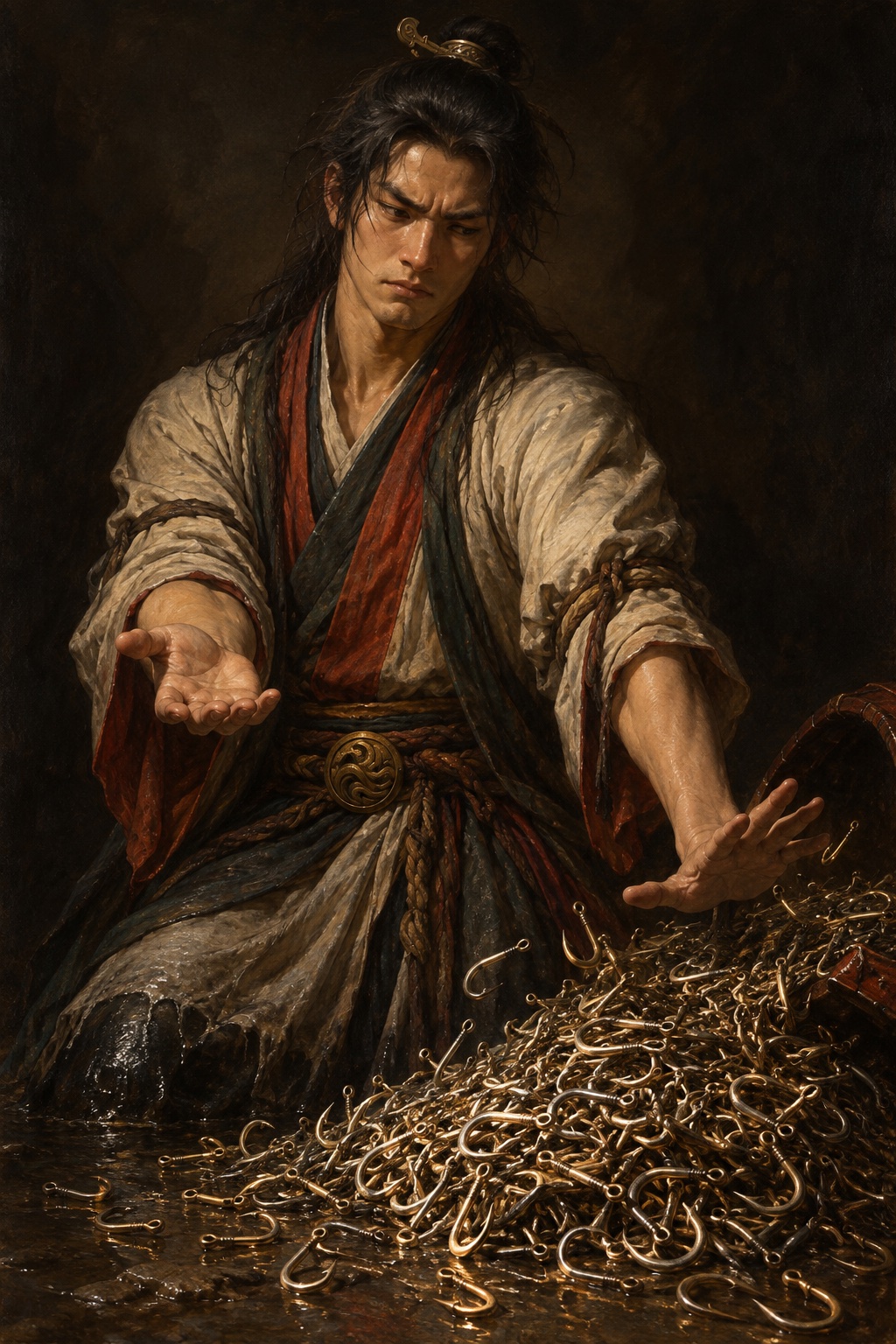
The sea-luck prince
He is the first of the three sons born in the doorless hall that Ko-no-hana-no-Sakuya-hime sealed with earth and set alight, to prove that the children she carried were the children of a heavenly deity, and the Kojiki names him for the moment of his birth. 其火盛燒時所生之子 — the child born while the fire burned at its fiercest — is 火照命, Fire-Shine, and a gloss in the same line makes him the ancestor of the Hayato lords of Ata. After him come Hosuseri, who is named and does nothing further in the story, and Hoori. Ninigi-no-Mikoto is the father of all three.
The fire gives him his name and nothing more. When the chronicle comes back to him he belongs to the sea: he is 海佐知毗古, a prince whose luck is on the water, and what he catches is the fish, broad of fin and narrow of fin, while his youngest brother takes the game of the hills. The proposal to trade is not his. It is Hoori who asks, and Hoderi who says no, three times, before the exchange is made, and even then only barely.
故,火照命者,為海佐知毗古〈此四字以音。下效此也〉而取鰭廣物、鰭狹物;火遠理命者,為山佐知毗古而取毛麁物、毛柔物。尒火遠理命謂其兄火照命:「各相易佐知欲用。」三度雖乞,不許,然遂纔得相易。尒火遠理命以海佐知釣魚,都不得一魚,亦其鉤失海。於是,其兄火照命乞其釣曰:「山佐知母,己之佐知佐知;海佐知母,已之佐知佐知。今各謂返佐知之時。〈佐知二字以音〉」其弟火遠理命答曰:「汝鉤者,釣魚不得一魚,遂失海。」
“So His Augustness Fire-Shine was a prince who got his luck on the sea, and caught things broad of fin and things narrow of fin. His Augustness Fire-Subside was a prince who got his luck on the mountains, and caught things rough of hair and things soft of hair. Then His Augustness Fire-Subside said to his elder brother His Augustness Fire-Shine: “Let us mutually exchange, and use each other’s luck.” [Nevertheless,] though he thrice made the request, [his elder brother] would not accede [to it]; but at last with difficulty the mutual exchange was obtained. Then His Augustness Fire-Subside, undertaking the sea-luck, angled for fish, but never got a single fish; and moreover he lost the fish-hook in the sea. Thereupon his elder brother His Augustness Fire-Shine asked him for the fish-hook, saying: “A mountain-luck is a luck of its own, and a sea-luck is a luck of its own. Let each of us now restore [to the other] his luck.” To which the younger brother His Augustness Fire-Subside replied, saying: “As for thy fish-hook, I did not get a single fish by angling with it; and at last I lost it in the sea.”” — Kojiki, Sect. XXXIX, tr. Basil Hall Chamberlain (1882)
Read from his side, the passage is the record of a man who refused three times, gave way, and then asked for the one thing that would undo it. His only speech here is not a complaint. It is a rule: a mountain-luck is its own luck and a sea-luck is its own luck, and each should now go back to the one it belongs to. He offers to return what he took in the same sentence that asks for his own back. And the reply he gets is an account of the loss, not a restitution. The hook caught nothing, and it is in the sea.
The one original hook
He does not accept the account. The next sentence has him pressing his demand harder, and it is his brother, not he, who looks for a way out — by breaking the ten-grasp sabre girded on him and beating the pieces into hooks by the hundred.
然其兄,強乞徴。故其弟,破御佩之十拳釼,作五百鉤,雖償不取;亦作一千鉤,雖償不受,云:「猶欲得其正本鉤。」
“But the elder brother required it of him [the more] urgently. So the younger brother, breaking his ten grasp sabre that was augustly girded on him, made [of the fragments] five hundred fish hooks as compensation; but he would not take them. Again he made a thousand fish-hooks as compensation; but he would not receive them, saying: “I still want the real original fish-hook.”” — Kojiki, Sect. XXXIX, tr. Basil Hall Chamberlain (1882)
Two offers and two refusals, and the chronicle uses a different verb each time: 不取, he does not take the five hundred; 不受, he does not receive the thousand. It gives him no anger in this scene and no threat. It gives him one sentence, and the sentence asks for 正本鉤, the hook that was the original, and nothing else. Measured by number, the offer doubles from five hundred to a thousand, all of them forged from a prince’s sword; he is not measuring by number. The substitutes are offered as 償, compensation, and compensation is exactly what he declines. He does not want to be paid for the hook. He wants the hook.
The story then leaves him on land. It follows the younger brother down to the shore, into the basket-boat and under the sea, and for three years Hoderi is present only as a subject of other people’s plans. When the sea-god finds the hook at last, in the throat of a sea-bream, the whole of his counsel to Hoori is about the elder brother: what is to be said as the hook is handed back, what is to be planted, what is to be done when he attacks.
The guard by day and night
The hook he demanded does come home, and it comes home as the first move against him. The sea-god has supplied a curse to be spoken over it and has told Hoori to hand it over with the back of his hand. He has laid out a scheme of fields: if the elder brother plants high fields, Hoori is to plant low ones, and if low, high, and because the water is the sea-god’s to govern, the elder brother will be poor within three years. And he has given Hoori the two jewels, 塩盈珠 to make the tide rise and 塩乾珠 to make it fall. None of this equipment is Hoderi’s. The tide-flowing jewel is the sea-god’s gift to his brother, and Hoderi is what it is aimed at.
是以備如海神之教言与其鉤。故自尒以後,稍俞貧,更起荒心迫來。將攻之時,出塩盈珠而令溺;其愁請者,出塩乾珠而救。如此令惣一作「惚」苦之時,稽首白:「僕者,自今以後,為汝命之晝夜守護人而仕奉。」故至今,其溺時之種種之態,不絶仕奉也。
“Hereupon [His Augustness Fire-Subside] gave the fish-hook [to his elder brother], exactly according to the Sea-Deity’s words of instruction. So thenceforward [the elder brother] became poorer and poorer, and, with renewed savage intentions, came to attack him. When he was about to attack [His Augustness Fire-Subside, the latter] put forth the tide-flowing jewel to drown him; on his expressing grief, he put forth the tide-ebbing jewel to save him. When he had thus been harrassed, he bowed his head, saying: “I henceforward will be Thine Augustness’s guard by day and night, and respectfully serve thee.” So down to the present day his various posturings when drowning are ceaselessly served up.” — Kojiki, Sect. XLI, tr. Basil Hall Chamberlain (1882)
What ruins him takes three characters, 稍俞貧: little by little, poorer. What he does about it is the one act the chronicle gives him on his own after the refusal — 更起荒心迫來, he comes at his brother again with a savage heart — and it is the act the plan was built to wait for, because the sea-god had said in advance that if the elder brother attacked in resentment, the tide-flowing jewel was to drown him. The plan does not aim to kill him. The second jewel is there so that he lives through each drowning, and the drowning is repeated until he gives in. When he does, he bows his head to the ground, 稽首, and makes the last speech of his story. The man who would take nothing in place of the one thing that had been his now offers himself: 晝夜守護人, a guard by day and by night, serving from this day on.
The last sentence turns from him to his line. 故至今 — down to the present — 其溺時之種種之態, the many postures of the time he drowned, are still offered up in service without a break. The sentence does not say who performs them. It has no need to: the chronicle named his descendants at his birth, in the gloss on 火照命, as the Hayato. The struggle in the water became a service his house would go on performing.
Ho no Susori in the Nihon Shoki
The Nihon Shoki tells the same story of an elder brother under another name. Its main account of the burning hall orders the three births by the stages of the fire — the first smoke, the drawing back from the heat, and a third child after that — and the child of the first smoke is not called 火照命.
始起烟末生出之兒。號火闌降命。
“The child which was born from the extremity of the smoke which first arose was called Ho no Susori no Mikoto” — Nihongi, Book II, tr. W. G. Aston (1896)
Aston’s English continues with the interlinear gloss that the quoted line stops before: this child was the ancestor of the Hayato. Next comes Hiko-ho-ho-demi no Mikoto, born as she drew back from the heat, and last Ho no akari no Mikoto, ancestor of the Wohari no Muraji. The name 火照 does not occur on the page at all. Aston’s own note on the passage says only that the Kojiki gives these names differently, and this entry leaves the question where he leaves it. What the two chronicles share is the role. In both, the first-born son is the Hayato ancestor; in both, he has the sea-gift and his younger brother the mountain-gift; in both, he loses the quarrel over the hook and submits. The Kojiki’s Hosuseri is a separate middle brother there, named in the same birth clause as Hoderi and Hoori, and neither text makes Hosuseri and Ho no Susori one figure.
It is at the submission that the Nihon Shoki says most about him. In its main account Ho no Susori, in the utmost straits, admits his offence of his own accord, offers to be his brother’s 俳優之民 — Aston’s subject to perform mimic dances — and begs for his life, and he is spared. The same account, which at his birth made him the ancestor of the Hayato, now names him the first ancestor of the Kimi of Wobashi in Ata, 吾田君小橋. Two of its alternative writings, which spell the elder brother’s name 火酢芹命 though Aston romanises it the same way, go further. In one, he pledges his descendants for eighty generations as mimes, or, as a note inside the text puts it, as dog-men, and the Hayato descended from him keep to the fence of the palace and serve in place of barking dogs; that writing ends by tracing a custom to the whole affair: this, it says, is why people do not press a man to return a lost needle. In another, there is no jewel. The sea-god raises wind and waves when the younger brother whistles on the shore, and afterwards, when his brother is still angry and will not speak to him, the elder brother strips to a waistcloth, smears his palms and his face with red earth, and dances the drowning stage by stage as the water had risen on him. At his feet he does the foot-divination. At his knees he lifts his feet, at his thighs he runs in a circle, at his loins he rubs his loins, at his sides he lays his hands on his breast, and at his neck he throws up his hands and waves his palms. The Kojiki gives that performance one phrase, the many postures of his drowning. This is the only place in either chronicle where the postures are named one by one.