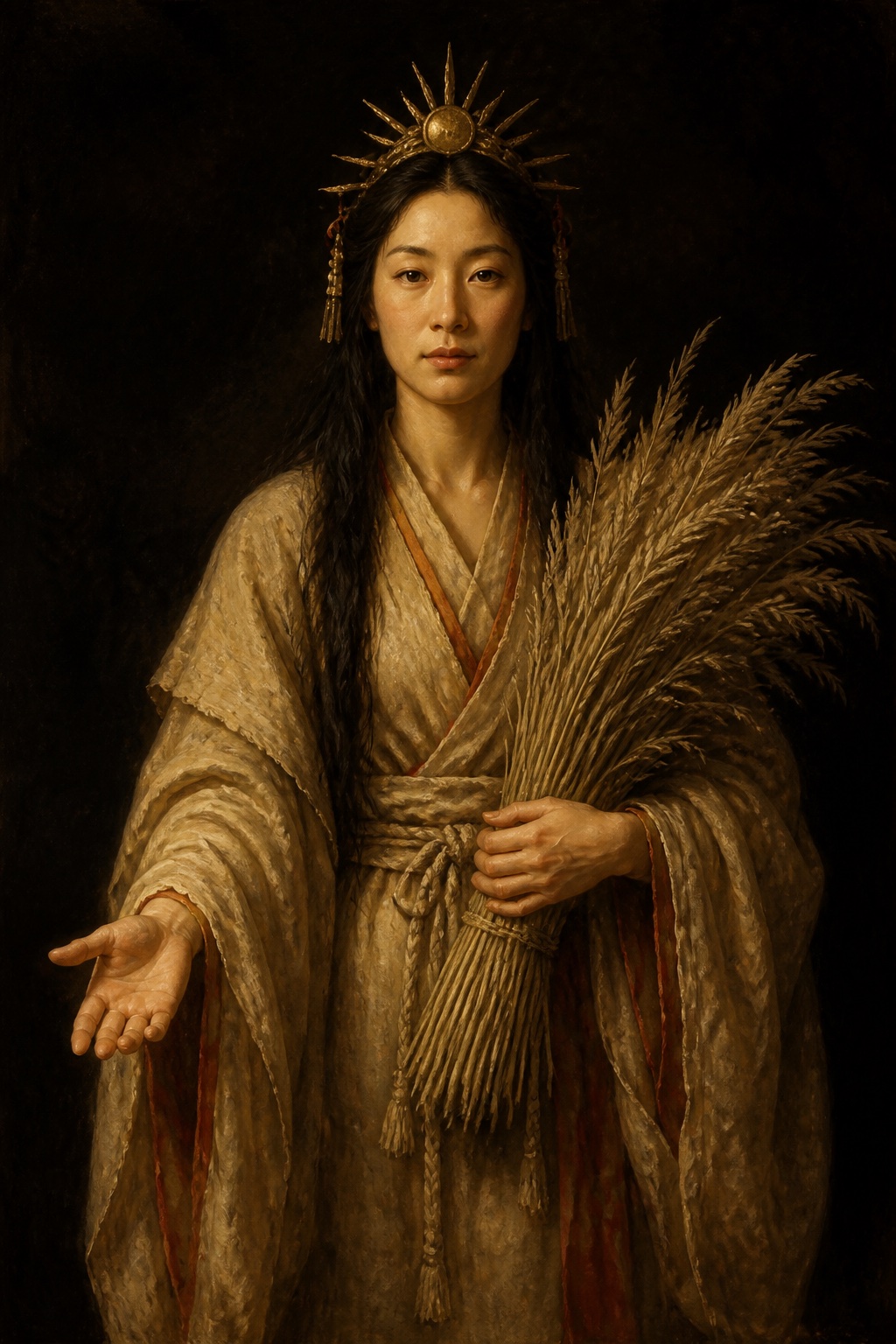
Kayanuhime, also called Nozuchi
In the Kojiki’s account, once Izanagi and Izanami have finished making the islands, they turn to making deities, and the text lists roughly thirty of them in a single unbroken sequence. The Deity of Mountains, Ōyamatsumi, is born, and immediately after him the Deity of Moors. Chamberlain’s translation names her “the Deity Thatch-Moor-Princess,” then in the same clause gives “another name for whom is the Deity Moor-Elder.” The kanbun original agrees in the same order: it names her Kayanuhime-no-kami first, then marks the second name with 亦名謂, “also named.” Both languages put Kayanuhime first as the given name and Nozuchi second as an alternate, so that is the order this entry keeps. Like Ōyamatsumi before her, she is a child of Izanagi and Izanami, one voice among the roughly thirty the same passage names in a single breath. By the time the text turns to what she and Ōyamatsumi do together, it stops using “Thatch-Moor-Princess” at all and calls her only by the second name, the Deity Moor-Elder.
The division of mountain and moor
The passage does not stop at a birth notice. Once both deities are named, it turns their two dominions into an act, and states plainly what that act produced:
次生,野神,名鹿屋野比賣神,亦名謂野椎一作「推/桘/槌」神〈自志那都比古神至野椎一作「推/桘/槌」并四神〉。此大山津見神、野椎神二神,因山野持別而生神名:天之狹一作「使」土神〈訓土云豆知。下效此〉。次,國之狹一作「侠」土神。次,天之狹一作「侠」霧神。次,國之狹一作「侠」霧神。次,天之闇戶神。次,國之闇戶神。次,大戶惑一作「或」子神〈訓惑一作「或」云麻刀比。下效此〉。次,大戶惑一作「或」女神
Next they gave birth to the Deity of Moors, whose name is the Deity Thatch-Moor-Princess, another name for whom is the Deity Moor-Elder. (Four Deities in all from the Deity Prince-of-Long-Wind to Moor-Elder.) The names of the Deities given birth to by these two Deities, the Deity Great-Mountain-Possessor and the Deity Moor-Elder from their separate dominions of mountain and moor were: the Deity Heavenly-Elder-of-the-Passes, next the Deity Earthly-Elder-of-the-Passes; next the Deity Heavenly-Pass-Boundary, next the Deity Earthly-Pass-Boundary; next the Deity Heavenly-Dark-Door, next the Deity Earthly Dark-Door; next the Deity Great-Vale-Prince, next the Deity Great-Vale-Princess. — Kojiki, Sect. VI, tr. Basil Hall Chamberlain (1882)
Kayanuhime and Ōyamatsumi are not simply named and set aside. Their separate dominions, moor and mountain, become the origin of eight further deities, born of the division itself rather than of any single act either god performs alone.
Eight deities of the boundary
The eight born of that division come in four pairs, each pair a Heavenly deity and an Earthly one: Heavenly-Elder-of-the-Passes and Earthly-Elder-of-the-Passes, who preside over the mountain passes themselves; Heavenly-Pass-Boundary and Earthly-Pass-Boundary, who mark the boundary of the passes; Heavenly-Dark-Door and Earthly Dark-Door, named for a dark gorge or gateway; and finally Great-Vale-Prince and Great-Vale-Princess, of the great valleys. None of the eight has a story of its own in the Kojiki beyond this list, and none of them recurs elsewhere in the chronicle. They exist as the named record of what dividing mountain from moor produced — a boundary that is, in this telling, a birth.
Sister, not wife
The passage names Kayanuhime and Ōyamatsumi together only this once, as “these two Deities” who, “from their separate dominions of mountain and moor,” bore the eight above. It never gives them a marriage. A few lines earlier in the very same section, the Kojiki is explicit when a pair is siblings rather than spouses: the Deity of the Water-Gates, Prince-of-Swift-Autumn, and “his younger sister the Deity Princess-of-Swift-Autumn” together bear eight deities of their own, “from their separate dominions of river and sea” — the identical construction, applied to a pair the text itself calls brother and sister. Later Shinto scholarship commonly calls Kayanuhime and Ōyamatsumi husband and wife, but that is not what the Kojiki’s own wording says here; it states only that the two, from their separate dominions, bore the eight together. This entry records them as siblings, on the strength of that parallel, rather than importing a later gloss as though the source itself had made it.