Seventy years, then an offer
The Shangshu’s “Canon of Yao” 堯典 does not open on a young king. It opens on an old one, already looking for the door.
朕在位七十載,汝能庸命
“I have been on the throne seventy years. You can carry out my commands.” — The Shû King, Part I, Book I (“The Canon of Yâo”), tr. James Legge (1879), Sacred Books of the East vol. III
朕, the sovereign’s own first person, and 七十載, seventy years counted off — the line does not ask whether the Four Mountains think him capable of ruling; it asks whether they are capable of taking the rule from him. The sentence that follows in the same breath, 巽朕位, goes further than a question: it is Yao himself offering to resign his place, unforced, to whoever answers. Sima Qian’s later retelling of this same exchange keeps the seventy years and the same request, but writes the last clause differently, 踐朕位 rather than 巽朕位 — a plainer verb of stepping into a place, next to Legge’s own reading of 巽 as “resign.” Two histories agree on the number of years and cannot agree on the word for what he did with them.
When the court is asked, in the same passage, whether his own heir should have it, Yao does not take the easy branch. The record elsewhere gives him a son, and the record elsewhere has Yao pass over him. Everything he does next is aimed at finding the rule a home outside his own household.
The portrait the canon opens with
Before the abdication, before the flood, before Shun, the Shangshu spends its very first sentence describing the man, in a register closer to eulogy than history.
欽明文思安安。允恭克讓,光被四表
“He was reverential, intelligent, accomplished, and thoughtful,—naturally and without effort. He was sincerely courteous, and capable of (all) complaisance. The bright (influence of these qualities) was felt through the four quarters (of the land).” — The Shû King, Part I, Book I (“The Canon of Yâo”), tr. James Legge (1879), Sacred Books of the East vol. III
The sage-king carries a byname in the wider tradition, 放勳, alongside the title 帝堯 itself, and every adjective in this opening line describes a disposition rather than a deed: 欽明文思, reverent, clear-sighted, accomplished, thoughtful, and then the qualifier that does the real work, 安安, naturally so, without strain. 允恭克讓 repeats the point from a different angle — sincerely deferential, able to yield — which is exactly the capacity the seventy-years passage later puts to the test. 光被四表 turns character into reach: whatever this is, it is felt at the four edges of the land before Yao has done a single administrative thing the chapter can point to. This is the corpus’s earlier “Di”/“Yao” 堯典 quotations read in a different translation of the same translator — Legge’s later, 1879 Sacred Books of the East rendering spells him “Tî Yâo” rather than “the Di” and “Yao,” the same drift in the same man’s romanization that the corpus already documents for Gun.
Two daughters, sent to be tested
Having offered the throne away, Yao does not simply announce an heir. He devises an experiment, and runs it himself.
帝曰:「我其試哉!女于時,觀厥刑于二女。」釐降二女于媯汭,嬪于虞。
“The Di said, ‘I will try him; I will wive him, and thereby see his behaviour with my two daughters.’ (Accordingly) he arranged and sent down his two daughters to the north of the Gui, to be wives in (the family of) Yu.” — Shangshu, “Canon of Yao” 堯典, tr. James Legge
我其試哉 is Yao’s own verb, spoken in his own voice: not “let him be tested” but “I will try him.” Nothing in the record obliges an emperor at the end of seventy years to run a private domestic trial before handing over an empire, and nothing obliges him to use his own daughters as the instrument. He does both, and the same court that had just refused him permission to name his own son is not consulted again — this decision, unlike the search for a candidate, is entirely his to make and entirely his to carry out. It is the same man who a moment earlier turned a plain question of years into a question of virtue, now turning a question of virtue into a household arrangement he can watch with his own eyes.
Ten suns, and the mandate that followed
Nothing in the Shangshu explains how Yao came to hold the throne he is now so intent on giving away. A different work does, and it does so by describing the one crisis he did not solve himself.
逮至堯之時,十日並出,焦禾稼,殺草木,而民無所食。猰貐、鑿齒、九嬰、大風、封豨、修蛇皆為民害。堯乃使羿誅鑿齒于疇華之野,殺九嬰于凶水之上,繳大風於青丘之澤,上射十日而下殺猰貐,斷修蛇於洞庭,禽封豨于桑林,萬民皆喜,置堯以為天子
“By the time of Yao, ten suns came out together; they scorched the grain and the crops, killed the plants and trees, and the people had nothing to eat. Yayu, Zaochi, Jiuying, Dafeng, Fengxi and Xiushe all preyed upon the people. So Yao sent Yi to execute Zaochi in the wilds of Chouhua, to kill Jiuying on the banks of the Xiong River, to net Dafeng in the marsh of Qingqiu, to shoot the ten suns above and slay Yayu below, to cut Xiushe in two at Dongting, and to take Fengxi in the Mulberry Forest. The people were all glad, and set up Yao as the Son of Heaven.” — Huainanzi, “Benjing”; tr. Mythos Atlas
Read from Yao’s side rather than the archer’s, the sentence has a hinge in it: 堯乃使羿, Yao then sent Yi, is the only thing Yao himself does in the whole crisis, and 置堯以為天子, the people set Yao up as Son of Heaven, is the only thing anyone does to him. Between the two clauses sits someone else’s archery. The mandate this entry’s other quotations already assume — a throne with seventy years of tenure behind it, secure enough to be offered away at will — is manufactured here out of a disaster Yao does not personally end, only correctly delegates. The same king elsewhere commands Xihe to track the sun’s own motions and fix the calendar by them; the ten suns loosed at once are the one time the sky itself refuses to keep the order he is otherwise credited with keeping.
The yellow cap and the vermilion chariot
The Shangshu’s Yao is nearly all disposition and no body. The Shiji supplies what the older text withholds.
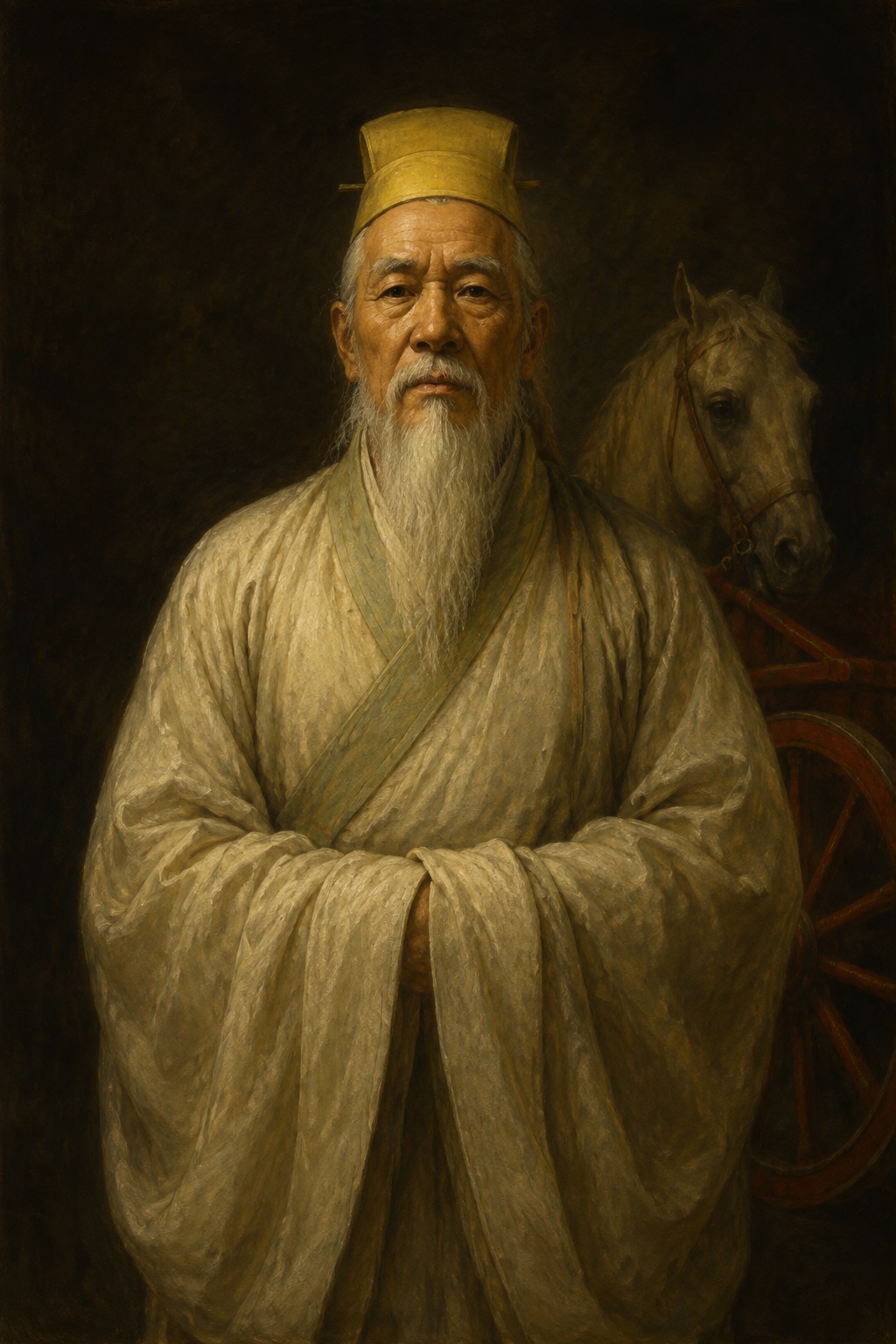
其仁如天,其知如神。就之如日,望之如雲。富而不驕,貴而不舒。黃收純衣,彤車乘白馬
“His benevolence was like Heaven’s, his wisdom like a spirit’s. Approach him and he was like the sun; look at him from afar and he was like a cloud. Rich, yet not arrogant; noble, yet not extravagant. He wore a yellow cap and plain robes, and rode in a vermilion chariot drawn by white horses.” — Sima Qian, Shiji, “Annals of the Five Emperors” 五帝本紀; tr. Mythos Atlas
Sima Qian keeps the 堯典’s abstractions — benevolent, wise — but pairs each with an image the older chapter never risks: like Heaven, like a spirit, like the sun up close and a cloud from a distance. Then the register drops all the way to inventory: 黃收, a plain yellow ceremonial cap, not a crown; 純衣, unadorned robes; 彤車乘白馬, a vermilion chariot drawn by white horses. Wealth and rank are named and immediately qualified away — rich yet not arrogant, noble yet not extravagant — so that the one concrete picture the tradition gives of Yao’s own appearance doubles as a case against reading rank into display. It is a historian’s portrait of a man already too famous for anyone to have to describe how he looked, filled in anyway, in exactly the colors and materials court ritual would prescribe for him.