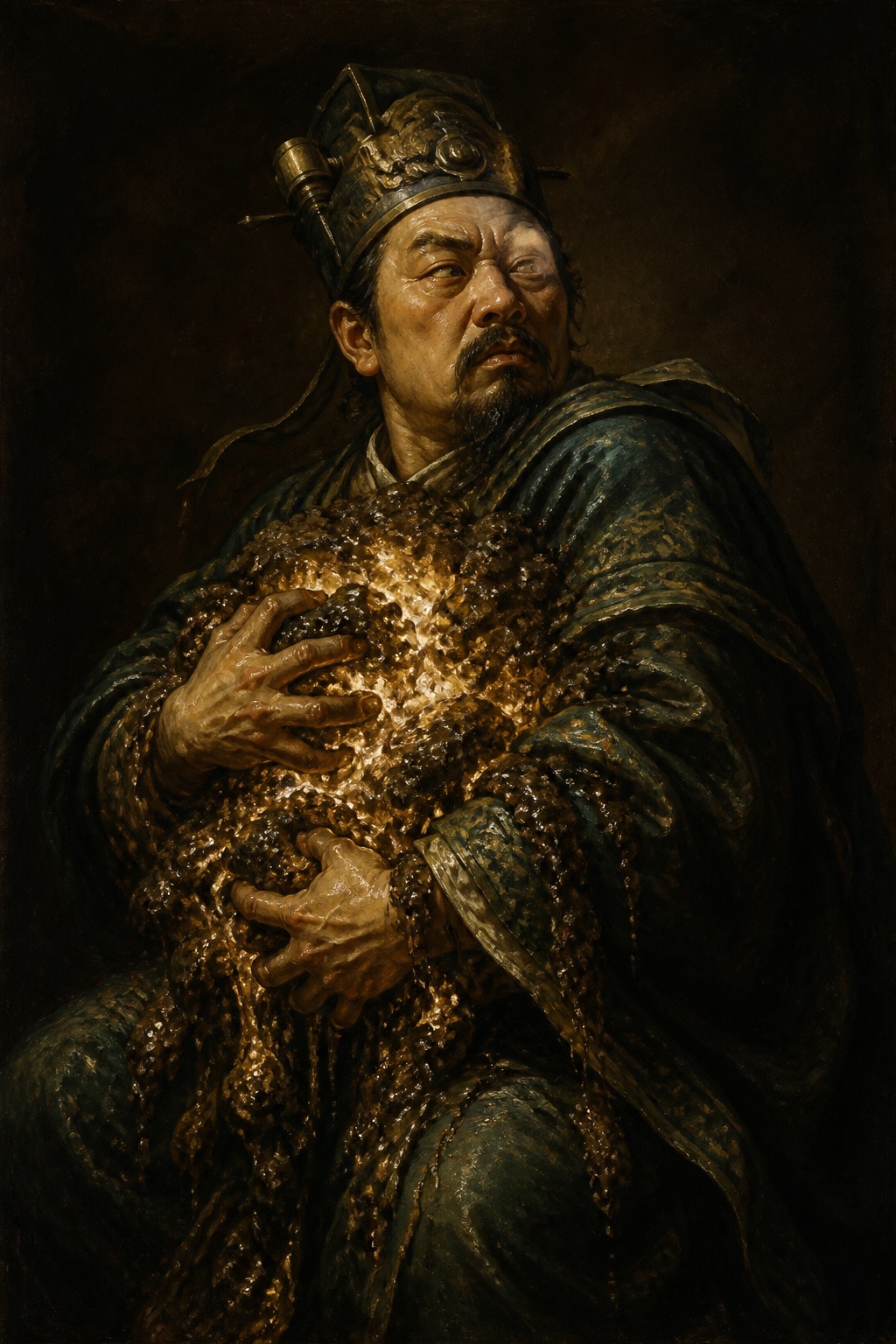
Recommended despite Yao’s doubt
Before Gun does anything else, the record already doubts him. In the Shangshu’s “Canon of Yao” 堯典, the flood has already reached the extremity every telling of this story starts from, and the court is looking for someone to send against it:
咨!四岳,湯湯洪水方割,蕩蕩懷山襄陵,浩浩滔天。下民其咨,有能俾乂?」僉曰:「於!鯀哉。」帝曰:「吁!咈哉,方命圮族。」岳曰:「异哉!試可乃已
“The Di said, ‘Ho! (President of) the Four Mountains, destructive in their overflow are the waters of the inundation. In their vast extent they embrace the hills and overtop the great heights, threatening the heavens with their floods, so that the lower people groan and murmur: Is there a capable man to whom I can assign the correction (of this calamity)?’ All (in the court) said, ‘Ah! is there not Kuan?’ The Di said, ‘Alas! how perverse is he! He is disobedient to orders, and tries to injure his peers.’ (The President of) the Mountains said, ‘Well but—. Try if he can (accomplish the work).’” — Shangshu, “Canon of Yao” 堯典, tr. James Legge
Yao’s objection changes nothing; the court overrules him, and Gun goes to the work anyway. This page’s own English spells his name “Kuan” — the first of three romanizations this entry has to cross, all credited to the same translator. What follows, in the same chapter, is not an episode but a verdict on one:
往,欽哉!」九載,績用弗成
“The Di said (to him), ‘Go; and be reverent!’ For nine years he laboured, but the work was unaccomplished.” — Shangshu, “Canon of Yao” 堯典, tr. James Legge
Nine years is the whole of it — no flood tamed, no method named, only labor spent and the court’s fears confirmed.
The Growing Soil, and the sentence at Yujiao
A different strand of the tradition says what that labor actually was, and gives it an ending the Shangshu never does. The Shanhaijing’s “Classic of Regions Within the Seas” 海內經 packs the flood, the theft, the execution and the birth of Gun’s son into one unbroken sentence:
洪水滔天。鯀竊帝之息壤以堙洪水,不待帝命。帝令祝融殺鯀于羽郊。鯀復生禹。帝乃命禹卒布土以定九州
“The floodwaters rose to the sky. Gun stole the High God’s Growing Soil to dam the flood, without waiting for the High God’s leave. The High God ordered Zhurong to kill Gun in the wilds of Yu. Gun then gave birth to Yu. The High God then commanded Yu to finish spreading the soil and settle the Nine Provinces.” — Shanhaijing, “Classic of Regions Within the Seas”; tr. Mythos Atlas
The crime here is specific: not failure but theft, and not of ordinary earth but of 息壤, the Growing Soil, the High God’s own self-renewing matter, taken without leave to wall the water in rather than guide it. The punishment is just as specific — an order from the High God, carried out by Zhurong, at 羽郊, the wilds of Yu. The sentence ends exactly where Yu’s own record begins: a son born from a father’s death, sent to finish what the theft had only made worse.
Two more verdicts on his death
Two further tellings put someone other than Zhurong’s hand on the sentence, and the two of them do not agree with each other either. In the Shangshu’s “Canon of Shun” 舜典, once Shun holds power in his own right, Gun’s death is not an execution ordered from above but a judicial sentence, one of four handed down together:
流共工于幽洲,放驩兜于崇山,竄三苗于三危,殛鯀于羽山,四罪而天下咸服
“He banished the Minister of Works to You island; confined Huan-dou on mount Chong; drove (the chief of) San-miao (and his people) into San-wei, and kept them there; and held Gun a prisoner till death on mount Yu. These four criminals being thus dealt with, all under heaven acknowledged the justice (of Shun’s administration).” — Shangshu, “Canon of Shun” 舜典, tr. James Legge
This page spells the name “Gun,” not “Kuan” — the same ctext site, crediting the same translator, romanizes him two different ways depending which chapter is open. The Chunqiu Zuozhuan supplies a third spelling, and a third account of who gives the order. Duke Zhao’s seventh year has the minister Zichan trace the same death to yet another sovereign, and gives it the only bodily detail Gun has anywhere in the record:
昔堯殛鯀于羽山,其神化為黃熊,以入于羽淵。實為夏郊
“Anciently, when Yaou put K‘wan to death on mount Yu, his spirit changed into a yellow bear, which entered into the abyss of Yu. He was under the Hea dynasty the assessor at its sacrifice to Heaven” — Chunqiu Zuozhuan 春秋左傳, “Duke Zhao, Year 7” 昭公七年, tr. James Legge (The Chinese Classics, vol. 5, 1872; Hong Kong University Press reprint, 1960)
Here the same translator’s own printed scan spells the name a third way, “K‘wan.” The place drifts too — 羽郊, “the wilds of Yu,” in the Shanhaijing, against 羽山, “Mount Yu,” in both the Shangshu and the Zuozhuan — almost certainly the same legendary ground named at different precision, not a real disagreement.
:::variant{source=“Shangshu 尚書, “Canon of Shun” 舜典 / Chunqiu Zuozhuan 春秋左傳, tr. James Legge”} This entry’s own relations follow the Shanhaijing: the High God orders the killing, and Zhurong’s hand carries it out. That is not the tradition’s only answer. The Canon of Shun gives the sentence to no god at all — it is Shun’s own judicial verdict against one of the Four Malefactors, the same set of four whose punishment closes Gong Gong’s story too. The Zuozhuan disagrees with both of them, naming Yao himself as the one who puts Gun to death at Mount Yu. The three tellings never reconcile, and nothing in any of them says which hand is the real one. :::
A disputed line of descent
Gun’s parentage is no more settled than his death. The same Shanhaijing chapter that tells of the theft and the execution also traces his ancestry upward: the Yellow Emperor begets Luoming, Luoming begets Baima, and Baima is Gun himself — a second name, meaning “White Horse,” making Gun the Yellow Emperor’s grandson. The Shiji’s account of the Xia, consulted here only for its Chinese and never quoted in English, since its own page carries no scholarly translation, gives a longer chain instead: Gun’s father is Zhuanxu, Zhuanxu’s father is Changyi, and Changyi’s father is, again, the Yellow Emperor. The two genealogies agree only on the ancestor at the top. Which generations lie between him and Gun, and what Gun’s father was even called, are two different answers the record never tries to settle.