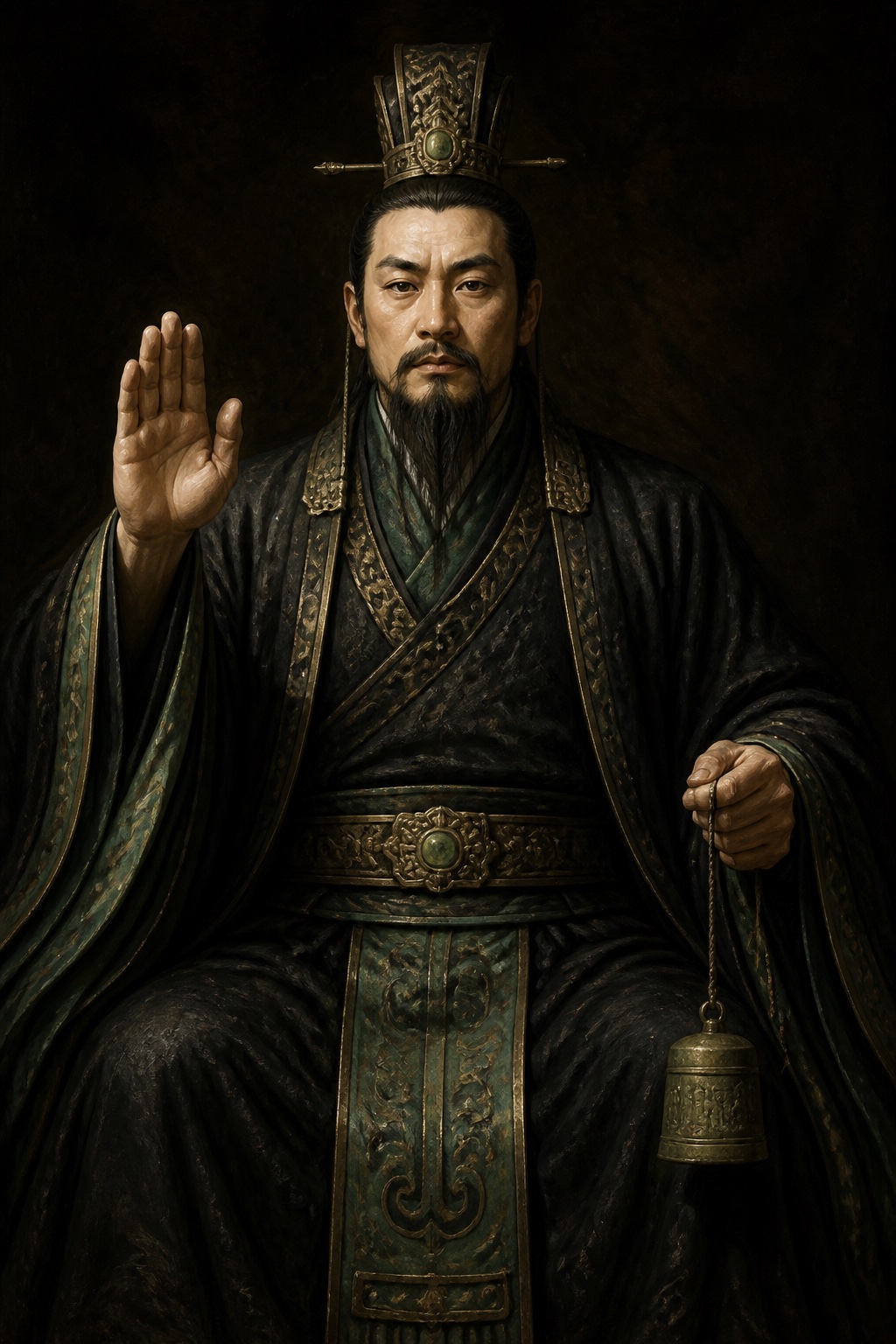
Severing the road between Heaven and Earth
By the Shangshu’s own telling, disorder starts as a collapse of boundaries. Once the house of Shaohao declines, the Jiuli corrupt the old order: every household keeps its own priest, every family its own shaman, and gods and commoners mingle as though nothing separated them. The chapter on punishments that eventually treats of this collapse folds the whole affair into one unnamed sovereign’s decree:
皇帝哀矜庶戮之不辜,報虐以威,遏絕苗民,無世在下。乃命重、黎,絕地天通,罔有降格
“The great Di compassionated the innocent multitudes that were (in danger of) being murdered, and made the oppressors feel the terrors of his majesty. He restrained and (finally) extinguished the people of Miao, so that they should not continue to future generations. Then he commissioned Zhong and Li to make an end of the communications between earth and heaven; and the descents (of spirits) ceased.” — Shangshu, “Marquis of Lu on Punishments” 呂刑; tr. James Legge
Legge’s “great Di” is simply the honorific the chapter uses for the reigning sovereign; nothing in this passage names him. The name comes from a separate, later strand of commentary. In the Guoyu’s “Discourses of Chu,” King Zhao of Chu asks the minister Guan Shefu to explain a line from “the Zhou Documents” — this same Shangshu passage — about Chong and Li cutting communication between heaven and earth, and the minister’s answer supplies what the Shangshu itself withholds:
及少昊之衰也,九黎亂德,民神雜糅,不可方物。夫人作享,家為巫史,無有要質。民匱于祀,而不知其福。蒸享無度,民神同位。民瀆齊盟,無有嚴威。神狎民則,不蠲其為。嘉生不降,無物以享。禍災薦臻,莫盡其氣。顓頊受之,乃命南正重司天以屬神,命火正黎司地以屬民,使復舊常,無相侵瀆,是謂絕地天通。
“When the house of Shaohao declined, the Jiuli corrupted virtue: people and spirits mingled together, and nothing could any longer be told apart. Every household made its own offerings; every family kept its own shaman-priest, with no shared standard to bind them. The people wore themselves out on sacrifices yet knew none of their blessing. Offerings were made without measure, and people and spirits held the same rank. The people profaned the old covenants, and no awe or authority remained. The spirits grew too familiar with human ways and no longer kept their own conduct pure. Good harvests ceased to descend, and there was nothing left to offer. Calamity followed calamity, and no one could any longer draw on what vital force was left. Zhuanxu received it in hand: he ordered Chong, Overseer of the South, to take charge of Heaven and gather the spirits beneath him, and Li, the Fire Minister, to take charge of Earth and gather the people beneath him, so that the old constant order was restored and the two no longer trespassed on each other. This is called ‘severing the road between Heaven and Earth.’” — Guoyu, “Discourses of Chu, Part II” 楚語下; tr. Mythos Atlas
Read together, the two texts are one act seen from outside and from within a later gloss: an anonymous decree in the Shangshu, the same decree finally signed with a name in the Guoyu. What Zhuanxu restores is not silence but separation — Chong answers for Heaven, Li for Earth, and the traffic between them stops.
Winter’s sovereign, and the steelyard he grips
The Huainanzi’s chapter on the patterns of Heaven assigns each cardinal direction a sovereign, a season, and a set of correspondences under the five phases. Zhuanxu governs the north:
北方,水也,其帝顓頊,其佐玄冥,執權而治冬;其神為辰星,其獸玄武,其音羽,其日壬癸
“The north is water. Its sovereign is Zhuanxu, his minister Xuanming; he grips the steelyard and governs winter. His planetary sign is the Chen Star, his creature the Black Tortoise-Serpent, his note is yu, and his days are ren and gui.” — Huainanzi, “Tianwen Xun” 天文訓; tr. Mythos Atlas
The steelyard — 權, the sliding counterweight of a balance — is the one object the record puts in his hand, and it suits a sovereign whose defining act elsewhere is restoring a measured order between two realms that had stopped keeping their distance. The Chen Star and the Black Tortoise-Serpent belong to the same passage but read differently: they are his correspondences under the five-phases system, the north’s planetary and animal signs rather than anything he wears or carries, and this entry treats them as cosmology rather than as attributes of his own.
Grandson of the Yellow Emperor — or great-grandson
The Shiji opens its account of Zhuanxu with a genealogy and a character sketch in the same breath:
帝顓頊高陽者,黃帝之孫而昌意之子也。靜淵以有謀,疏通而知事;養材以任地,載時以象天,依鬼神以制義,治氣以教化,絜誠以祭祀
“Sovereign Zhuanxu, Gaoyang, was grandson of the Yellow Emperor and son of Changyi. Calm and deep, he was full of counsel; open and discerning, he understood affairs. He raised up resources to make use of the land, tracked the seasons to take Heaven as his pattern, relied on gods and spirits to establish what was right, ordered the vital breath to bring about instruction, and kept himself pure and sincere in offering sacrifice.” — Sima Qian, Shiji, “Annals of the Five Emperors” 五帝本紀; tr. Mythos Atlas
The Yellow Emperor’s line runs through him by two different counts, and the Shanhaijing’s “Classic of Regions Within the Seas” gives the longer one, adding a generation the Shiji has no room for:
黃帝妻雷祖,生昌意,昌意降處若水,生韓流。韓流擢首、謹耳、人面、豕喙、麟身、渠股、豚止,取淖子曰阿女,生帝顓頊
“The Yellow Emperor’s wife Leizu bore Changyi. Changyi descended to dwell by the Ruo River, and there fathered Hanliu. Hanliu had a long, upright head and small ears, a human face and a boar’s snout, a body scaled like a qilin, bowed thighs and pig’s feet; he took to wife a woman of the Chuo clan named A Nü, and she bore Sovereign Zhuanxu.” — Shanhaijing, “Classic of Regions Within the Seas” 海內經; tr. Mythos Atlas
Grandson in one book, great-grandson in the other — the extra generation is Hanliu, and nothing here decides between the two counts. Zhuanxu’s own children split the same way between traditions rather than agreeing on one heir: the Shanhaijing makes Laotong his son, the father of Chong and Li in the family version of the severing above; the Shiji separately names a son called Qiongchan. Neither text so much as mentions the other’s candidate. One relation the Shiji does settle explicitly, against an easy assumption: Gaoxin, who succeeds Zhuanxu on the throne, is not his son but his clan-nephew, descended instead through Xuanxiao’s line — the throne passes sideways at that step, not down it.
Rival to Gong Gong
None of this — the decree, the steelyard, the disputed generations — is the act most readers will already know him for. In the Liezi and the Huainanzi, it is Zhuanxu whom Gong Gong fights for the throne and loses to, the loss that sends Gong Gong ramming his head into Mount Buzhou and snapping the pillar that held up the sky — the wreck Gong Gong’s own entry tells in full, from the loser’s side. Later tradition would put other names in that seat — Sima Zhen’s Supplementary Three Sovereigns Annals stages the same rage against Zhurong instead, in Nüwa’s reign — but the oldest and most repeated telling keeps Zhuanxu on the throne Gong Gong wants and cannot have. It is one more shape the same figure takes across this record: never quite the one who acts on the world so much as the order the world is measured against, whether the measure is a throne, a season, or the road between Heaven and Earth.