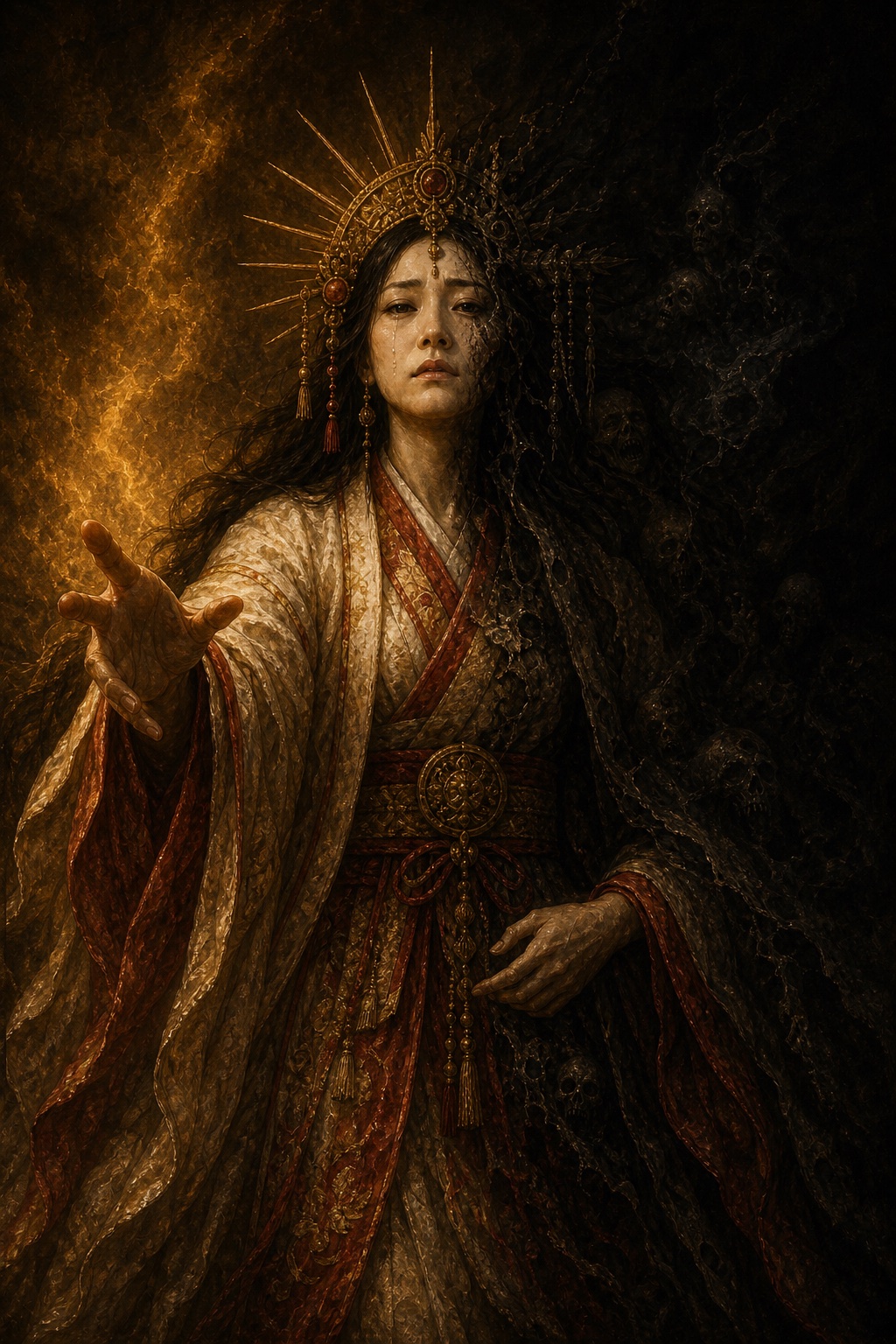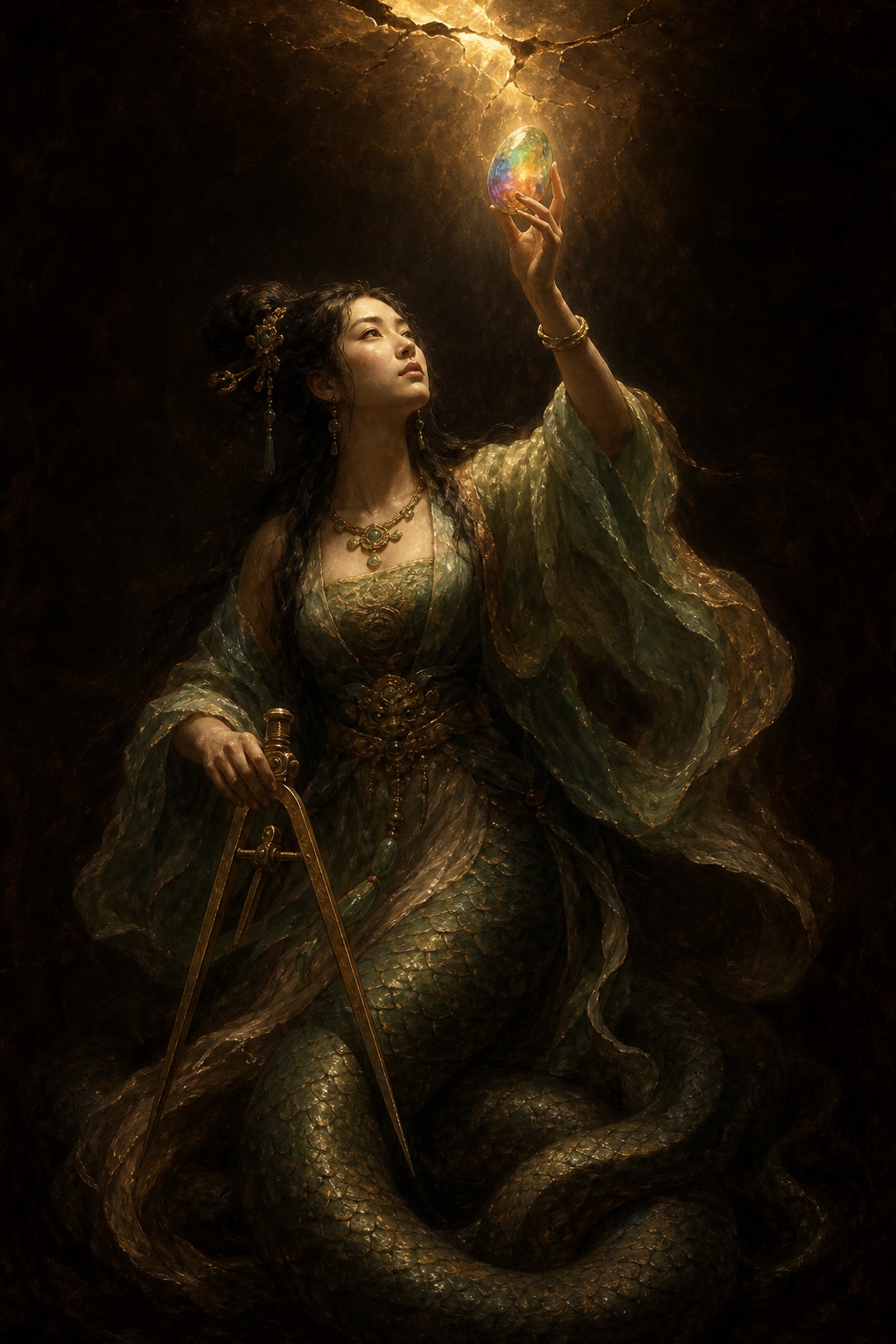
Nüwa has a human head and the body of a serpent, and she arrives in the record not as a story but as a question. In the Tianwen — the “Heavenly Questions”, a Warring States poem that is nothing but unanswered riddles fired at the cosmos — Qu Yuan puts her in a single line:
登立為帝孰道尚之女媧有體孰制匠之
“Who rose and stood as sovereign, and who exalted his way? Nüwa had a body — who fashioned and made it?” — Chuci, “Tianwen”; tr. Mythos Atlas
The poem is unpunctuated and gives no answer, which tells us something exact: by the third century BC everyone already knew that Nüwa shaped bodies, and the interesting problem was who had shaped hers. She is the maker who cannot account for her own making.
What she made, the second-century Fengsu Tongyi reports as common talk — and the report has a barb in it:
俗說天地開闢,未有人民,女媧摶黃土作人,劇務,力不暇供,乃引繩于縆泥中于舉以爲人。故富貴者黃土人也,貧賤凡庸者縆人也。
“Popular tradition says that when heaven and earth had opened but there were as yet no people, Nüwa patted yellow earth together and made human beings. The work was gruelling and her strength could not keep up with it, so she dragged a cord through the mud and hauled it up to make people. This is why the rich and honoured are the yellow-earth people, and the poor, the low and the ordinary are the cord people.” — Ying Shao, Fengsu Tongyi, in Taiping Yulan 78; tr. Mythos Atlas
That is a creation myth doing frank political work: the class you are born into is a manufacturing defect, a consequence of the maker getting tired. It is also, characteristically, told as 俗說 — “popular tradition says” — by an author keeping it at arm’s length.
Her other job is repair, and for that the Huainanzi gives her the grandest passage she has. The minister Gong Gong, having lost a contest for the throne, rams his head into Mount Buzhou and snaps one of the pillars holding up the sky:
往古之時,四極廢,九州裂,天不兼覆,地不周載,火爁炎而不滅,水浩洋而不息,猛獸食顓民,鷙鳥攫老弱,於是女媧煉五色石以補蒼天,斷鼇足以立四極。
“In remote antiquity the four poles collapsed and the Nine Provinces split apart. Heaven did not cover everything; earth did not carry everything. Fire blazed and would not go out; water surged and would not subside. Ferocious beasts ate the people; birds of prey seized the old and the weak. So Nüwa smelted stones of five colours to patch the blue sky, and cut the legs off the great sea turtle to stand the four poles upright.” — Huainanzi, “Lanming”; tr. Mythos Atlas
The passage goes on: she kills the black dragon to deliver the province of Jizhou, and heaps up reed ash to dam the flood. 蒼天補,四極正 — the blue sky patched, the four poles set right.
It is worth noticing what she is not. Nüwa is never enthroned, never given a department, never worshipped as a sovereign of heaven. She is a repairer — the one who turns up after the cosmos has been wrecked by somebody else’s ambition and makes it hold with smelted stone and turtle legs. The five-coloured stones are still up there, in the story’s own logic. The sky we have is a patched one.